Japan researchers grow tooth in mouse kidney
July 20, 2011 in Dentistry
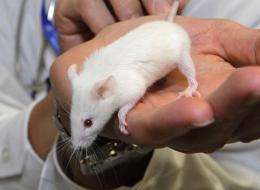
A mouse is pictured in a laboratory in Tokyo. Japanese bio engineers have succeeded in growing a tooth from cells implanted into a mouse kidney, using a technique that could create replacement organs faster than previously tested methods.
Japanese bio engineers have succeeded in growing a tooth from cells implanted into a mouse kidney, using a technique that could create replacement organs faster than previously tested methods.
Biologists have previously cultivated teeth in a laboratory and successfully transplanted them into the jaws of mice, but Japanese researchers have hailed the latest development as offering much faster growth rates.
The latest method "saves about 10 days" compared to earlier techniques, said Tokyo University of Science professor Takashi Tsuji, who led the research.
"It is our first step towards the goal -- to regenerate organs that could replace damaged or lost ones," he said.
"We still haven't got to the point where it can be used for humans," he added. "We have just completed our first step."
The research team, including scientists from Tokyo Medical and Dental University and Tohoku University, developed a "seed" by combining special cells necessary to form a tooth, their research showed.
The cells reacted to each other and started growing into tissues to create a real tooth.
The researchers then wrapped the "seed" in a tiny piece of plastic and implanted it in a mouse's kidney, where it grew to form a tooth, the study showed.
When the tooth was substantially developed, they transplanted it to another mouse's gums, confirming it could adapt to the oral environment and connect to nerves and blood vessels as if it was a real tooth, it said.
The mouse would feel pain and stimulation because the regenerative tooth functions just like a real tooth, the researchers said.
The researchers hope that scientists will eventually be able to use the technique to develop fully functioning bio-engineered organs that can replace lost or damaged organs following disease, injury or aging.
(c) 2011 AFP
-
Stem cells grow fully functional new teeth
Jul 13, 2011 |
not rated yet |
0
-
Reconstructing mandibular defects with bioengineered tooth and bone
Apr 06, 2008 |
not rated yet |
0
-
Teeth: a future renewable natural resource?
Nov 21, 2006 |
not rated yet |
0
-
Stem cells used to reattach teeth with new technique
Sep 29, 2010 |
not rated yet |
0
-
Genetic discovery could lead to advances in dental treatment
Feb 23, 2009 |
not rated yet |
0
-
Of mice and mental models: Neuroscientific implications of risk-optimized behavior in the mouse
3 hours ago |
not rated yet |
0
-
Limits to growth: Scientists identify key metastasis-enabling enzyme
May 22, 2012 |
5 / 5 (3) |
0
-
Seeing is as seeing does: Spatially-structured retinal input in early development of cortical maps
Apr 26, 2012 |
5 / 5 (4) |
1
-
Dreamless nights: Brain activity during nonrapid eye movement sleep
Apr 09, 2012 |
4.4 / 5 (12) |
0
-
Take your time: Neurobiology sheds light on the superiority of spaced vs. massed learning
Mar 28, 2012 |
4.5 / 5 (21) |
3
-
Surface current density
1 hour ago
-
Work done on body moving in a circle
5 hours ago
-
Crest or Trough?
5 hours ago
-
Origin of magnetism
9 hours ago
-
Polarization vector of water molecule
12 hours ago
-
understanding the strain energy function invariant term
15 hours ago
- More from Physics Forums - Classical Physics
More news stories
Two-step tooth implantation and built-up bone can be longer lasting: study
Periodontists routinely grow bone in the mouth to guarantee a stable environment for teeth and tooth implants. But whether it's better to build up bone before placing the implant, or to simply place the implant and allow ...
Dentistry
May 22, 2012 |
not rated yet |
0
Severe gum disease, impotence may be linked
(HealthDay) -- Men with severe gum disease, known as periodontitis, are at greater risk for impotence, according to a new study that finds young men and the elderly at particular risk.
Dentistry
May 21, 2012 |
not rated yet |
0
|
Tiny tots in the dentist's chair among changes in pediatric dentistry
(HealthDay) -- If you've been to the dentist with your children recently, you may have noticed that things have changed since you were a kid.
Dentistry
May 18, 2012 |
5 / 5 (1) |
1
|
From one generation to the next, dental care changes
(HealthDay) -- Stephanie Crowe, a mother of three from Croton-on-Hudson, N.Y., still remembers dreading a visit to the dentist as a young girl. It was often a painful experience, and her family's dentist showed little empathy ...
Dentistry
May 18, 2012 |
not rated yet |
0
Fish oil could be therapy for periodontal disease
Periodontitis, inflammation of the tissue surrounding the teeth, affects more than half of adults and is linked to an increased risk of stroke and other heart problems. To evaluate whether fish oil supplementation could be ...
Dentistry
Apr 24, 2012 |
5 / 5 (3) |
0
More mental health care urged for kids who self-harm
(HealthDay) -- Doctors have long known that some kids suffering severe emotional turmoil find relief in physical pain -- cutting or burning or sticking themselves with pins to achieve a form of release.
Neck strength, cervical spine mobility don't predict pain
(HealthDay) -- Neither isometric neck muscle strength nor passive mobility of the cervical spine, two physical capacity parameters found to be associated with neck pain in other studies, predicts later neck ...
Cancer patients share web info with docs for insight, advice
(HealthDay) -- Cancer patients' primary goal in talking with their doctors about information they've found on the Internet is to get more insight and advice on the online information, new research indicates.
P&G to add latches to make detergent packs safer
(AP) -- Procter & Gamble says it will change the design of packaging for its miniature laundry detergent product to deter children from eating the brightly colored packets that look like candy.
Cancer may require simpler genetic mutations than previously thought
Chromosomal deletions in DNA often involve just one of two gene copies inherited from either parent. But scientists haven't known how a deletion in one gene from one parent, called a "hemizygous" deletion, can contribute ...
Inherited DNA change explains overactive leukemia gene
A small inherited change in DNA is largely responsible for overactivating a gene linked to poor treatment response in people with acute leukemia.