Stem cell foundation for muscular dystrophy treatment
July 14, 2011 in Medical research
Stem cell foundation for muscular dystrophy treatment

Enlarge

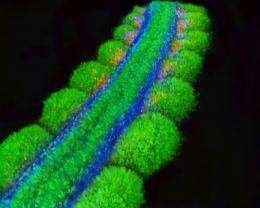
Professor Christophe Marcelle and his team have deciphered how signals from neural crest cells (pictured in blue) regulate the development of the first muscle cells.

Research at the Australian Regenerative Medicine Institute (ARMI) at Monash University could lay the groundwork for new muscular dystrophy treatments.

A team led by developmental biologist Professor Christophe Marcelle has worked out how embryonic stem cells differentiate into specialist early in development.

The work, published in the British journal Nature in May 2011, could point the way to regulating the differentiation of muscle stem cells into functional , leading to treatments for muscular dystrophy through cell therapy. Cell therapy involves implanting healthy or genetically engineered muscle cells into the patient.

“We wanted to find out the mechanism of cell fate – why some simply renew themselves while others undergo differentiation,” Professor Marcelle said.

“This is the main unresolved question in any stem cell field – to understand how you can affect the balance between self renewal and differentiation into tissue.”

Professor Marcelle says there is no cure for any of the muscle wasting disorders collectively known as .

Cell therapy could also be used to treat the debilitating muscle wasting of ageing at a time when Australia is grappling with the problems of its ageing population.

“More than 2 per cent of the population is affected by various muscle dysfunctions, including genetic diseases such as dystrophies or muscle weakness from aging,” Professor Marcelle says.

“Given the burden that muscle diseases impose on the economy, it is critical to develop innovative approaches and explore avenues of research that will lead to the discovery of new cures for muscle pathologies and muscle wasting.”

Provided by Monash University search and more info website

5 /5 (1 vote)  

Rank 5 /5 (1 vote)
Relevant PhysicsForums posts
  • A question about drug tolerance
    createdMay 23, 2012
  • Poor nutrition leading to overeating?
    createdMay 23, 2012
  • Math and dyslexia?
    createdMay 21, 2012
  • portable metabolism meter?
    createdMay 21, 2012
  • Rare medical conditions on 20/20 tonight
    createdMay 18, 2012
  • "Good" Cholesterol in Doubt
    createdMay 17, 2012
  • More from Physics Forums - Medical Sciences

More news stories

Implantable pain disk may help those with cancer

An estimated 3.5 million cancer patients around the globe are in severe pain from their disease, but many get no relief.

Medical research created 5 hours ago | popularity not rated yet | comments 0 | with audio podcast

Energy levels link sleep control mechanisms

Sleep, or lack of it, can determine level of cognitive performance which is linked with accidents as well as increased risk of serious health problems. Links between cell energy levels, gene transcription ...

Medical research created 7 hours ago | popularity not rated yet | comments 0

Researchers identify key brain cell in antidepressant action

(Medical Xpress) -- Antidepressant medications such as Prozac have helped improve mood and lessen anxiety in millions of people with major depression. But scientists know surprisingly little about how these drugs work.

Medical research created 8 hours ago | popularity not rated yet | comments 0 | with audio podcast

Rockefeller scientists pioneer new method to determine mechanisms of drug action

(Medical Xpress) -- Knowing that a drug works is great. Knowing how it works is a luxury. And until now, determining a drug’s mechanism of action has been a tedious and difficult process for scientists.

Medical research created 8 hours ago | popularity not rated yet | comments 0 | with audio podcast

Like curry? New biological role identified for compound used in ancient medicine

Scientists have just identified a new reason why some curry dishes, made with spices humans have used for thousands of years, might be good for you.

Medical research created 15 hours ago | popularity 4.3 / 5 (4) | comments 1 | with audio podcast


Of mice and mental models: Neuroscientific implications of risk-optimized behavior in the mouse

(Medical Xpress) -- Regardless of an organism’s biological complexity, every encephalized animal continuously makes under-informed behavioral choices that can have serious consequences. Despite its ubiquity, ...

Cancer may require simpler genetic mutations than previously thought

Chromosomal deletions in DNA often involve just one of two gene copies inherited from either parent. But scientists haven't known how a deletion in one gene from one parent, called a "hemizygous" deletion, can contribute ...

Early physical therapist treatment associated with reduced risk of healthcare utilization and reduced overall healthcare

A new study published in Spine shows that early treatment by a physical therapist for low back pain (LBP), as compared to delayed treatment, was associated with reduced risk of subsequent healthcare utilization and lower ...

Skp2 activates cancer-promoting, glucose-processing Akt

HER2 and its epidermal growth factor receptor cousins mobilize a specialized protein to activate a major player in cancer development and sugar metabolism, scientists report in the May 25 issue of Cell.

Inherited DNA change explains overactive leukemia gene

A small inherited change in DNA is largely responsible for overactivating a gene linked to poor treatment response in people with acute leukemia.

First study to suggest that the immune system may protect against Alzheimer's changes in humans

Recent work in mice suggested that the immune system is involved in removing beta-amyloid, the main Alzheimer's-causing substance in the brain. Researchers have now shown for the first time that this may apply in humans.