A little exercise may protect the aging brain from memory loss following infection
August 9, 2011 in Neuroscience
A little exercise may protect the aging brain from memory loss following infection

Enlarge

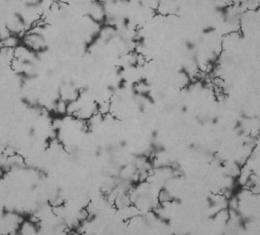
Microglia -- the immune defense cells of the brain shown here -- become more reactive to infection during aging. Researchers found a small amount of exercise protected older rats from memory loss following infection and prevented the exaggerated response of microglia in the brain’s learning and memory center. Credit: Reprinted with permission: Milligan, et al., The Journal of Neuroscience 2001, 21(8):2808-19.

A small amount of exercise shields older animals from memory loss following a bacterial infection, according to a study in the August 10 issue of The Journal of Neuroscience. The findings suggest moderate exercise may lead to several changes in the brain that boost its ability to protect itself during aging — a period of increased vulnerability.

In the new study, researchers led by Ruth Barrientos, PhD, of the University of Colorado at Boulder, found running on an exercise wheel protected older rats from following an Escherichia coli (E. coli) . Wheel-running also blunted changes in the hippocampus — an area of the brain involved in learning and memory — that typically follow in aging animals. In humans, older adults are more likely than the young to suffer memory impairment following severe bacterial infection or injury.

"This is the first study to show that exercise reduces susceptibility to the cognitive impairments that follow infection in aging animals, and the changes taking place in the brain thought to underlie these impairments," Barrientos said.

Bacterial infections kick off a cascade of events that signal the brain that something is wrong. Barrientos and colleagues previously found older rats experienced memory loss following E. coli infection, an outcome not seen in young adult rats. They also found the microglia — immune defense cells in the — of older animals became more reactive to infection, releasing more chemicals involved in inflammation in the hippocampus, in contrast with younger animals.

In the current study, the researchers allowed unlimited access to a running wheel to determine if exercise could help block the events that follow E. coli infection in the aging . Although the old rats only ran an average of 0.43 miles per week (50 times less distance than the young rats), they performed better on a memory test than rats who only had access to a locked exercise wheel. Additionally, the runners performed as well on the memory test as rats that were not exposed to E. coli. The small amount of exercise performed by the aging rats also prevented the reactive response of microglia in the hippocampus.

"While many of us are hopeful about developing a pharmaceutical intervention to reverse the effects of aging, this study provides exciting evidence that a little is protective against age-related problems with health and immunity," said Jonathan Godbout, PhD, an expert on aging at Ohio State University, who was unaffiliated with the study.

More information: http://www.jneurosci.org/

Provided by Society for Neuroscience search and more info website

not rated yet  

Rank not rated yet
Relevant PhysicsForums posts
  • A question about drug tolerance
    createdMay 23, 2012
  • Poor nutrition leading to overeating?
    createdMay 23, 2012
  • Math and dyslexia?
    createdMay 21, 2012
  • portable metabolism meter?
    createdMay 21, 2012
  • Rare medical conditions on 20/20 tonight
    createdMay 18, 2012
  • "Good" Cholesterol in Doubt
    createdMay 17, 2012
  • More from Physics Forums - Medical Sciences

More news stories

Of mice and mental models: Neuroscientific implications of risk-optimized behavior in the mouse

(Medical Xpress) -- Regardless of an organism’s biological complexity, every encephalized animal continuously makes under-informed behavioral choices that can have serious consequences. Despite its ubiquity, ...

Neuroscience created 9 hours ago | popularity not rated yet | comments 0 | with audio podcast feature

Persistent sensory experience is good for aging brain

Despite a long-held scientific belief that much of the wiring of the brain is fixed by the time of adolescence, a new study shows that changes in sensory experience can cause massive rewiring of the brain, even as one ages. ...

Neuroscience created May 24, 2012 | popularity not rated yet | comments 0

Boundary stops molecule right where it needs to be

A molecule responsible for the proper formation of a key portion of the nervous system finds its way to the proper place not because it is actively recruited, but instead because it can't go anywhere else.

Neuroscience created May 24, 2012 | popularity not rated yet | comments 0 | with audio podcast

Locating ground zero: How the brain's emergency workers find the disaster area

Like emergency workers rushing to a disaster scene, cells called microglia speed to places where the brain has been injured, to contain the damage by 'eating up' any cellular debris and dead or dying neurons. ...

Neuroscience created May 24, 2012 | popularity 5 / 5 (2) | comments 0 | with audio podcast

Genetic 'reset switch' enables signaling pathway to induce multiple developmental outcomes for olfactory neurons

Within the nervous system, a handful of signaling pathways modulate development of a cornucopia of different neuronal subtypes. “Even small alterations in neuron differentiation pathways can disrupt subsequent ...

Neuroscience created May 24, 2012 | popularity not rated yet | comments 0


Tongue analysis software uses ancient Chinese medicine to warn of disease

For 5,000 years, the Chinese have used a system of medicine based on the flow and balance of positive and negative energies in the body. In this system, the appearance of the tongue is one of the measures used to classify ...

Most occupational injury and illness costs are paid by the government and private payers

UC Davis researchers have found that workers' compensation insurance is not used nearly as much as it should be to cover the nation's multi-billion dollar price tag for workplace illnesses and injuries. Instead, almost 80 ...

Cancer may require simpler genetic mutations than previously thought

Chromosomal deletions in DNA often involve just one of two gene copies inherited from either parent. But scientists haven't known how a deletion in one gene from one parent, called a "hemizygous" deletion, can contribute ...

Inherited DNA change explains overactive leukemia gene

A small inherited change in DNA is largely responsible for overactivating a gene linked to poor treatment response in people with acute leukemia.

Early physical therapist treatment associated with reduced risk of healthcare utilization and reduced overall healthcare

A new study published in Spine shows that early treatment by a physical therapist for low back pain (LBP), as compared to delayed treatment, was associated with reduced risk of subsequent healthcare utilization and lower ...

Skp2 activates cancer-promoting, glucose-processing Akt

HER2 and its epidermal growth factor receptor cousins mobilize a specialized protein to activate a major player in cancer development and sugar metabolism, scientists report in the May 25 issue of Cell.