Blood vessels participate in the eradication of tumors
August 17, 2011 in Cancer
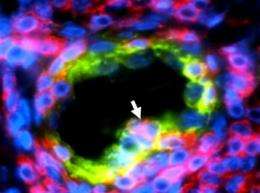
Microscope image of a breast tumor section showing a HEV blood vessel (green) surrounded by lymphocytes (red). The white arrow indicates a lymphocyte weaving its way through the HEV vessel. Credit: Jean-Philippe GIRARD - IPBS (CNRS/Université Toulouse III - Paul Sabatier
Breast cancer: for the first time, very specific blood vessels have been discovered in tumors. These vessels facilitate the access of certain white blood cells, known as killer lymphocytes, into tumor tissues and thus lead to the efficient destruction of tumors. This work, led by Jean-Philippe Girard, Inserm senior researcher at the Institut de Pharmacologie et de Biologie Structurale, in collaboration with the Institut Claudius Regaud, is published in the journal Cancer Research (August 2011).
A category of white blood cells, called killer lymphocytes, has the function of recognizing and destroying cancerous cells in the body. However, the eradication of the disease requires the presence of a large number of killer cells in contact with the tumors. How do these lymphocytes manage to penetrate the tumors in order to destroy them? Although the mechanism has been shrouded in mystery until now, Girard's team at the Institut de Pharmacologie et de Biologie Structurale, in collaboration with researchers from the Institut Claudius Regaud, has lifted the veil on how lymphocytes infiltrate into tumors. By carrying out a study involving nearly 150 patients suffering from breast cancer, the scientists discovered the presence of a particular type of blood vessel, known as HEVs, in tumors. Normally, these HEV vessels are present in the lymph nodes where they serve as port of entry for lymphocytes from the blood. The cells lining the walls of these HEV vessels are bulging and rounded and this very characteristic morphology facilitates the passage of lymphocytes from the blood into the tissue.
The Toulouse-based team discovered that the presence of a large number of killer lymphocytes in breast tumors was linked to the presence of a large number of HEV vessels in these tumors. This suggests that, as in lymph nodes, HEVs constitute the port of entry for lymphocytes into tumors. In addition, the researchers observed that when a tumor contains many HEV vessels, the patients are more likely to recover. The presence of these HEV vessels in a tumor could thus be a favorable prognosis factor.
The next steps for the researchers will be to confirm these results on larger groups of patients and to study the influence of HEV vessels on the response to therapeutics (chemo- and radiotherapy) widely used in breast cancer treatment. Studies are also underway to examine the role of HEV vessels in melanoma and cancer of the ovaries and the colon. The longer-term objective is to increase the quantity of HEVs in tumors and/or to make them form in tumors that do not have them, so as to enable a massive recruitment of killer lymphocytes for eradicating cancerous cells.
More information: Human solid tumors contain high endothelial venules (HEVs): association with T and B lymphocyte infiltration and favourable prognosis in breast cancer, Ludovic Martinet, et al., Cancer Research, 16 August 2011.
Provided by
CNRS
-
Adipose cells and breast cancer -- a dangerous combination
Apr 05, 2011 |
not rated yet |
0
-
Precancerous stem cells can form tumor blood vessels
Feb 20, 2008 |
not rated yet |
0
-
New cancer treatment targets both tumor cells and blood vessels
Jun 18, 2008 |
not rated yet |
0
-
Drug/radiation combo may help shrink established tumors
Aug 25, 2008 |
not rated yet |
0
-
T-regulatory lymphocytes in gastrointestinal cancer
Jan 31, 2011 |
not rated yet |
0
-
Of mice and mental models: Neuroscientific implications of risk-optimized behavior in the mouse
10 hours ago |
not rated yet |
0
-
Limits to growth: Scientists identify key metastasis-enabling enzyme
May 22, 2012 |
5 / 5 (3) |
0
-
Seeing is as seeing does: Spatially-structured retinal input in early development of cortical maps
Apr 26, 2012 |
5 / 5 (4) |
1
-
Dreamless nights: Brain activity during nonrapid eye movement sleep
Apr 09, 2012 |
4.4 / 5 (12) |
0
-
Take your time: Neurobiology sheds light on the superiority of spaced vs. massed learning
Mar 28, 2012 |
4.5 / 5 (21) |
3
-
A question about drug tolerance
May 23, 2012
-
Poor nutrition leading to overeating?
May 23, 2012
-
Math and dyslexia?
May 21, 2012
-
portable metabolism meter?
May 21, 2012
-
Rare medical conditions on 20/20 tonight
May 18, 2012
-
"Good" Cholesterol in Doubt
May 17, 2012
- More from Physics Forums - Medical Sciences
More news stories
Skp2 activates cancer-promoting, glucose-processing Akt
HER2 and its epidermal growth factor receptor cousins mobilize a specialized protein to activate a major player in cancer development and sugar metabolism, scientists report in the May 25 issue of Cell.
Cancer
4 hours ago |
not rated yet |
0
|
Pancreatectomy OK without downstaging from therapy
(HealthDay) -- Pancreatectomy improves median survival in pancreatic cancer patients even when presurgical neoadjuvant therapy does not lead to radiographic downstaging of tumors, according to a study published ...
Cancer
5 hours ago |
not rated yet |
0
Common therapies for basal cell carcinoma offer similar survival
(HealthDay) -- For patients with superficial basal cell carcinoma (sBCC), treatment with imiquimod or photodynamic therapy (PDT) results in similar long-term tumor-free survival, according to a review published ...
Cancer
5 hours ago |
not rated yet |
0
Cancer may require simpler genetic mutations than previously thought
Chromosomal deletions in DNA often involve just one of two gene copies inherited from either parent. But scientists haven't known how a deletion in one gene from one parent, called a "hemizygous" deletion, can contribute ...
Cancer
7 hours ago |
not rated yet |
0
|
New prostate cancer screening guidelines face a tough sell, study suggests
(Medical Xpress) -- Recent recommendations from the U.S. Preventive Services Task Force (USPSTF) advising elimination of routine prostate-specific antigen (PSA) screening for prostate cancer in healthy men are likely to encounter ...
Cancer
10 hours ago |
not rated yet |
1
Tongue analysis software uses ancient Chinese medicine to warn of disease
For 5,000 years, the Chinese have used a system of medicine based on the flow and balance of positive and negative energies in the body. In this system, the appearance of the tongue is one of the measures used to classify ...
Of mice and mental models: Neuroscientific implications of risk-optimized behavior in the mouse
(Medical Xpress) -- Regardless of an organism’s biological complexity, every encephalized animal continuously makes under-informed behavioral choices that can have serious consequences. Despite its ubiquity, ...
Early physical therapist treatment associated with reduced risk of healthcare utilization and reduced overall healthcare
A new study published in Spine shows that early treatment by a physical therapist for low back pain (LBP), as compared to delayed treatment, was associated with reduced risk of subsequent healthcare utilization and lower ...
Inherited DNA change explains overactive leukemia gene
A small inherited change in DNA is largely responsible for overactivating a gene linked to poor treatment response in people with acute leukemia.
Most occupational injury and illness costs are paid by the government and private payers
UC Davis researchers have found that workers' compensation insurance is not used nearly as much as it should be to cover the nation's multi-billion dollar price tag for workplace illnesses and injuries. Instead, almost 80 ...
New device allows pacemaker patients to safely undergo MRIs
For many, it's a medical conundrum: The very pacemaker keeping their heart in rhythm prevents them from undergoing an MRI to diagnose other ailments, because interaction between the two devices could prove deadly.