Research finds enzyme disrupting nerve cell communication in Alzheimer's disease
August 15, 2011 in Medical research

Research finds enzyme disrupting nerve cell communication in Alzheimer's disease

Enlarge

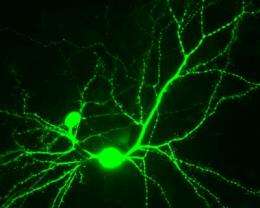
In Alzheimer's disease, communication between nerve cells (shown here in green) is disrupted by an aberrant protein called SNO-Cdk5. Credit: Tomohiro Nakamura, Sanford-Burnham Medical Research Institute

Alzheimer's disease is characterized by abnormal proteins that stick together in little globs, disrupting cognitive function (thinking, learning, and memory). These sticky proteins are mostly made up of beta-amyloid peptide. A better understanding of these proteins, how they form, and how they affect brain function will no doubt improve the diagnosis and treatment of Alzheimer's disease.

To this end, a research team led by Stuart A. Lipton, M.D., Ph.D. at Sanford-Burnham Medical Research Institute (Sanford-Burnham) found that beta-amyloid-induced destruction of synapses—the connections that mediate communication between nerve cells—is driven by a chemical modification to an enzyme called Cdk5. The team found that this altered form of Cdk5 (SNO-Cdk5) was prevalent in human brains, but not in normal brains. These results, published online the week of August 15 in the Proceedings of the National Academy of Sciences of the USA, suggest that SNO-Cdk5 could be targeted for the development of new Alzheimer's disease therapies.

Cdk5 is an enzyme known to play a role in normal neuronal survival and migration. In this study, Dr. Lipton and colleagues found that beta-amyloid , the hallmark of Alzheimer's disease, trigger Cdk5 modification by a chemical process called S-nitrosylation. In this reaction, nitric oxide (NO) is attached to the enzyme, producing SNO-Cdk5 and disrupting its normal activity.

"After NO is attached to Cdk5, it then jumps like a 'hot potato' to another protein called Drp1, disrupting its function and fragmenting mitochondria, the energy powerhouse of nerve cells. When the mitochondria are damaged, the synapses, which normally require a lot of energy for their function, are destroyed. This scenario disrupts communication between nerve cells, and thus memory and cognitive ability in Alzheimer's disease," said Dr. Lipton, professor and director of Sanford-Burnham's Del E. Webb Neuroscience, Aging and Stem Cell Research Center. Dr. Lipton is also a neurologist who sees Alzheimer's disease patients in his own clinical practice, and is credited with characterizing and developing memantine (Namenda®), the latest FDA-approved drug for Alzheimer's disease.

In the current study, Cdk5 is shown to perform a new function not previously known—the ability to transfer NO from one protein to another. Until now, Cdk5 was only known to influence the function of other proteins by tagging them with phosphate groups in a process known as phosphorylation. The new study shows that the addition of NO sends Cdk5 into overdrive and allows it to also S-nitrosylate other proteins, in this case Drp1 on mitochondria. Most notably, the transfer of NO from SNO-Cdk5 to Drp1 triggers the loss of synapses, the part of a nerve cell that transmits electrochemical signals to other . Loss of is known to correlate with the degree of cognitive decline in Alzheimer's disease.

Taking the study a step further, the team compared SNO-Cdk5 levels in brain tissue from healthy people and from Alzheimer's disease patients. SNO-Cdk5 was dramatically elevated in human brains with Alzheimer's disease.

"Our experiments using human brain tissue from patients with Alzheimer's disease give this finding clear clinical relevance," Dr. Lipton said. "SNO-Cdk5 could provide a new target for treating this devastating condition."

As many as 5.3 million Americans are living with Alzheimer's, currently the seventh-leading cause of death in the United States. This study was funded by the National Institutes of Health (NIH). Co-authors include Jing Qu, Tomohiro Nakamura, Gang Cao, Emily A. Holland, Scott R. McKercher, and Stuart A. Lipton, all located at Sanford-Burnham in La Jolla, Calif.

Provided by Sanford-Burnham Medical Research Institute

not rated yet  

Rank not rated yet
Related Stories
Relevant PhysicsForums posts

More news stories

Common food supplement fights degenerative brain disorders

Widely available in pharmacies and health stores, phosphatidylserine is a natural food supplement produced from beef, oysters, and soy. Proven to improve cognition and slow memory loss, it's a popular treatment for older ...

Medical research created 1 hour ago | popularity 5 / 5 (1) | comments 0 | with audio podcast

Finding a family for a pair of orphan receptors in the brain

Researchers at Emory University have identified a protein that stimulates a pair of "orphan receptors" found in the brain, solving a long-standing biological puzzle and possibly leading to future treatments for neurological ...

Medical research created 1 hour ago | popularity not rated yet | comments 0 | with audio podcast

Insight into the dazzling impact of insulin in cells

Australian scientists have charted the path of insulin action in cells in precise detail like never before. This provides a comprehensive blueprint for understanding what goes wrong in diabetes.

Medical research created 2 hours ago | popularity 4.5 / 5 (2) | comments 0 | with audio podcast

Do men's and women's hearts burn fuel differently?

Researchers at the University of Illinois at Chicago College of Medicine will study gender differences in how the heart uses and stores fat—its main energy source—and how changes in fat metabolism play ...

Medical research created 4 hours ago | popularity not rated yet | comments 0

Study suggests new source of kidneys for transplant

Nearly 20 percent of kidneys that are recovered from deceased donors in the U.S. are refused for transplant due to factors ranging from scarring in small blood vessels of the kidney's filtering units to the organ going too ...

Medical research created 21 hours ago | popularity 5 / 5 (2) | comments 0 | with audio podcast


B vitamins could delay dementia

(Medical Xpress)—Despite spending billions of dollars on research and development, drug companies have been unable to come up with effective treatments for dementia and Alzheimer's Disease (AD). Now, A. ...

Waiting for a sign? Researchers find potential brain 'switch' for new behavior

You're standing near an airport luggage carousel and your bag emerges on the conveyor belt, prompting you to spring into action. How does your brain make the shift from passively waiting to taking action when ...

Aggressive behavior linked specifically to secondhand smoke exposure in childhood

Children who are exposed to secondhand smoke in early childhood are more likely to grow up to physically aggressive and antisocial, regardless of whether they were exposed during pregnancy or their parents have a history ...

If you can remember it, you can remember it wrong

(Medical Xpress)—Native peoples in regions where cameras are uncommon sometimes react with caution when their picture is taken. The fear that something must have been stolen from them to create the photo ...

Estimates reveal low population immunity to new bird flu virus H7N9 in humans

The level of immunity to the recently circulating H7N9 influenza virus in an urban and rural population in Vietnam is very low, according to the first population level study to examine human immunity to the virus, which was ...

Study finds vitamin C can kill drug-resistant TB (w/ video)

In a striking, unexpected discovery, researchers at Albert Einstein College of Medicine of Yeshiva University have determined that vitamin C kills drug-resistant tuberculosis (TB) bacteria in laboratory culture. The finding ...