Free radicals crucial to suppressing appetite, study finds
August 28, 2011 in Medical research

Free radicals crucial to suppressing appetite

Enlarge

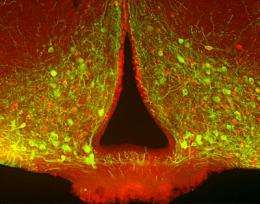
This image shows satiety promoting melanocortin neurons (green) in the hypothalamus, some of which are activated (red nuclei) after treatment. Credit: Tamas Horvath, Yale University

Obesity is growing at alarming rates worldwide, and the biggest culprit is overeating. In a study of brain circuits that control hunger and satiety, Yale School of Medicine researchers have found that molecular mechanisms controlling free radicals—molecules tied to aging and tissue damage—are at the heart of increased appetite in diet-induced obesity.

Published Aug. 28 in the advanced online issue of Nature Medicine, the study found that elevating free radical levels in the hypothalamus directly or indirectly suppresses in obese mice by activating satiety-promoting melanocortin neurons. Free radicals, however, are also thought to drive the aging process.

"It's a catch-22," said senior author Tamas Horvath, the Jean and David W. Wallace Professor of Biomedical Research, chair of comparative medicine and director of the Yale Program on Integrative Cell Signaling and Neurobiology of Metabolism. "On one hand, you must have these critical signaling molecules to stop eating. On the other hand, if exposed to them chronically, free radicals damage cells and promote aging."

"That's why, in response to continuous overeating, a cellular mechanism kicks in to suppress the generation of these free radicals," added lead author Sabrina Diano, associate professor of Ob/Gyn, neurobiology and comparative medicine. "While this free radical-suppressing mechanism—promoted by growth of intracellular organelles, called peroxisomes—protects the cells from damage, this same process will decrease the ability to feel full after eating."

After the mice ate, the team saw that the neurons responsible for stopping overeating had high levels of free radicals. This process is driven by the hormone leptin and glucose, which signal the brain to modulate food intake. When mice eat, leptin and glucose levels go up, as does free radical levels. However, in mice with diet-induced obesity, these same neurons display impaired firing and activity (leptin resistance); in these mice, levels of free radicals were buffered by peroxisomes, preventing the activation of these neurons and thus the ability to feel sated after eating.

According to Horvath and Diano, the crucial role of free radicals in promoting satiety as well as degenerative processes associated with aging may explain why it has been difficult to develop successful therapeutic strategies for without major side effects. Current studies address the question of whether, under any circumstance, satiety could be promoted without sustained elevation of in the brain and periphery.

More information: Nature Medicine, DOI: 10.1038/nm.2421

Provided by Yale University search and more info website

4.9 /5 (7 votes)  

Rank 4.9 /5 (7 votes)
Related Stories
Relevant PhysicsForums posts

More news stories

Study reveals new mechanism for estrogen suppression of liver lipid synthesis

By discovering the new mechanism by which estrogen suppresses lipid synthesis in the liver, UC Irvine endocrinologists have revealed a potential new approach toward treating certain liver diseases.

Medical research created 3 hours ago | popularity not rated yet | comments 0 | with audio podcast

MRI-based measurement helps predict vascular disease in the brain

Aortic arch pulse wave velocity, a measure of arterial stiffness, is a strong independent predictor of disease of the vessels that supply blood to the brain, according to a new study published in the June issue the journal ...

Medical research created 3 hours ago | popularity not rated yet | comments 0

Antibiotics: A new understanding of sulfonamide nervous system side effects

Since the discovery of Prontosil in 1932, sulfonamide antibiotics have been used to combat a wide spectrum of bacterial infections, from acne to chlamydia and pneumonia. However, their side effects can include serious neurological ...

Medical research created 5 hours ago | popularity not rated yet | comments 0 | with audio podcast

Scientists discover molecule triggers sensation of itch

Scientists at the National Institutes of Health report they have discovered in mouse studies that a small molecule released in the spinal cord triggers a process that is later experienced in the brain as ...

Medical research created 5 hours ago | popularity 5 / 5 (2) | comments 0 | with audio podcast

Discarded immune cells induce the relocation of stem cells

Spanish researchers have discovered that the daily clearance of neutrophils from the body stimulates the release of hematopoietic stem cells from the bone marrow into the bloodstream, according to a report published today ...

Medical research created 6 hours ago | popularity 5 / 5 (2) | comments 0


Statin use is linked to increased risk of developing diabetes, warn researchers

Treatment with high potency statins (especially atorvastatin and simvastatin) may increase the risk of developing diabetes, suggests a paper published today in BMJ.

Consumers largely underestimating calorie content of fast food

People eating at fast food restaurants largely underestimate the calorie content of meals, especially large ones, according to a paper published today in BMJ.

Dual-source cardiac CT IDs CAD in hard-to-image patients

(HealthDay)—In patients who have previously been considered difficult to image, dual-source cardiac (DSC) computed tomography (CT) can identify clinically significant coronary artery disease, according ...

Controlling mood through the motions of mitochondria

(Medical Xpress)—Regulating the distribution of power in neurons is done by a system that makes the national electric grid look simple by comparison. Each neuron has several thousand mitochondria confined ...

WHO: Scientific red tape mars efforts vs. virus

International efforts to combat a new pneumonia-like virus that has now killed 22 people are being slowed by unclear rules and competition for the potentially profitable rights to disease samples, the head ...

Future doctors unaware of their obesity bias

Two out of five medical students have an unconscious bias against obese people, according to a new study by researchers at Wake Forest Baptist Medical Center. The study is published online ahead of print in the Journal of ...