New genetically engineered vaccines target Rift Valley fever
(PhysOrg.com) -- Researchers from the University of California, Davis, and elsewhere are reporting the development of two genetically engineered vaccines to combat the mosquito-borne Rift Valley fever, devastating to livestock and so far confined to Africa and the Middle East.
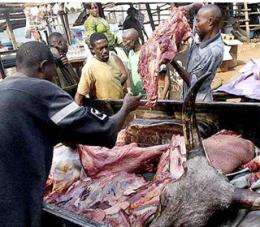
The virus can sicken people, too, who can be infected by mosquitoes or by direct contact with infected animals or their meat.
The scientists from UC Davis, the University of Connecticut and the University of Texas Medical Branch hope the new livestock vaccines can be further developed for use in people.
The vaccine development is the subject of a paper that was posted this week in the online edition of the scientific journal Proceedings of the National Academy of Sciences.
“There currently are no approved vaccines available for treating Rift Valley fever in humans, and those available for livestock are either inefficient or have serious side effects,” said lead author Tilahun Yilma, a veterinary professor specializing in viral diseases and the director of the International Laboratory of Molecular Biology for Tropical Diseases in the UC Davis School of Veterinary Medicine.
“Because Rift Valley fever is spread by mosquitoes, there is concern that the disease could be accidentally or intentionally introduced to North America and other regions where it is not now found,” he said. “Such an introduction could have devastating economic and human health implications.”
Earlier in his career, Yilma did extensive work on foot-and-mouth disease and developed a similar genetically engineered vaccine for the devastating cattle disease rinderpest, which the World Organisation for Animal Health in May declared to be eradicated.
About Rift Valley Fever
Rift Valley fever is a viral disease first identified in 1931 among sheep in the Rift Valley of Kenya. Since then, outbreaks have been reported in Sub-Saharan and North Africa, and there was a major outbreak of the disease in 1998-99 in Kenya, Somalia and Tanzania.
In 2000, cases of Rift Valley fever were reported in Saudi Arabia and Yemen, the first reports of the disease outside of the African continent. This raised concern among health officials that the disease might spread to Asia, Europe and the Americas.
In livestock, the disease causes major losses due to illness, with the rate of abortion among pregnant sheep approaching 100 percent. In people, infection results in fever, hepatitis, vision loss and occasionally hemorrhagic fever.
About the new vaccines
In developing the two vaccines, the researchers made use of the vaccinia virus, the same virus used to make the smallpox vaccine. They inactivated two vaccinia genes to weaken that virus and prevent it from causing disease, and inserted two Rift Valley fever genes to stimulate an immune response, thereby equipping the vaccinated animals to fight off infection.
The vaccines are similar, except that one of them includes one more gene to further weaken the vaccinia virus and enhance the safety of the vaccine, especially for people who would be vaccinating livestock.
Both vaccines proved safe and produced significant immune responses when tested in mice and baboons, the researchers reported. When mice were challenged with the Rift Valley fever virus, the vaccines proved to be 90 percent protective.
In describing the advantages of the new vaccines, Yilma noted that both would be easy to produce in large scale and would not need to be refrigerated.
The researchers plan to conduct additional studies to determine how safe and effective the vaccines are in sheep and cattle.


