Ready to learn? Brain scans can tell you
August 19, 2011 by Anne Trafton, MIT News in Neuroscience
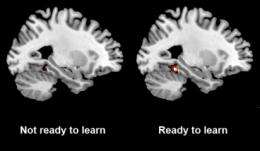
MIT neuroscientists showed that activity in a part of the brain called the parahippocampal cortex correlates with the brain’s preparedness to learn new information. Image: Julie Yoo
Our memories work better when our brains are prepared to absorb new information, according to a new study by MIT researchers. A team led by Professor John Gabrieli has shown that activity in a specific part of the brain, known as the parahippocampal cortex (PHC), predicts how well people will remember a visual scene.
The new study, published in the journal NeuroImage, found that when the PHC was very active before people were shown an image, they were less likely to remember it later. When that area is busy, for some reason or another, its less ready to learn something new, says Gabrieli, the Grover Hermann Professor of Health Sciences and Technology and Cognitive Neuroscience and a principal investigator at the McGovern Institute for Brain Research at MIT.
The PHC, which has previously been linked to recollection of visual scenes, wraps around the hippocampus, a part of the brain critical for memory formation. However, this study is the first to investigate how PHC activity before a scene was presented would affect how well the scene was remembered. Lead author of the paper is Julie Yoo, a postdoc at the McGovern Institute.
Subjects were shown 250 color photographs of indoor and outdoor scenes as they lay in a functional magnetic resonance imaging (fMRI) scanner. They were later shown 500 scenes including the 250 they had already seen as a test of their recollection of the first batch of images. The fMRI scans revealed that images were remembered better when there was lower activity in the PHC before the scenes were presented.
The precise area of activation was slightly different in each person studied, but was always located in the PHC.
In a second experiment, the researchers used real-time fMRI, which can monitor subjects brain states from moment to moment, to determine when the brain was ready or not ready to recall images. Those states were used as triggers to present new visual scenes. As expected, images presented while the brain was in a ready state were better remembered.
The finding adds a new element to the longstanding question of why we remember certain things better than others, says Nicholas Turk-Browne, assistant professor of psychology at Princeton University, who was not involved in this study. Traditionally, scientists have believed that memory is based on the inherent memorability of specific events, with strongly emotional events likeliest to be remembered. More recently, cognitive neuroscientists have found that the brains ability to consolidate, store and retrieve information is also important.
The significance of this study is that it suggests that beyond the inherent memorability of things, and how well the memory systems are working, theres a huge role to be played by how well prepared you are to process whats coming in, Turk-Browne says.
In theory, this method could be used to determine when a student is best prepared to learn new material, or to monitor workers who need to stay alert. Thats what we would like to think that we are able to measure states of receptivity for learning, or preparedness for learning, Gabrieli says. In terms of how that would be translated to real life, there are still a few steps to go.
The main hurdle is that fMRI scanners are very large, and at this point, they cannot be made into small, portable devices. A possible alternative is using electroencephalography (EEG), a more easily miniaturized technology that measures electrical activity along the scalp. The researchers are now working on ways to use EEG to measure activity in the PHC.
This story is republished courtesy of MIT News (web.mit.edu/newsoffice/), a popular site that covers news about MIT research, innovation and teaching.
Provided by
Massachusetts Institute of Technology
-
Cognitive neuroscientists shed light on how the brain responds to scenes and their mirror-image reversals
Aug 18, 2011 |
not rated yet |
0
-
What makes an image memorable? We tend to remember pictures of people much better than wide open spaces
May 24, 2011 |
not rated yet |
0
-
The surprising connection between two types of perception
Jun 14, 2011 |
not rated yet |
0
-
Money motivates memory, study finds
May 04, 2006 |
not rated yet |
0
-
Sleep helps brain sift memories, study shows
Dec 01, 2010 |
not rated yet |
0
-
Motion perception revisited: High Phi effect challenges established motion perception assumptions
Apr 23, 2013 |
3 / 5 (2) |
2
-
Anything you can do I can do better: Neuromolecular foundations of the superiority illusion (Update)
Apr 02, 2013 |
4.5 / 5 (11) |
5
-
The visual system as economist: Neural resource allocation in visual adaptation
Mar 30, 2013 |
5 / 5 (2) |
9
-
Separate lives: Neuronal and organismal lifespans decoupled
Mar 27, 2013 |
4.9 / 5 (8) |
0
-
Sizing things up: The evolutionary neurobiology of scale invariance
Feb 28, 2013 |
4.8 / 5 (10) |
14
-
How can there be a term called "intestinal metaplasia" of stomach
23 hours ago
-
Pressure-volume curve: Elastic Recoil Pressure don't make sense
May 18, 2013
-
If you became brain-dead, would you want them to pull the plug?
May 17, 2013
-
MRI bill question
May 15, 2013
-
Ratio of Hydrogen of Oxygen in Dessicated Animal Protein
May 13, 2013
-
Alcohol and acetaminophen
May 13, 2013
- More from Physics Forums - Medical Sciences
More news stories
Reducing caloric intake delays nerve cell loss
Activating an enzyme known to play a role in the anti-aging benefits of calorie restriction delays the loss of brain cells and preserves cognitive function in mice, according to a study published in the May ...
Neuroscience
13 hours ago |
5 / 5 (5) |
0
|
B vitamins could delay dementia
(Medical Xpress)—Despite spending billions of dollars on research and development, drug companies have been unable to come up with effective treatments for dementia and Alzheimer's Disease (AD). Now, A. ...
Neuroscience
17 hours ago |
4.9 / 5 (14) |
0
|
Waiting for a sign? Researchers find potential brain 'switch' for new behavior
You're standing near an airport luggage carousel and your bag emerges on the conveyor belt, prompting you to spring into action. How does your brain make the shift from passively waiting to taking action when ...
Neuroscience
17 hours ago |
5 / 5 (1) |
0
|
If you can remember it, you can remember it wrong
(Medical Xpress)—Native peoples in regions where cameras are uncommon sometimes react with caution when their picture is taken. The fear that something must have been stolen from them to create the photo ...
Neuroscience
19 hours ago |
4.2 / 5 (5) |
0
|
Study shows where scene context happens in our brain
In a remote fishing community in Venezuela, a lone fisherman sits on a cliff overlooking the southern Caribbean Sea. This man –– the lookout –– is responsible for directing his comrades on the water, ...
Neuroscience
21 hours ago |
4 / 5 (1) |
0
|
Portland, Ore., rejecting water fluoridation
(AP)—The mayor of Portland, Ore., has conceded defeat in an effort to add fluoride to the city's drinking water.
Study says empathy plays a key role in moral judgments
Is it permissible to harm one to save many? Those who tend to say "yes" when faced with this classic dilemma are likely to be deficient in a specific kind of empathy, according to a report published in the scientific journal ...
Phthalates: Study links chemicals widely found in plastics, processed food to elevated blood pressure in children, teens
Plastic additives known as phthalates (pronounced THAL-ates) are odorless, colorless and just about everywhere: They turn up in flooring, plastic cups, beach balls, plastic wrap, intravenous tubing and—according to the ...
Insight into the dazzling impact of insulin in cells
Australian scientists have charted the path of insulin action in cells in precise detail like never before. This provides a comprehensive blueprint for understanding what goes wrong in diabetes.
New sleeping pill poised to hit US markets
An experimental sleeping pill from US drug company Merck is effective at helping people fall and stay asleep, according to reviewers at the US Food and Drug Administration, which could soon approve the new drug.
Antidepressant reduces stress-induced heart condition
A drug commonly used to treat depression and anxiety may improve a stress-related heart condition in people with stable coronary heart disease, according to researchers at Duke Medicine.
Aug 19, 2011
Rank: not rated yet
The are portable fMRI scanners worldwide.
The fact that the quoted statement is incorrect is irrelevant.
Important is what caused that statement to be stated.
The researchers do not know what they are describing in the article. The ad hoc 'creative' wording terminology reflects this.
Aug 27, 2011
Rank: not rated yet
Have you seen the size of those 'portables'? I think they are looking for something more briefcase or even cart-sized.