New technique to stimulate heart muscle by light may lead to light-controlled pacemakers
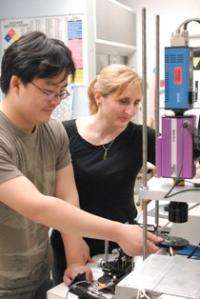
By employing optogenetics, a new field that uses genetically altered cells to respond to light, and a tandem unit cell (TCU) strategy, researchers at Stony Brook University have demonstrated a way to control cell excitation and contraction in cardiac muscle cells, the details of which are published in the early online edition of Circulation: Arrhythmia & Electrophysiology: “Stimulating Cardiac Muscle by Light: Cardiac Optogenetics by Cell Delivery.” The team of scientists, led by Emilia Entcheva, Ph.D., Associate Professor in the Departments of Biomedical Engineering, Physiology & Biophysics, and the Division of Cardiology in Medicine, Stony Brook University, includes members of the inter-departmental Institute of Molecular Cardiology at Stony Brook. The authors claim that their technique may help form the basis for a new generation of light-driven cardiac pacemakers and other medical devices.
The Institute of Molecular Cardiology at Stony Brook facilitated the close collaboration of several laboratories to carry out the research. This included Dr. Entcheva’s laboratory in the Department of Biomedical Engineering, and the laboratories of Peter Brink, Ph.D., Professor and Chair, Department of Physiology & Biophysics; and Ira Cohen, M.D., Ph.D., Leading Professor, Department of Physiology & Biophysics. Lead author of the study is Zhiheng Jia, a biomedical engineering Ph.D., student in Dr. Entcheva’s lab.
Dr. Entcheva and the research team are the first group of researchers to combine optogenetic stimulation with high-resolution, high-speed optical imaging of electrical activity in heart muscle cells. They are also the first research team to use a non-viral optogenetics approach that allows inscription of light sensitivity at the tissue level and results in the lowest light energy ever reported to control electrical activity in excitable tissue.
Summarizing the study results and implications, the team claims: “Our study highlights the utility of optogenetics for cardiac applications by using a strategy inspired by the specific properties of cardiac tissue, i.e., high cell-cell coupling. The optogenetic approach offers high spatiotemporal resolution for precise interrogation and control of excitation, seemingly without interfering with essential cardiac properties. Therefore, it presents a new versatile actuation tool in cardiac research for dissection of arrhythmias. Furthermore, cardiac optogenetics based on the TCU strategy may evolve in a more translational direction and lead to a new generation of optical pacemakers and potentially cardioverter/defibrillators.”
“This novel approach using light to activate specific cells within the heart provides a new tool to help our understanding of cardiac conduction pathways and excitation-contraction coupling, a hallmark of the heart as a regulated pump,” comments Kenneth Kaushansky, M.D., Senior Vice President for the Health Sciences, and Dean, School of Medicine, Stony Brook University. “The collaborative research by the Stony Brook team opens the door to specific patterns of stimulation or region-specific stimulation of heart contraction in a myriad of disorders of the heart.”
Dr. Entcheva points out that while electronic cardiac pacemakers and defibrillators are well established and successful technologies, they are not without problems, including the breakage of metal leads, limited battery life, and interference from strong magnetic fields. Optical stimulation, she says, may eventually offer a new way of controlling heart function.
Previous research has shown that brain cells could be stimulated using light if they were genetically altered to produce a light-sensitive protein called channelrhodopsin 2 (ChR2). In the Stony Brook study, the research team used the TCU approach, i.e., instead of directly modifying heart cells, the researchers used donor cells optimized for light responsiveness (via ChR2) and coupled them to heart cells, thus creating light-responsive heart tissue. They found that light-triggered heart muscle contractions were indistinguishable from electrically-triggered waves.
Importantly, the new technique uses much lower energy than in prior studies and doesn’t require the use of viruses or the introduction of genes from other organisms into heart cells. Therefore, the authors explained, cells from a person’s bone marrow or skin can be cultured and modified to respond to light, reducing the possibility that the immune system will reject the light-sensitive cells.
“Our method of non-viral cell delivery may overcome some hurdles towards potential clinical use by harvesting cells from the patient, making them light-responsive and using them as donor cells in the same patient,” added Dr. Entcheva.
Also, in preliminary calculations, the research team estimated that a light-based system might require lower energy for stimulation, which if extrapolated to pacemakers in the future, may potentially translate to life-long batteries.
Overall, Dr. Entcheva describes the immediate impact of the new low-energy light technique as a simple and elegant tool for advancing various aspects of cardiovascular disease research by achieving exquisite spatiotemporal control. She believes the approach may be useful in creating muscle actuators, testing new drugs for possible cardiac side effects, and potentially improving pacemakers and defibrillators.


