Atomic nano-switches emulate human memory
September 15, 2011 in Medical research

Atomic nano-switches emulate human memory

Enlarge

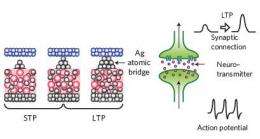
An inorganic synapse showing short-term plasticity and long-term potentiality depending on input-pulse repetition time. Credit: MANA

In a breakthrough, researchers at the International Center for Materials Nanoarchitectonics (MANA, Japan) demonstrate for the first time the key features in the neuroscience and psychology of memory by a AgS2 synapse.

Artificial neural networks have attracted attention as a means to a better understanding of biological neural networks, as well as aiding developments in . The complex and interconnected nature of make neural behavior difficult to reproduce in artificial structures without software programming. Now Takeo Ohno and researchers at the International Center for Materials Nanoarchitectonics (MANA), Tsukuba, Japan, and the University of California have mimicked synaptic activity with the electro-ionic behavior of a AgS2 electrode.

The researchers observed a temporary higher-conductance state in the AgS2 system following an incident electric pulse. Repetition of the input pulse over two second intervals led to permanently higher . These two responses mimic the short-term plasticity and long-term potentiality in biological synapses.

In the most widely accepted ‘multistore’ model of memory in human psychology, new information is stored briefly as a sensory memory. Rehearsal converts short-term memory to long-term. When demonstrating memorization of the numerals ‘1’ and ‘2’ in a 7 × 7 inorganic synapse array, the behaviour of the artificial synapse indicated ‘multistore’ memory rather than a conventional switch.

The researchers add, “The data indicate that we may apply a psychlogical memory model simultaneously with the emulation of biological synaptic-like behavior.”

More information: Takeo Ohno1, Tsuyoshi Hasegawa1, Tohru Tsuruoka1, Kazuya Terabe1, James K. Gimzewski1,2,3 and Masakazu Aono1, Short-term plasticity and long-term potentiation mimicked in single inorganic synapses. Nature Materials, 10, 591-595, (2011).

Provided by NIMS

5 /5 (1 vote)  

Rank 5 /5 (1 vote)
Relevant PhysicsForums posts

More news stories

Study reveals new mechanism for estrogen suppression of liver lipid synthesis

By discovering the new mechanism by which estrogen suppresses lipid synthesis in the liver, UC Irvine endocrinologists have revealed a potential new approach toward treating certain liver diseases.

Medical research created May 23, 2013 | popularity 5 / 5 (1) | comments 0 | with audio podcast

MRI-based measurement helps predict vascular disease in the brain

Aortic arch pulse wave velocity, a measure of arterial stiffness, is a strong independent predictor of disease of the vessels that supply blood to the brain, according to a new study published in the June issue the journal ...

Medical research created May 23, 2013 | popularity not rated yet | comments 0

Antibiotics: A new understanding of sulfonamide nervous system side effects

Since the discovery of Prontosil in 1932, sulfonamide antibiotics have been used to combat a wide spectrum of bacterial infections, from acne to chlamydia and pneumonia. However, their side effects can include serious neurological ...

Medical research created May 23, 2013 | popularity 3 / 5 (1) | comments 0 | with audio podcast

Scientists discover molecule triggers sensation of itch

Scientists at the National Institutes of Health report they have discovered in mouse studies that a small molecule released in the spinal cord triggers a process that is later experienced in the brain as ...

Medical research created May 23, 2013 | popularity 5 / 5 (3) | comments 0 | with audio podcast

Discarded immune cells induce the relocation of stem cells

Spanish researchers have discovered that the daily clearance of neutrophils from the body stimulates the release of hematopoietic stem cells from the bone marrow into the bloodstream, according to a report published today ...

Medical research created May 23, 2013 | popularity 5 / 5 (2) | comments 0


First drug to improve heart failure mortality in over a decade

Coenzyme Q10 decreases all cause mortality by half, according to the results of a multicentre randomised double blind trial presented today at Heart Failure 2013 congress. It is the first drug to improve heart failure mortality ...

Seniors more likely to crash when driving with pet, study finds

(HealthDay)—Animals make great companions for senior citizens, but elderly people who always drive with a pet in the car are far more likely to crash than those who never drive with a pet, researchers have ...

Heart failure accelerates male 'menopause'

Heart failure accelerates the aging process and brings on early andropausal syndrome (AS), according to research presented today at the Heart Failure Congress 2013. AS, also referred to as male 'menopause', was four times ...

Death highest in heart failure patients admitted in January, on Friday, and overnight

Mortality and length of stay are highest in heart failure patients admitted in January, on Friday, and overnight, according to research presented today at the Heart Failure Congress 2013. The analysis of nearly 1 million ...

Feds fight morning-after pill age ruling in NY

(AP)—Department of Justice lawyers have again asked a federal appeals court in New York to delay lifting age restrictions and prescription requirements on an emergency contraceptive popularly known as the morning-after ...

New immune system discovered

(Medical Xpress)—A research team, led by Jeremy Barr, a biology post-doctoral fellow, unveils a new immune system that protects humans and animals from infection.