Blood vessels from your printer
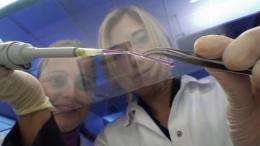
Researchers have been working at growing tissue and organs in the laboratory for a long time. These days, tissue engineering enables us to build up artificial tissue, although science still hasn't been successful with larger organs. Now, researchers at Fraunhofer are applying new techniques and materials to come up with artificial blood vessels in their BioRap project that will be able to supply artificial tissue and maybe even complex organs in future. They are exhibiting their findings at the Biotechnica Fair that will be taking place in Hannover, Germany on October 11-13.
There were more than 11,000 persons on the waiting list for organ transplantation in Germany alone at the beginning of this year, although on the average hardly half as many transplantations are performed. The aim of tissue engineering is to create organs in the laboratory for opening up new opportunities in this field. Unfortunately, researchers have still not been able to supply artificial tissue with nutrients because they do not have the necessary vascular system. Five Fraunhofer-institutes joined forces in 2009 to come up with biocompatible artificial blood vessels. It seemed impossible to build structures such as capillary vessels that are so small and complex and it was especially the branches and spaces that made life difficult for the researchers. But production engineering came to the rescue because rapid prototyping makes it possible to build workpieces specifically according to any complex 3-D model. Now, scientists at Fraunhofer are working on transferring this technology to the generation of tiny biomaterial structures by combining two different techniques: the 3-D printing technology established in rapid prototyping and multiphoton polymerization developed in polymer science.
Successful Combination
A 3-D inkjet printer can generate 3-dimensional solids from a wide variety of materials very quickly. It applies the material in layers of defined shape and these layers are chemically bonded by UV radiation. This already creates microstructures, but 3-D printing technology is still too imprecise for the fine structures of capillary vessels. This is why these researchers combine this technology with two-photon polymerization. Brief but intensive laser impulses impact the material and stimulate the molecules in a very small focus point so that crosslinking of the molecules occurs. The material becomes an elastic solid, due to the properties of the precursor molecules that have been adjusted by the chemists in the project team. In this way highly precise, elastic structures are built according to a 3-dimensional building plan. Dr. Günter Tovar is the project manager at the Fraunhofer Institute for Interfacial Engineering and Biotechnology IGB based in Stuttgart. When we caught up with him, he described the latest work: »The individual techniques are already functioning and they are presently working in the test phase; the prototype for the combined system is being built.«
When ink becomes an artificial vessel system
You have to have the right material to manufacture 3-dimensional elastic solids. This is the reason why the researchers came up with special inks because printing technology itself calls for very specific properties. The later blood vessels have to be flexible and elastic and interact with the natural tissue. Therefore, the synthetic tubes are biofunctionalized so that living body cells can dock onto them. The scientists integrate modified biomolecules – such as heparin and anchor peptides – into the inside walls. They also develop inks made of hybrid materials that contain a mixture of synthetic polymers and biomolecules right from the beginning. The second step is where endothelial cells that form the innermost wall layer of each vessel in the body can attach themselves in the tube systems. Günter Tovar points out that »the lining is important to make sure that the components of the blood do not stick, but are transported onwards.« The vessel can only work in the same fashion as its natural model to direct nutrients to their destination if we can establish an entire layer of living cells.
Opportunities for Medicine
The virtual simulation of the finished workpieces is just as significant for project success as the new materials and production techniques. Researchers have to precisely calculate the design of these structures and the course of the vascular systems to ensure optimum flow speeds while preventing back-ups. The scientists at Fraunhofer are still at the dawn of this entirely new technology for designing elastic 3-dimensionally shaped biomaterials, although this technology offers a whole series of opportunities for further development. Günter Tovar acknowledges »we are establishing a basis for applying rapid prototyping to elastic and organic biomaterials. The vascular systems illustrate very dramatically what opportunities this technology has to offer, but that's definitely not the only thing possible.« One example would be building up completely artificial organs based on a circulation system with blood vessels created in this fashion to supply them with nutrients. They are still not suited for transplantations, but the complex of organs can be used as a test system to replace animal experiments. It would also be conceivable to treat bypass patients with artificial vessels. In any event, it will take a long time until we will actually be able to implant organs from the laboratory with their own blood vessels.
This is a project that the Fraunhofer Institute for Applied Polymer Research IAP in Potsdam, Germany, the Fraunhofer Institute for Interfacial Engineering and Biotechnology IGB in Stuttgart, Germany, the Fraunhofer Institute for Laser Technology ILT in Aachen, Germany, the Fraunhofer Institute for Manufacturing Engineering and Automation IPA in Stuttgart, Germany and the Fraunhofer Institute for Material Mechanics IWM in Freiburg, Germany are all participating in. They are exhibiting a large model of an artificial blood vessel printed with conventional with rapid prototyping technologies and samples of their current developments in Hall 9, Stand D10 at the Biotechnica Fair.


