Control of fear in the brain decoded
September 6, 2011 in Neuroscience
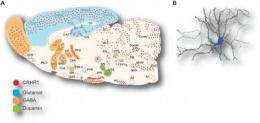
A) A schematic cross-section of a mouse brain showing the distribution of CRHR1 gene activity and the associated neurotransmitter specificity. B) A glutamatergic neuron of the hippocampus. Credit: MPI of Psychiatry
When healthy people are faced with threatening situations, they react with a suitable behavioural response and do not descend into a state of either panic or indifference, as is the case, for example, with patients who suffer from anxiety. With the help of genetic studies on mice, scientists from the Max Planck Institute of Psychiatry have discovered two opposing neuronal regulatory circuits for the generation and elimination of fear. Both are controlled by the stress-inducing messenger substance corticotropin-releasing hormone (CRH) and its type 1 receptor (CRHR1). The availability of these factors in neurons that release glutamate in brain areas of the limbic system activates a neuronal network which causes anxiety behaviour. Conversely, in dopamine-releasing neurons in the mid-brain, these factors give rise to behaviour that reduces fear. Because disorders of the stress factors may be observed in many patients with affective illnesses, the scientists suspect that the pathological alteration of the CRHR1-dependent regulatory circuits may be at the root of such emotional maladies.
An organism's response to stress is one of the key strategies essential to its survival in dealing with environmental factors. A balanced emotional reaction is of particular importance here and is subject to a highly complex molecular regulation system. Corticotropin-releasing hormone (CRH), which is released in the brain and places the organism in a state of alert, is a central molecular factor of the stress response. In addition to its effect as a hormonal messenger substance, it also controls the activity of neurons through binding to its receptors.
Many patients with anxiety disorders and depression display an altered hormonal stress response and have increased volumes of CRH in the brain. To investigate the underlying pathological processes, the research team working with Jan Deussing at the Max Planck Institute of Psychiatry carried out studies on the mouse model system. This enabled them to selectively deactivate an important factor, for example the CRH type 1 receptor, in certain cells, and thus establish the locations where the receptor is normally active and identify its function.
Using immunohistochemical methods and a series of transgenic mouse lines, the researchers succeeded in mapping the gene activity of the type 1 CRH receptor in the mouse brain in detail for the first time. Interestingly, a specific activity pattern emerged in different neuron groups which release different neuronal messenger substances. In regions of the forebrain (cortex, hippocampus, thalamus, septum), CRHR1 is detectable in glutamatergic and GABAergic neurons. As the limbic system, these regions are linked and, as the current study shows, trigger fear-inducing behaviour in glutamatergic neurons.
In regions of the midbrain (substantia nigra, ventral tegmental area), CRHR1 arises in dopamine-releasing neurons. The functional examination of the mice gave rise to the fairly sensational discovery that the stress hormone CRH actually reduces fear through its receptors in this part of the brain. These neurons demonstrably trigger the direct release of dopamine in regions of the forebrain and hence cause behaviour that overcomes fear.
The opposing effects of the fear-generating and fear-eliminating effect of the CRH/CRHR1 was demonstrated for the first time by this study and prompted the re-evaluation of the use of CRH-receptor antagonists as anxiolytic and antidepressant drugs. The authors speculate that the over-activity of the CRH system in patients with mood disorders is not general but probably limited to certain regulatory circuits in the brain, thus causing imbalanced emotional behaviour. "The use of CRH-receptor 1 antagonists could be particularly useful in patients in who one of these systems is out of sync," says research group leader Jan Deussing.
More information: Glutamatergic and Dopaminergic Neurons Mediate Anxiogenic and Anxiolytic Effects of CRHR1, by Damian Refojo et al., Science Express, online September 1, 2011. DOI: 10.1126/science.1202107
Provided by
Max-Planck-Gesellschaft
-
Gene protects adults abused as children from depression
Feb 04, 2008 |
not rated yet |
0
-
New insights into the neural basis of anxiety
Jun 03, 2007 |
not rated yet |
0
-
A mother's touch: Study shows maternal stimuli can improve cognitive function, stress resilience
May 04, 2010 |
not rated yet |
0
-
Freeze or run? Not that simple: Scientists discover neural switch that controls fear
Aug 25, 2010 |
not rated yet |
0
-
Scientists find hormone activity explains adolescent mood swings
Mar 11, 2007 |
not rated yet |
0
-
Motion perception revisited: High Phi effect challenges established motion perception assumptions
Apr 23, 2013 |
3 / 5 (2) |
2
-
Anything you can do I can do better: Neuromolecular foundations of the superiority illusion (Update)
Apr 02, 2013 |
4.5 / 5 (11) |
5
-
The visual system as economist: Neural resource allocation in visual adaptation
Mar 30, 2013 |
5 / 5 (2) |
9
-
Separate lives: Neuronal and organismal lifespans decoupled
Mar 27, 2013 |
4.9 / 5 (8) |
0
-
Sizing things up: The evolutionary neurobiology of scale invariance
Feb 28, 2013 |
4.8 / 5 (10) |
14
-
Pressure-volume curve: Elastic Recoil Pressure don't make sense
May 18, 2013
-
If you became brain-dead, would you want them to pull the plug?
May 17, 2013
-
MRI bill question
May 15, 2013
-
Ratio of Hydrogen of Oxygen in Dessicated Animal Protein
May 13, 2013
-
Alcohol and acetaminophen
May 13, 2013
-
Marie Curie's leukemia
May 13, 2013
- More from Physics Forums - Medical Sciences
More news stories
Leading researchers report on the elusive search for biomarkers in Huntington's disease
While Huntington's disease (HD) is currently incurable, the HD research community anticipates that new disease-modifying therapies in development may slow or minimize disease progression. The success of HD research depends ...
Neuroscience
2 hours ago |
not rated yet |
0
Study shows premature birth interrupts vital brain development processes leading to reduced cognitive abilities
Researchers from King's College London have for the first time used a novel form of MRI to identify crucial developmental processes in the brain that are vulnerable to the effects of premature birth. This new study, published ...
Neuroscience
5 hours ago |
not rated yet |
0
|
Researchers find far-reaching, microvascular damage in uninjured side of brain after stroke
While the effects of acute stroke have been widely studied, brain damage during the subacute phase of stroke has been a neglected area of research. Now, a new study by the University of South Florida reports that within a ...
Neuroscience
7 hours ago |
not rated yet |
0
|
Neurons that can multitask greatly enhance the brain's computational power, study finds
Over the past few decades, neuroscientists have made much progress in mapping the brain by deciphering the functions of individual neurons that perform very specific tasks, such as recognizing the location ...
Neuroscience
10 hours ago |
4.9 / 5 (7) |
0
|
For combat veterans suffering from post-traumatic stress disorder, 'fear circuitry' in the brain never rests
Chronic trauma can inflict lasting damage to brain regions associated with fear and anxiety. Previous imaging studies of people with post-traumatic stress disorder, or PTSD, have shown that these brain regions can over-or ...
Neuroscience
May 18, 2013 |
5 / 5 (1) |
0
|
The compound in the Mediterranean diet that makes cancer cells 'mortal'
New research suggests that a compound abundant in the Mediterranean diet takes away cancer cells' "superpower" to escape death. By altering a very specific step in gene regulation, this compound essentially re-educates cancer ...
New immune system discovered
(Medical Xpress)—A research team, led by Jeremy Barr, a biology post-doctoral fellow, unveils a new immune system that protects humans and animals from infection.
Practice makes perfect? Not so much
Turns out, that old "practice makes perfect" adage may be overblown. New research led by Michigan State University's Zach Hambrick finds that a copious amount of practice is not enough to explain why people ...
Older prostate cancer patients should think twice before undergoing treatment
Older prostate cancer patients with other underlying health conditions should think twice before committing to surgery or radiation therapy for their cancer, according to a multicenter study led by researchers in the UCLA ...
New test better detects elephantiasis worm infection
A new diagnostic test for a worm infection that can lead to severe enlargement and deformities of the legs and genitals is far more sensitive than the currently used test, according to results of a field ...
Scientists identify molecular trigger for Alzheimer's disease
Researchers have pinpointed a catalytic trigger for the onset of Alzheimer's disease – when the fundamental structure of a protein molecule changes to cause a chain reaction that leads to the death of neurons ...