Breast cancer risk drops when diet includes walnuts, researchers find
September 1, 2011 in Cancer
Breast cancer risk drops when diet includes walnuts, Marshall researchers find

Enlarge

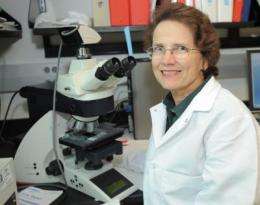
Dr. Elaine Hardman of Marshall University led a recent study that showed the risk of breast cancer dropped significantly in mice when their regular diet included a modest amount of walnut. Credit: Photo by Rick Haye/Marshall University.

The risk of breast cancer dropped significantly in mice when their regular diet included a modest amount of walnut, Marshall University researchers report in the journal Nutrition and Cancer.

The study, led by Elaine Hardman, Ph.D., of Marshall's Joan C. Edwards School of Medicine, compared the effects of a typical and a diet containing walnuts across the lifespan: through the mother from conception through weaning, and then through eating the food directly. The amount of walnut in the test diet equates to about 2 ounces a day for humans.

Hardman said that during the study period, the group whose diet included walnut at both stages developed at less than half the rate of the group with the typical diet. In addition, the number of tumors and their sizes were significantly smaller.

"These reductions are particularly important when you consider that the mice were genetically programmed to develop cancer at a high rate," Hardman said. "We were able to reduce the risk for cancer even in the presence of a preexisting genetic mutation."

The paper notes that dietary modification studies do not show whether benefits result from what is added to a diet or what is removed.

In this case, adding healthy fat and other components meant that unhealthy fat was reduced to keep total dietary fat balanced in the mice.

Hardman said other studies have clearly shown, however, that multiple ingredients in reduce the risk of cancer or slow its growth.

Using , the Marshall study found that the walnut-containing diet changed the activity of multiple genes that are relevant to breast cancer in both mice and humans. Other testing showed that increases in did not fully account for the anti-cancer effect, and found that decreased when dietary vitamin E increased.

Hardman said the findings highlight the vital role diet plays in health.

"Food is important medicine in our diet," she said. "What we put into our bodies makes a big difference – it determines how the body functions, our reaction to illness and health. The simple stuff really works: eat right, get off the couch, and turn off the TV.

"The results of this study indicate that increased consumption of walnut could be part of a healthy diet and reduce risk for cancer in future generations," she said.

Provided by Marshall University Research Corporation

5 /5 (1 vote)  

Rank 5 /5 (1 vote)
Related Stories
Relevant PhysicsForums posts
  • A question about drug tolerance
    createdMay 23, 2012
  • Poor nutrition leading to overeating?
    createdMay 23, 2012
  • Math and dyslexia?
    createdMay 21, 2012
  • portable metabolism meter?
    createdMay 21, 2012
  • Rare medical conditions on 20/20 tonight
    createdMay 18, 2012
  • "Good" Cholesterol in Doubt
    createdMay 17, 2012
  • More from Physics Forums - Medical Sciences

More news stories

Skp2 activates cancer-promoting, glucose-processing Akt

HER2 and its epidermal growth factor receptor cousins mobilize a specialized protein to activate a major player in cancer development and sugar metabolism, scientists report in the May 25 issue of Cell.

Cancer created 12 hours ago | popularity not rated yet | comments 0 | with audio podcast

Pancreatectomy OK without downstaging from therapy

(HealthDay) -- Pancreatectomy improves median survival in pancreatic cancer patients even when presurgical neoadjuvant therapy does not lead to radiographic downstaging of tumors, according to a study published ...

Cancer created 13 hours ago | popularity not rated yet | comments 0

Common therapies for basal cell carcinoma offer similar survival

(HealthDay) -- For patients with superficial basal cell carcinoma (sBCC), treatment with imiquimod or photodynamic therapy (PDT) results in similar long-term tumor-free survival, according to a review published ...

Cancer created 14 hours ago | popularity not rated yet | comments 0

Cancer may require simpler genetic mutations than previously thought

Chromosomal deletions in DNA often involve just one of two gene copies inherited from either parent. But scientists haven't known how a deletion in one gene from one parent, called a "hemizygous" deletion, can contribute ...

Cancer created 16 hours ago | popularity not rated yet | comments 0 | with audio podcast

New prostate cancer screening guidelines face a tough sell, study suggests

(Medical Xpress) -- Recent recommendations from the U.S. Preventive Services Task Force (USPSTF) advising elimination of routine prostate-specific antigen (PSA) screening for prostate cancer in healthy men are likely to encounter ...

Cancer created 19 hours ago | popularity not rated yet | comments 1


Of mice and mental models: Neuroscientific implications of risk-optimized behavior in the mouse

(Medical Xpress) -- Regardless of an organism’s biological complexity, every encephalized animal continuously makes under-informed behavioral choices that can have serious consequences. Despite its ubiquity, ...

Tongue analysis software uses ancient Chinese medicine to warn of disease

For 5,000 years, the Chinese have used a system of medicine based on the flow and balance of positive and negative energies in the body. In this system, the appearance of the tongue is one of the measures used to classify ...

Inherited DNA change explains overactive leukemia gene

A small inherited change in DNA is largely responsible for overactivating a gene linked to poor treatment response in people with acute leukemia.

Early physical therapist treatment associated with reduced risk of healthcare utilization and reduced overall healthcare

A new study published in Spine shows that early treatment by a physical therapist for low back pain (LBP), as compared to delayed treatment, was associated with reduced risk of subsequent healthcare utilization and lower ...

New device allows pacemaker patients to safely undergo MRIs

For many, it's a medical conundrum: The very pacemaker keeping their heart in rhythm prevents them from undergoing an MRI to diagnose other ailments, because interaction between the two devices could prove deadly.

First study to suggest that the immune system may protect against Alzheimer's changes in humans

Recent work in mice suggested that the immune system is involved in removing beta-amyloid, the main Alzheimer's-causing substance in the brain. Researchers have now shown for the first time that this may apply in humans.