Estrogen treatment may help reverse severe pulmonary hypertension
UCLA researchers have found that the hormone estrogen may help reverse advanced pulmonary hypertension, a rare and serious condition that affects 2 to 3 million individuals in the U.S., mostly women, and can lead to heart failure.
The condition causes a progressive increase in blood pressure in the main pulmonary artery, which originates in the heart's right ventricle and delivers blood to the lungs. The rise in pressure impairs heart function by enlarging the right ventricle, potentially leading to heart failure.
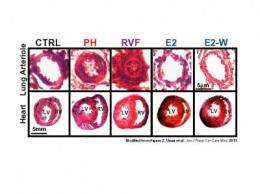
Published in the Sept. 15 issue of the American Journal of Respiratory and Critical Care Medicine, the preclinical study shows that in rats, estrogen treatment can reverse the progression of pulmonary hypertension to heart failure and can restore lung and ventricle structure and function.
The disease progresses slowly, so most patients don't seek treatment until major symptoms occur, such as shortness of breath, dizziness and fainting. According to researchers, current medication for pulmonary hypertension only temporarily reduces the disease's severity. For advanced pulmonary hypertension, there are fewer options, and the condition often necessitates a lung transplant.
"Unfortunately, up until now, there hasn't been an ideal pharmacological therapy to treat advanced pulmonary hypertension," said senior study author Mansoureh Eghbali, Ph.D., an assistant professor of anesthesiology at the David Geffen School of Medicine at UCLA who has a strong background in studying the role of gender and estrogen in cardiovascular diseases. "We hope that this early study may offer insight into new therapies."
The UCLA team found that by treating rats with severe pulmonary hypertension with low doses of estrogen, they were able to prevent the disease from progressing to right-ventricular heart failure; this did not happen in untreated rats.
Systolic blood pressure and ejection fraction — the volume of blood being pumped out of the heart's right chamber with each heart beat — also improved. Tests showed that lung weight, which can increase with the disease and resulting heart-ventricle enlargement, was also corrected. After 10 days of estrogen treatment, function returned to an almost normal state.
The researchers stopped the estrogen therapy after 10 days but continued to observe some of the treated rats. They tracked the continued improvement and found almost full restoration of systolic blood pressure and ejection fraction to normal levels after an additional 12 days.
"We were surprised to find this continued benefit, even after we stopped the estrogen treatment," said the study's first author, Dr. Soban Umar, a UCLA Department of Anesthesiology researcher who has studied pulmonary hypertension and right-ventricular heart failure and is a key member of Eghbali's laboratory team. "These findings suggest that even short-term estrogen therapy may suffice to reverse the disease."
All rats with severe pulmonary hypertension that were treated with estrogen survived by the study's end. Only 25 percent of the untreated rats survived.
The team also explored how estrogen could work in reversing the disease by studying several cellular and molecular mechanisms.
They found that the number of inflammatory cells in rats with pulmonary hypertension increased five-fold, compared with normal rats. In the animals treated with estrogen, this was reversed to normal. The team found that estrogen reduced regulation of a pro-inflammatory gene that also plays a key role in disease development caused by pulmonary hypertension. They also found that estrogen had an inhibitory effect on lung fibrosis.
In addition, the team observed that estrogen therapy restored blood vessels in the lungs and right ventricle whose loss is associated with the disease.
Further study identified that estrogen exerts its biological effects on pulmonary hypertension through a receptor called estrogen receptor beta, a protein that regulates estrogen's activity in the body.
"Estrogen appears to work through an interplay of several factors, including suppression of lung inflammation and fibrosis, as well as reversal of ventricle enlargement," Eghbali said. "We may be able to utilize estrogen receptor beta in the development of future therapies to stimulate estrogen activity to treat pulmonary hypertension."
Researchers had also tested estrogen receptor alpha, the other receptor that controls estrogen activity, but found that it wasn't as effective in treating pulmonary hypertension.
Eghbali added that estrogen receptor beta may prove to be a favorable therapeutic target, since this receptor may require only a short treatment duration and low dosage and has less pro-estrogenic effects on the breasts and uterus than estrogen receptor alpha.
Pulmonary hypertension affects mostly younger women, despite the fact that females in this age group should be under the protective benefits of natural estrogen produced by the body, Eghbali said.
"These patients may have a genetic mutation that is interfering in how estrogen receptor beta directs estrogen activity that is leading to pulmonary hypertension," she said.
Her team's next step is to explore these genetic questions. Currently, Umar and Eghbali are collaborating with UCLA pulmonary hypertension physicians to investigate gender-related issues and to define the role of estrogen in patients with this deadly disease.


