Study puts a new spin on ibuprofen's actions
September 25, 2011 in Medical research
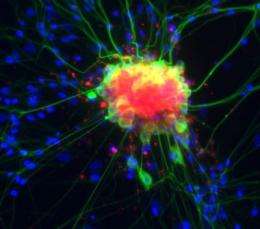
Neurons (green) and glial cells from isolated dorsal root ganglia express COX-2 (red) after exposure to an inflammatory stimulus (cell nuclei are blue). Lawrence Marnett and colleagues have demonstrated that certain drugs selectively block COX-2 metabolism of endocannabinoids -- naturally occurring analgesic molecules -- in stimulated dorsal root ganglia. Credit: Lawrence Marnett and colleagues and Nature Chemical Biology
Ibuprofen, naproxen, and related non-steroidal anti-inflammatory drugs (NSAIDs) the subjects of years of study still have some secrets to reveal about how they work.
Vanderbilt University investigators have discovered surprising new insights into the actions of NSAIDs. Their findings, reported Sept. 25 in Nature Chemical Biology, raise the possibility of developing a new class of inflammation- and pain-fighting medicines.
NSAIDs block the activity of the cyclooxygenase enzymes, COX-1 and COX-2.
"Until about three years ago, we thought we knew everything there was to know about these enzymes and these inhibitors, but we were unaware of some of the details of how they work," said Lawrence Marnett, Ph.D., director of the Vanderbilt Institute of Chemical Biology and professor of Biochemistry, Chemistry and Pharmacology.
COX-1 and COX-2 oxygenate (add oxygen to) the lipid arachidonic acid to generate biologically active prostaglandins. Marnett and his team discovered about 10 years ago that COX-2 (but not COX-1) also oxygenates endocannabinoids naturally occurring analgesic and anti-inflammatory agents that activate cannabinoid receptors (the same receptors that marijuana activates).
The investigators then made a puzzling observation. They found that ibuprofen was a more potent inhibitor of endocannabinoid metabolism compared to arachidonic acid metabolism.
"This was the same drug inhibiting two substrates of the same protein differently," Marnett said. "We didn't understand it."
In the current report, the researchers surveyed a series of different types of NSAIDs for inhibition of COX-2. They included the "mirror-image" versions of ibuprofen, naproxen and flurbiprofen (these drugs come in two different chemical configurations a "right hand" (R) version and a "left hand" (S) version over-the-counter ibuprofen is a mixture of both forms). It had previously been assumed that only the S-forms of these NSAIDs (S-profens) were able to inhibit COX-2.
Marnett and colleagues found that the R-profens inhibited endocannabinoid, but not arachidonic acid, oxygenation.
The researchers also determined that R-profens selectively block endocannabinoid metabolism in isolated dorsal root ganglia (neurons and glial cells from the spinal column). They found that treatment of these cultures with an inflammatory stimulus increased expression of COX-2 and stimulated release of arachidonic acid and endocannabinoids, which were oxidized by COX-2. The R-profens inhibited metabolism of the endocannabinoids (and increased their concentrations), but not arachidonic acid.
The findings offer a potential explanation for the reported observation that R-flurbiprofen is analgesic in people and that it inhibits neuropathic pain in a mouse model.
"We're proposing that R-flurbiprofen is effective in this neuropathic pain setting because it is preventing the metabolism of endocannabinoids by COX-2; so it's maintaining endocannabinoid tone and that's the basis for the analgesic activity," Marnett said.
"It's exciting because you will only see this effect at sites of inflammation where COX-2 might play a role in depleting endocannabinoids. Selective inhibitors like the R-profens could represent a new way to target analgesia without having the GI, and maybe cardiovascular, side effects of traditional NSAIDs."
Marnett and his team will pursue this idea by studying in vivo models of neuroinflammation to determine if these drugs and new compounds they are developing work to inhibit endocannabinoid oxidation and maintain endocannabinoid tone.
Provided by
Vanderbilt University Medical Center
-
Ibuprofen puts high risk cardiac patients at risk
Apr 05, 2007 |
not rated yet |
0
-
Fluorescent compounds make tumors glow
Apr 29, 2010 |
not rated yet |
0
-
Common painkillers linked to irregular heart rhythm: study
Jul 04, 2011 |
not rated yet |
0
-
Licorice compound offers new cancer prevention strategy
Mar 23, 2009 |
not rated yet |
0
-
Common painkillers linked to increased risk of heart problems
Jan 11, 2011 |
not rated yet |
0
-
Motion perception revisited: High Phi effect challenges established motion perception assumptions
Apr 23, 2013 |
3 / 5 (2) |
2
-
Anything you can do I can do better: Neuromolecular foundations of the superiority illusion (Update)
Apr 02, 2013 |
4.5 / 5 (11) |
5
-
The visual system as economist: Neural resource allocation in visual adaptation
Mar 30, 2013 |
5 / 5 (2) |
9
-
Separate lives: Neuronal and organismal lifespans decoupled
Mar 27, 2013 |
4.9 / 5 (8) |
0
-
Sizing things up: The evolutionary neurobiology of scale invariance
Feb 28, 2013 |
4.8 / 5 (10) |
14
-
How can there be villous adenoma in colon, if there are no villi there
5 hours ago
-
How can there be a term called "intestinal metaplasia" of stomach
May 21, 2013
-
Pressure-volume curve: Elastic Recoil Pressure don't make sense
May 18, 2013
-
If you became brain-dead, would you want them to pull the plug?
May 17, 2013
-
MRI bill question
May 15, 2013
-
Ratio of Hydrogen of Oxygen in Dessicated Animal Protein
May 13, 2013
- More from Physics Forums - Medical Sciences
More news stories
Research shows how immune system peacefully co-exists with 'good' bacteria
The human gut is loaded with commensal bacteria – "good" microbes that, among other functions, help the body digest food. The gastrointestinal tract contains literally trillions of such cells, and yet the ...
Medical research
3 minutes ago |
not rated yet |
0
|
Slowing the aging process—only with antibiotics
Swiss scientists reveal the mechanism responsible for aging hidden deep within mitochondria—and dramatically slow it down in worms by administering antibiotics to the young.
Medical research
6 minutes ago |
not rated yet |
0
|
How healthy are you for your age?
On May 22, JoVE will publish details of a technique to measure the health of human genetic material in relation to a patient's age. The method is demonstrated by the laboratory of Dr. Gil Atzmon at New York's Albert Einste ...
Medical research
3 hours ago |
not rated yet |
0
A molecular explanation for age-related fertility decline in women
(Medical Xpress)—Scientists supported by the National Institutes of Health have a new theory as to why a woman's fertility declines after her mid-30s. They also suggest an approach that might help slow ...
Medical research
4 hours ago |
not rated yet |
0
|
Medical researchers discover new ways to target, develop and design drugs to prevent and treat viral infection
Researchers at the University of Alberta have discovered a new drug target, developed a new drug and identified a new way to design drugs—all of which could be a winning combination in the battle against viruses.
Medical research
5 hours ago |
4 / 5 (1) |
0
|
Researchers complete largest genetic sequencing study of human disease
Researchers from Queen Mary, University of London have led the largest sequencing study of human disease to date, investigating the genetic basis of six autoimmune diseases.
Taming suspect gene reverses schizophrenia-like abnormalities in mice
Scientists have reversed behavioral and brain abnormalities in adult mice that resemble some features of schizophrenia by restoring normal expression to a suspect gene that is over-expressed in humans with ...
Scientists uncover molecular roots of cocaine addiction in the brain
Researchers at Johns Hopkins have unraveled the molecular foundations of cocaine's effects on the brain, and identified a compound that blocks cravings for the drug in cocaine-addicted mice. The compound, already proven safe ...
Acne treatment: Natural substance-based formula is more effective than artificial compounds
University of Granada scientists have patented a new treatment for acne that is based on completely natural substances and is much more effective than artificial formulas because it does not create resistance ...
Costs to treat stroke in America may double by 2030
Costs to treat stroke are projected to more than double and the number of people having strokes may increase 20 percent by 2030, according to the American Heart Association/American Stroke Association.
Study finds new pneumococcal vaccine appears to be as safe as previously used vaccine
The new 13-valent pneumococcal conjugate vaccine (PCV13) appears to be as safe as the previous version used prior to 2010, the 7-valent pneumococcal conjugate vaccine (PCV7), according to a Kaiser Permanente study published ...