Men and women fight infection differently, study suggests
September 21, 2011 in Medical research
Men and women fight infection differently, study suggests

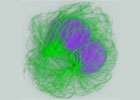
A macrophage, showing the nucleus in blue and the microtubules in green. Credit: MRC NIMR, Wellcome Images.

Female mammals are better prepared to fight infections and their bodies suffer less collateral damage when an infection does hit, according to a new study part-funded by the Wellcome Trust.

Researchers from Queen Mary, University of London, who conducted the study, believe that their results give a biological explanation to the widely observed 'man flu' phenomenon. The study, published in the journal 'Blood', focuses on , called leukocytes, which patrol the body guarding against .

The researchers looked at the number of these cells in healthy male and and rats. In females they found that levels were consistently higher: females had twice as many, on average, than males.

In addition, they found that these cells differed between . In females, they were more sensitive to the presence of bacteria and other infectious agents and more efficient at tackling them.

The research also showed that in females, these cells could eliminate infection without the substantial release of chemicals that further stimulate the immune system. This is crucial because the release of these chemicals in humans is responsible for many of the common symptoms of infection such as tiredness and feeling unwell.

Dr Ramona Scotland, who led the research, explained: "Our experiments demonstrate a profound difference in the way females respond to infectious agents compared to males.

"The aggressive elimination of the bacteria, together with a lack of production of the chemicals and cells that make you feel lousy whilst fighting infections, results in milder symptoms in and faster recovery. And this could explain why, in humans, men also seem to suffer more severe symptoms when they encounter infections.

"What's also important is that our study shows that biological sex-differences outside of the are far bigger than we thought. Sex matters. Women are not merely smaller versions of men. And this has to be taken into consideration in both investigation into and treatment of inflammatory diseases."

More information: Scotland RS et al. Sex-differences in resident immune cell phenotype underlies more efficient acute inflammatory responses in female mice. Blood 2011 (epub ahead of print).

Provided by Wellcome Trust search and more info website

5 /5 (3 votes)  

Filter


Move the slider to adjust rank threshold, so that you can hide some of the comments.


Display comments: newest first

Squirrel
Sep 21, 2011

Rank: not rated yet
The free abstract can be found here
http://bloodjourn...abstract
Rank 5 /5 (3 votes)
Related Stories
Relevant PhysicsForums posts
  • A question about drug tolerance
    createdMay 23, 2012
  • Poor nutrition leading to overeating?
    createdMay 23, 2012
  • Math and dyslexia?
    createdMay 21, 2012
  • portable metabolism meter?
    createdMay 21, 2012
  • Rare medical conditions on 20/20 tonight
    createdMay 18, 2012
  • "Good" Cholesterol in Doubt
    createdMay 17, 2012
  • More from Physics Forums - Medical Sciences

More news stories

Implantable pain disk may help those with cancer

An estimated 3.5 million cancer patients around the globe are in severe pain from their disease, but many get no relief.

Medical research created 18 hours ago | popularity not rated yet | comments 0 | with audio podcast

Energy levels link sleep control mechanisms

Sleep, or lack of it, can determine level of cognitive performance which is linked with accidents as well as increased risk of serious health problems. Links between cell energy levels, gene transcription ...

Medical research created 20 hours ago | popularity not rated yet | comments 0

Researchers identify key brain cell in antidepressant action

(Medical Xpress) -- Antidepressant medications such as Prozac have helped improve mood and lessen anxiety in millions of people with major depression. But scientists know surprisingly little about how these drugs work.

Medical research created 20 hours ago | popularity 4.5 / 5 (2) | comments 0 | with audio podcast

Rockefeller scientists pioneer new method to determine mechanisms of drug action

(Medical Xpress) -- Knowing that a drug works is great. Knowing how it works is a luxury. And until now, determining a drug’s mechanism of action has been a tedious and difficult process for scientists.

Medical research created 21 hours ago | popularity not rated yet | comments 0 | with audio podcast

Like curry? New biological role identified for compound used in ancient medicine

Scientists have just identified a new reason why some curry dishes, made with spices humans have used for thousands of years, might be good for you.

Medical research created May 25, 2012 | popularity 4.4 / 5 (10) | comments 2 | with audio podcast


Of mice and mental models: Neuroscientific implications of risk-optimized behavior in the mouse

(Medical Xpress) -- Regardless of an organism’s biological complexity, every encephalized animal continuously makes under-informed behavioral choices that can have serious consequences. Despite its ubiquity, ...

Tongue analysis software uses ancient Chinese medicine to warn of disease

For 5,000 years, the Chinese have used a system of medicine based on the flow and balance of positive and negative energies in the body. In this system, the appearance of the tongue is one of the measures used to classify ...

Cancer may require simpler genetic mutations than previously thought

Chromosomal deletions in DNA often involve just one of two gene copies inherited from either parent. But scientists haven't known how a deletion in one gene from one parent, called a "hemizygous" deletion, can contribute ...

Inherited DNA change explains overactive leukemia gene

A small inherited change in DNA is largely responsible for overactivating a gene linked to poor treatment response in people with acute leukemia.

Skp2 activates cancer-promoting, glucose-processing Akt

HER2 and its epidermal growth factor receptor cousins mobilize a specialized protein to activate a major player in cancer development and sugar metabolism, scientists report in the May 25 issue of Cell.

Early physical therapist treatment associated with reduced risk of healthcare utilization and reduced overall healthcare

A new study published in Spine shows that early treatment by a physical therapist for low back pain (LBP), as compared to delayed treatment, was associated with reduced risk of subsequent healthcare utilization and lower ...