Mobile phones offer heart lifeline
September 16, 2011 By Pete Wilton in Cardiology
Mobile phones offer heart lifeline

Enlarge

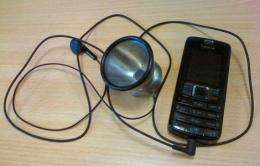
The final prototype: the microphone of a hands-free kit fixed at the base of an egg-cup using blue-tack. A rubber o-ring and a plastic transparency are fixed to the other end to ensure a good seal with the chest.

Technology that turns low-cost mobile phones into sophisticated stethoscopes could save thousands of lives in poor countries.

The kit, developed by Oxford University and South African researchers, enables people to record and analyze their own sounds using a mobile phone .

Patients then send the recordings to medics who can remotely monitor their condition.

The idea came from a conversation between Thomas Brennan of Oxford University’s Department of Engineering Science and Bongani Mayosi of the University of Cape Town about how to reduce the numbers dying of tuberculous pericarditis: a condition affecting up to 2% of TB patients where the lining of the heart becomes infected. 

"About 40% of people die post-diagnosis, largely because the onset of symptoms is insidious and they can't get into the clinic before it's too late and they die of cardiac arrest," Thomas tells me.

"We discussed various ideas of being able to remotely monitor their heart in a low-cost way to pick up early signs of deterioration. The idea of using the phone's microphone as a stethoscope to analyse and record heart sounds came after seeing the iPhone app iStethoscope, and I wondered if we could do something similar using low-cost phones."

As half of all Africans own a the number of patients who could potentially benefit was enormous.

Thomas teamed up with Gari Clifford of Oxford’s Institute for Biomedical Engineering (IBME) who had worked with Katherine Kuan, a student at MIT, on listening technology for smart phones. They extended that work to enable low-cost phones to effectively capture and analyse the resultant phonocardiogram (PCG) recordings to assess the feasibility of the project.

"The original idea was that a person could use their own phone to record their heart sounds," Thomas explains "and that any phone would be able to make an adequate heart sound recording at little or no cost using readily available objects, from which heart rate and abnormal heart sounds could be detected."

Before they could create a device a number of technical challenges had to be overcome: low-cost phones are designed for voice so they had to deal with distortion introduced by the phone, signal processing techniques were needed to identify a poor recording and ask the user to try again, and algorithms had to be developed that could reliably identify heart rate and heart sounds.

"The biggest challenge was in assessing the feasibility of the device," Thomas comments. Between January and April 2011 the team ran a clinical trial, in partnership with Groote Schuur Hospital, Cape Town, to compare two mobiles - a Nokia 3110 Classic and an iPhone 3G - with the £400 3M Littmann Electronic Stethoscope.

They collected phonocardiograms from 150 volunteers with a range of cardiac conditions using the Littmann, the iPhone, and the Nokia 3100 Classic. The trial showed that the Nokia actually out-performed the Littmann in estimating , although it had to discard more low signal quality recordings.

After these promising results the team are pressing ahead with the next stage of the project:

"Alongside a MSc student, David Springer - who worked with me in developing the algorithms - we're developing an Android application to record and process the heart sounds recordings," Thomas tells me.

"The next step is to expand the scope of the device to see if it can be used as a screening tool for patients with heart disease, particularly rheumatic heart disease, which has a particularly high prevalence in southern Africa."

Provided by Oxford University search and more info website

not rated yet  

Filter


Move the slider to adjust rank threshold, so that you can hide some of the comments.


Display comments: newest first

Technology Coast Consulting
Sep 18, 2011

Rank: not rated yet
Hello Pete,
Thank you for a very interesting article. It is encouraging to see mHealth not only transforming patient care within traditional hospital settings, but outside the normal boundaries of healthcare institutions as well.
I am curious about what becomes of the phonocardiogram data once it is captured. In a recent mHealth study we found that captured vital sign data is fed into an enterprise application with pre-established thresholds and alerts. Examples include SAP's E-Care and Independa's Angela. A care giver, healthcare worker or physician is alerted if the monitored vital sign appears outside the normal range. With the mHealth solutions we profiled smartphone and tablet apps, often in conjunction with medical device peripherals, are used as the input devices. I'm curious to know what kind of analysis, if any, is performed on the collected phonocardiograms.
Thank you in advance for the information,
Amy von Kaenel
Technology Coast Consulting
Rank not rated yet
Related Stories
Relevant PhysicsForums posts
  • What capacitors to use in a Tesla coil...?
    created14 hours ago
  • Work done by us on the spring
    created16 hours ago
  • Surface current density
    created18 hours ago
  • Work done on body moving in a circle
    created22 hours ago
  • Crest or Trough?
    created22 hours ago
  • Origin of magnetism
    createdMay 25, 2012
  • More from Physics Forums - Classical Physics

More news stories

One-fifth of healthy middle-aged men have low-grade murmur

(HealthDay) -- More than one-fifth of healthy middle-aged men have a low-grade systolic heart murmur that confers a nearly five-fold higher risk of future aortic valve replacement (AVR), according to a study ...

Cardiology created 16 hours ago | popularity not rated yet | comments 0

New device allows pacemaker patients to safely undergo MRIs

For many, it's a medical conundrum: The very pacemaker keeping their heart in rhythm prevents them from undergoing an MRI to diagnose other ailments, because interaction between the two devices could prove deadly.

Cardiology created 16 hours ago | popularity not rated yet | comments 0 | with audio podcast

New study should end debate over magnesium treatment for preventing poor outcome after haemorrhagic stroke

An international randomised trial and meta-analysis published Online First in The Lancet should put an end to the debate about the use of intravenous magnesium sulphate to prevent poor outcomes after haemorrhagic stroke. The in ...

Cardiology created 22 hours ago | popularity not rated yet | comments 0

Low vitamin D in diet increases stroke risk in Japanese-Americans

Japanese-American men who did not eat foods rich in vitamin D had a higher risk of stroke later in life, according to results of a 34-year study reported in Stroke, an American Heart Association journal.

Cardiology created May 24, 2012 | popularity not rated yet | comments 0

Clot buster seems to help up to 6 hours after stroke

(HealthDay) -- The largest study of its kind finds that stroke patients benefit from a clot-busting drug even six hours after a stroke, suggesting that the current recommended 4.5-hour limit could be expanded.

Cardiology created May 24, 2012 | popularity not rated yet | comments 0


Of mice and mental models: Neuroscientific implications of risk-optimized behavior in the mouse

(Medical Xpress) -- Regardless of an organism’s biological complexity, every encephalized animal continuously makes under-informed behavioral choices that can have serious consequences. Despite its ubiquity, ...

Tongue analysis software uses ancient Chinese medicine to warn of disease

For 5,000 years, the Chinese have used a system of medicine based on the flow and balance of positive and negative energies in the body. In this system, the appearance of the tongue is one of the measures used to classify ...

Cancer may require simpler genetic mutations than previously thought

Chromosomal deletions in DNA often involve just one of two gene copies inherited from either parent. But scientists haven't known how a deletion in one gene from one parent, called a "hemizygous" deletion, can contribute ...

Inherited DNA change explains overactive leukemia gene

A small inherited change in DNA is largely responsible for overactivating a gene linked to poor treatment response in people with acute leukemia.

Skp2 activates cancer-promoting, glucose-processing Akt

HER2 and its epidermal growth factor receptor cousins mobilize a specialized protein to activate a major player in cancer development and sugar metabolism, scientists report in the May 25 issue of Cell.

Early physical therapist treatment associated with reduced risk of healthcare utilization and reduced overall healthcare

A new study published in Spine shows that early treatment by a physical therapist for low back pain (LBP), as compared to delayed treatment, was associated with reduced risk of subsequent healthcare utilization and lower ...