Mold removal in homes, offices could cut respiratory illness
September 9, 2011 By Glenda Fauntleroy in Health
A new evidence review finds that ridding homes and offices of mold and dampness can help reduce respiratory infections and troubling symptoms for asthma sufferers across the globe; however, the best way to eliminate the mold remains unclear.
Mold is one of the most important environmental triggers of symptoms such as coughing and wheezing, according to National Institute of Environmental Health Sciences.
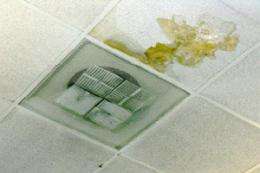
Mold is found in many homes with basements, in apartments and walkouts that are partially or fully below ground, and in buildings that have been flooded or have poor humidity control, said Peter Thorne, head of the occupational and environmental health department at the University of Iowa. Homes and office buildings alike have problems.
But does remediating or relieving homes, offices and schools of dampness and mold make a big difference? Lead reviewer Riitta Sauni at the Finnish Institute of Occupational Health in Tampere, Finland, said that results are mixed.
We were happy to find evidence that remediation of mold-damaged houses decreased the severity and amount of symptoms in patients with asthma and respiratory infections, Sauni said. Unfortunately, we did not find evidence that remeditation could prevent these diseases.
The review appears in the September issue of The Cochrane Library, a publication of The Cochrane Collaboration, an international organization that evaluates research in all aspects of health care. Systematic reviews draw evidence-based conclusions about medical practice after considering both the content and quality of existing trials on a topic.
Remediation of mold and dampness requires total or partial renovation of a building, or cleaning with a fungicide or bleach solution. Sauni and her team looked at eight studies with 6,538 participants who had their homes, schools or workplaces remediated by a mixture of these methods. The reviewers say that because the available studies did not offer high-quality evidence and sample sizes were small, drawing hard conclusions was difficult.
Nonetheless, the review found that when compared to doing nothing at all, repairing houses decreased asthma-related symptoms as well as the amount of respiratory infections in adults. Remediation also decreased the number of acute care visits in children and students visits to physicians for common colds.
In one South Wales study, for instance, 115 members of the group who had their homes remediated with the complete removal of visible mold, a fungicide treatment and installation of a fan, were more likely to see improvement in their respiratory symptoms for six and 12 months afterwards, compared to those in the control group whose homes were not cleaned.
The reviewers, however, could not determine which method of remediation was superior to significantly improving asthma symptoms.
The studies have shown that after cleaning and fungicide treatment, a large number of the buildings were soon re-infected with molds, and also a partially remediated office building had to be repaired more thoroughly, Sauni said, adding that mold removal can be costly.
Sometimes, if the structures are damaged widely, the easiest and most cost-effective possibility is to pull down the damp building and build a new one, she said.
The reviewers concluded that better research is necessary to give evidence of improved outcomes.
More information: Sauni R, et al. Remediating buildings damaged by dampness and mould for preventing or reducing respiratory tract symptoms, infections and asthma. Cochrane Database of Systematic Reviews 2011, Issue 9.
Provided by
Health Behavior News Service
-
Mold linked to asthma
Sep 05, 2007 |
not rated yet |
0
-
Midwest mold count peaks due to extreme heat, storms
Jul 26, 2011 |
not rated yet |
0
-
Mold exposure during infancy increases asthma risk
Aug 02, 2011 |
not rated yet |
0
-
Study: No sign of 'Katrina Cough'
Apr 20, 2006 |
not rated yet |
0
-
Telehealth keeps asthmatics out of hospitals
Oct 06, 2010 |
not rated yet |
0
-
Of mice and mental models: Neuroscientific implications of risk-optimized behavior in the mouse
20 hours ago |
not rated yet |
0
-
Limits to growth: Scientists identify key metastasis-enabling enzyme
May 22, 2012 |
5 / 5 (4) |
0
-
Seeing is as seeing does: Spatially-structured retinal input in early development of cortical maps
Apr 26, 2012 |
5 / 5 (4) |
1
-
Dreamless nights: Brain activity during nonrapid eye movement sleep
Apr 09, 2012 |
4.4 / 5 (12) |
0
-
Take your time: Neurobiology sheds light on the superiority of spaced vs. massed learning
Mar 28, 2012 |
4.5 / 5 (21) |
3
-
Classical and Quantum Mechanics via Lie algebras
Apr 15, 2011
- More from Physics Forums - Independent Research
More news stories
Most occupational injury and illness costs are paid by the government and private payers
UC Davis researchers have found that workers' compensation insurance is not used nearly as much as it should be to cover the nation's multi-billion dollar price tag for workplace illnesses and injuries. Instead, almost 80 ...
Health
11 hours ago |
not rated yet |
0
Early physical therapist treatment associated with reduced risk of healthcare utilization and reduced overall healthcare
A new study published in Spine shows that early treatment by a physical therapist for low back pain (LBP), as compared to delayed treatment, was associated with reduced risk of subsequent healthcare utilization and lower ...
Health
14 hours ago |
not rated yet |
0
|
Cancer patients share web info with docs for insight, advice
(HealthDay) -- Cancer patients' primary goal in talking with their doctors about information they've found on the Internet is to get more insight and advice on the online information, new research indicates.
Health
16 hours ago |
not rated yet |
0
P&G to add latches to make detergent packs safer
(AP) -- Procter & Gamble says it will change the design of packaging for its miniature laundry detergent product to deter children from eating the brightly colored packets that look like candy.
Health
17 hours ago |
not rated yet |
0
In Spain, 70 percent of women use contraceptives during their first sexual encounter
Contraceptive use in Spain during the first sexual encounter is similar to other European countries. However, there are some geographical differences between Spanish regions: women in Murcia use contraceptives ...
Health
18 hours ago |
not rated yet |
0
Of mice and mental models: Neuroscientific implications of risk-optimized behavior in the mouse
(Medical Xpress) -- Regardless of an organism’s biological complexity, every encephalized animal continuously makes under-informed behavioral choices that can have serious consequences. Despite its ubiquity, ...
Tongue analysis software uses ancient Chinese medicine to warn of disease
For 5,000 years, the Chinese have used a system of medicine based on the flow and balance of positive and negative energies in the body. In this system, the appearance of the tongue is one of the measures used to classify ...
Cancer may require simpler genetic mutations than previously thought
Chromosomal deletions in DNA often involve just one of two gene copies inherited from either parent. But scientists haven't known how a deletion in one gene from one parent, called a "hemizygous" deletion, can contribute ...
Inherited DNA change explains overactive leukemia gene
A small inherited change in DNA is largely responsible for overactivating a gene linked to poor treatment response in people with acute leukemia.
Skp2 activates cancer-promoting, glucose-processing Akt
HER2 and its epidermal growth factor receptor cousins mobilize a specialized protein to activate a major player in cancer development and sugar metabolism, scientists report in the May 25 issue of Cell.
New device allows pacemaker patients to safely undergo MRIs
For many, it's a medical conundrum: The very pacemaker keeping their heart in rhythm prevents them from undergoing an MRI to diagnose other ailments, because interaction between the two devices could prove deadly.