How much sleep's enough? Navy wants to know
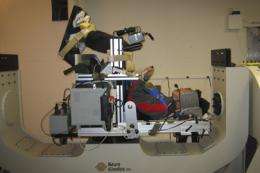
It is unarguable that lack of sleep can affect cognitive and motor performance, but the U.S. Navy wants to know what happens when exposure to motion is also a factor.
Research at the Brandeis Ashton Graybiel Spatial Orientation Laboratory has long covered a wide range of topics such as sensory motor adaptation, motion sickness and the effects of varying force environments on the body, making the lab a hot spot as the Navy is currently developing small combat ships, which require a limited crew that must always be on top of their game. The goal of a recent study for the Navy was to determine how exposure to motion, level of sleep deprivation and the combination of the two factors affect performance in cognitive, sensory and motor domains.
While testing the ability to maintain cognitive vigilance in a laboratory environment is nothing new — including the factor of sleep loss— all of those studies had been performed in stationary laboratories, says Paul DiZio, associate professor of psychology, associate director of the Graybiel Lab and chair of the psychology department. Current fatigue models for predicting performance on small ships have not been tested at sea or under conditions of repetitive whole body motion.
Many other situations where people have to work while fatigued also involve motion, such as driving a truck and flying an airplane, broadening the appeal of the study.
“We all know that motion has some effects on performance,” says DiZio. “You can become disoriented and motion sick, but no one understood how the sleep effects and the motion effects would combine, which was the role of our study.”
Prof. James Lackner and DiZio were the principle investigators; senior research associate and lecturer in psychology Janna Kaplan coordinated subject recruitment and test development and research scientist Joel Ventura acted as head engineer.
Enter Brandeis students, who can, on occasion, be known to pull all-nighters.
Members of the Graybiel Lab recruited 60 student subjects who were paid to either limit their sleep to four hours or lavish in slumber for eight. The subjects participated for 50 consecutive hours in the laboratory, randomly assigned to various combinations of sleep or sleep deprivation, and motion exposure: normal stationary condition or horizontal linear oscillation, which involved being seated in a swing suspended from a high ceiling on four steel posts. The swing moves from left to right instead of fore and aft. The platform remained level and a swinging at fixed frequency so it did not rock.
“Ship motion is a complex motion with left, right, up, down, rocking, and pitching back and forth,” says DiZio. “The left-right motion in previous studies has been shown to be a large component in motion sickness, so it was reasonable to start with this, as the motion environment had to be something that we could quantify in a laboratory, yet also be relevant to ship motion.”
One side of the study looked at the interaction of sleep and motion; the other, using computer-generated images and procedures, looked across a range of functions, including attention, perception, motor control and perceptual learning.
“We also wanted to look at how people perform in a stable environment but when sleep loss affects how you learn a difficult task,” DiZio says.
Researchers determined that sleep deprivation increases both measured sleepiness and motion sickness. Similarly, swing motion increases both sleepiness and motion sickness. Furthermore, the effects from sleep deprivation and motion do not interact, but are magnified as if they were being added together linearly.
Interestingly, the researchers found that the effects of sleep deprivation and motion on cognitive, perceptual and sensory-motor performance variables were not so straightforward: they indicated the importance to note that motion has a significant effect on sleepiness— like rocking a baby— therefore, in the future, a successful model of fatigue in a motion environment would have to take this into account.
“Looking at all these results together, a consistent pattern seemed to emerge,” says DiZio. “The more conscious and cognitive the task, the more likely and the more extensively performance on that task will be degraded by sleep deprivation and motion.”
The perceptual discrimination task, done with computer-generated images, had two parts. The first was fixation and identification of a target letter at a very specific location on the screen. This aspect of the task was not affected by sleep deprivation.
The second part of the task required that subjects direct their attention away from the location being fixated and read information out of a decaying icon before it was masked, while still retaining the identity of the fixation letter in short term memory. This part of the task required substantially more attention and was impacted by both sleep deprivation and motion.
“The motor task that we employed was simple and automatic,” says DiZio. “More complex tasks, like sequence learning or coordinating the head, eyes, torso and arm in a realistic motor paradigm might be severely compromised at very low levels of motion stimulation and sleep loss.”
The research team emphasized that when they speak about whether sleep deprivation or motion had an affect on a particular dependent variable, they are talking specifically about levels that were used in their own study.
“If we had not stopped swinging subjects when their motion sickness rating reached midway or higher, we would have seen a more significant motion affect on all variables,” says DiZio. “More than half of the swinging subjects would not have been able to do any of the tasks in the latter portions of most sessions.”
Researchers feel that this is particularly important to note because the motion exposure that their subjects had was only during the test sessions, whereas sailors on a ship are exposed to motion continuously.
Results also showed that although simple vigilance tasks were not affected by even severe levels of motion sickness, it would be useful to employ a higher level of sleep deprivation and motion exposure, and to test participants in other cognitive tasks that impose a greater cognitive load.
Research results will be submitted for review later this fall to the journal Applied Physiology as well as journals that focus on sleep.


