Researchers study aging's effect on the brain
October 10, 2011 in Neuroscience
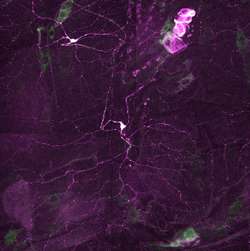
A Drosophila dendrite field in the body wall of the larvae, showing mitochondria - one possible source of oxidative stress - in green. Image, M.Oswald and S. Sweeney
(Medical Xpress) -- Research by biologists at the University of York and Hull York Medical School has revealed important new information about the way the brain is affected by age.
Working with scientists at the Peninsula College of Medicine and Dentistry in Plymouth, they have studied responses to stress in synapses -- neuronal connections.
The researchers discovered that under stressful conditions, such as neuro-degeneration, resulting high energy forms of damaging oxygen cause synapses to grow excessively, potentially contributing to dysfunction.
Such stresses occur during neurodegenerative disease such as Alzheimer's and Parkinson's Disease.
The research, which was funded by the Medical Research Council and the Biotechnology and Biological Sciences Research Council, is published in the latest issue of the Proceedings of the National Academy of Sciences (PNAS).
Laboratory modelling was carried out using Drosophila, but similar pathways are present in humans. The scientists studied the responses using a model of lysosomal storage disease, an inherited incurable childhood neurodegeneration where enlarged synapses have been observed, but the role that growth has in disease progression and brain function is not yet clear.
Co-author Dr Sean Sweeney, of the Department of Biology at the University of York, said: "The findings have strong implications for neuronal function as brains age, and will add significantly to our understanding of neurodegenerative disease such as Alzheimer's and Parkinson's disease."
Co-author Dr Iain Robinson, of the Peninsula College of Medicine and Dentistry, added: "Neuronal contacts in the brain are constantly changing. These changes in the brain enable us to form short term memories such as where we parked the car, or longer term memories, such as what is our pin number for the cash point machine. Our work sheds light on how our brain becomes less able to make these changes in neuronal contacts as we age and helps explain the loss of neuronal contacts seen in several neurodegenerative diseases."
Provided by University of York
-
Researchers develop marker that identifies energy-producing centers in nerve cells
Feb 01, 2007 |
not rated yet |
0
-
Tau disrupts neural communication prior to neurodegeneration
Dec 22, 2010 |
not rated yet |
0
-
QBI neuroscientists make Alzheimer's disease advance
Jun 10, 2008 |
not rated yet |
0
-
New mechanism links cellular stress and brain damage
Dec 08, 2010 |
not rated yet |
0
-
Immune system may target some brain synapses
Dec 13, 2007 |
not rated yet |
0
-
Of mice and mental models: Neuroscientific implications of risk-optimized behavior in the mouse
22 hours ago |
not rated yet |
0
-
Limits to growth: Scientists identify key metastasis-enabling enzyme
May 22, 2012 |
5 / 5 (4) |
0
-
Seeing is as seeing does: Spatially-structured retinal input in early development of cortical maps
Apr 26, 2012 |
5 / 5 (4) |
1
-
Dreamless nights: Brain activity during nonrapid eye movement sleep
Apr 09, 2012 |
4.4 / 5 (12) |
0
-
Take your time: Neurobiology sheds light on the superiority of spaced vs. massed learning
Mar 28, 2012 |
4.5 / 5 (21) |
3
-
A question about drug tolerance
May 23, 2012
-
Poor nutrition leading to overeating?
May 23, 2012
-
Math and dyslexia?
May 21, 2012
-
portable metabolism meter?
May 21, 2012
-
Rare medical conditions on 20/20 tonight
May 18, 2012
-
"Good" Cholesterol in Doubt
May 17, 2012
- More from Physics Forums - Medical Sciences
More news stories
Of mice and mental models: Neuroscientific implications of risk-optimized behavior in the mouse
(Medical Xpress) -- Regardless of an organism’s biological complexity, every encephalized animal continuously makes under-informed behavioral choices that can have serious consequences. Despite its ubiquity, ...
Neuroscience
22 hours ago |
not rated yet |
0
|
Persistent sensory experience is good for aging brain
Despite a long-held scientific belief that much of the wiring of the brain is fixed by the time of adolescence, a new study shows that changes in sensory experience can cause massive rewiring of the brain, even as one ages. ...
Neuroscience
May 24, 2012 |
not rated yet |
0
Boundary stops molecule right where it needs to be
A molecule responsible for the proper formation of a key portion of the nervous system finds its way to the proper place not because it is actively recruited, but instead because it can't go anywhere else.
Neuroscience
May 24, 2012 |
not rated yet |
0
|
Locating ground zero: How the brain's emergency workers find the disaster area
Like emergency workers rushing to a disaster scene, cells called microglia speed to places where the brain has been injured, to contain the damage by 'eating up' any cellular debris and dead or dying neurons. ...
Neuroscience
May 24, 2012 |
5 / 5 (2) |
0
|
Genetic 'reset switch' enables signaling pathway to induce multiple developmental outcomes for olfactory neurons
Within the nervous system, a handful of signaling pathways modulate development of a cornucopia of different neuronal subtypes. Even small alterations in neuron differentiation pathways can disrupt subsequent ...
Neuroscience
May 24, 2012 |
not rated yet |
0
Cancer may require simpler genetic mutations than previously thought
Chromosomal deletions in DNA often involve just one of two gene copies inherited from either parent. But scientists haven't known how a deletion in one gene from one parent, called a "hemizygous" deletion, can contribute ...
Inherited DNA change explains overactive leukemia gene
A small inherited change in DNA is largely responsible for overactivating a gene linked to poor treatment response in people with acute leukemia.
Tongue analysis software uses ancient Chinese medicine to warn of disease
For 5,000 years, the Chinese have used a system of medicine based on the flow and balance of positive and negative energies in the body. In this system, the appearance of the tongue is one of the measures used to classify ...
Skp2 activates cancer-promoting, glucose-processing Akt
HER2 and its epidermal growth factor receptor cousins mobilize a specialized protein to activate a major player in cancer development and sugar metabolism, scientists report in the May 25 issue of Cell.
Early physical therapist treatment associated with reduced risk of healthcare utilization and reduced overall healthcare
A new study published in Spine shows that early treatment by a physical therapist for low back pain (LBP), as compared to delayed treatment, was associated with reduced risk of subsequent healthcare utilization and lower ...
New device allows pacemaker patients to safely undergo MRIs
For many, it's a medical conundrum: The very pacemaker keeping their heart in rhythm prevents them from undergoing an MRI to diagnose other ailments, because interaction between the two devices could prove deadly.