Blood-pressure-lowering drug after stroke aids recovery, study finds
October 21, 2011 in Cardiology
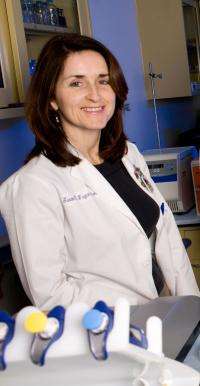
Susan Fagan
A commonly prescribed blood pressure-lowering medication appears to kick start recovery in the unaffected brain hemisphere after a stroke by boosting blood vessel growth, a new University of Georgia study has found.
The discovery, based on a study using rats and published recently in the online journal PLoS ONE, occurred only because the team, led by Susan Fagan, professor of clinical and administrative pharmacy at the UGA College of Pharmacy, struck a new path in stroke research by examining the healthy side of brain after the stroke occurred.
"I'm very excited because I think we can harness the restorative properties of the contralesional hemispherethe other side of the brainwith drug therapies," Fagan said. "When most researchers study stroke they compare the animal's side of the brain that's damaged to the opposite side, assuming that that side is normal or not affected."
For the study, Fagan and her team induced strokes in two groups of male Wistar rats by blocking a major artery in the brain. A third group of placebo, or sham, animals did not experience strokes so that scientists could compare healthy brain hemispheres across all groups. One group received a single dose of saline solution; the other received a dose of the blood pressure drug candesartan. The placebo group received no treatment.
Animals treated with candesartan displayed higher levels of growth factors that aid with the formation of new blood vessels in the brain, a result that confirmed that of earlier studies from the lab. However, the study revealed a previously unobserved phenomenon: Different types of growth factors dominated different hemispheres in the brain, which suggests that candesartan could have healing properties beyond the area of damage.
Doctors and researchers have sought to settle a long-standing debate over whether elevated blood pressure should be lowered in stroke victims. Lowering blood pressure too soon after a stroke could lessen amounts of critical oxygen to the brain. Fagan cited a large clinical trial conducted earlier this year by Scandinavian researchers who concluded that using candesartan to lower blood pressure early after stroke produced no real benefit. In order to bypass the blood pressure debate, Fagan's lab plans to pursue future research with drugs and doses that provide protection to the brain's blood vessels without lowering blood pressure.
The study also found that animals treated with candesartan had increased levels of a "pro-survival" protein in both brain hemispheres. The protein is responsible for helping neurons in the brain survive insultslike a strokeand promote longer life. Fagan said the study contributes to a body of literature that finds new potential for drug therapy.
"We tell patients the reason they go to rehab after they've had a stroke is to retrain and make new connections so that they can get function back. Maybe it's because the other hemisphere takes over," Fagan said. "If we could stimulate that with drug therapy and make it even more so, it would help lots of people."
More information: http://www.plosone … pone.0024551
Provided by
University of Georgia
-
New study could help stroke victims
Apr 24, 2007 |
not rated yet |
0
-
Do-it-yourself brain repair following stroke
Jul 11, 2011 |
not rated yet |
0
-
Antibiotic appears safe for stroke patients and good companion for tPA
Sep 13, 2010 |
not rated yet |
0
-
Old antibiotic may find new life as a stroke treatment
May 19, 2008 |
not rated yet |
0
-
Blood pressure drug telmisartan shows powerful activity against stroke
Dec 12, 2007 |
not rated yet |
0
-
Of mice and mental models: Neuroscientific implications of risk-optimized behavior in the mouse
23 hours ago |
not rated yet |
0
-
Limits to growth: Scientists identify key metastasis-enabling enzyme
May 22, 2012 |
5 / 5 (4) |
0
-
Seeing is as seeing does: Spatially-structured retinal input in early development of cortical maps
Apr 26, 2012 |
5 / 5 (4) |
1
-
Dreamless nights: Brain activity during nonrapid eye movement sleep
Apr 09, 2012 |
4.4 / 5 (12) |
0
-
Take your time: Neurobiology sheds light on the superiority of spaced vs. massed learning
Mar 28, 2012 |
4.5 / 5 (21) |
3
-
What capacitors to use in a Tesla coil...?
17 hours ago
-
Work done by us on the spring
19 hours ago
-
Surface current density
20 hours ago
-
Work done on body moving in a circle
May 25, 2012
-
Crest or Trough?
May 25, 2012
-
Origin of magnetism
May 25, 2012
- More from Physics Forums - Classical Physics
More news stories
One-fifth of healthy middle-aged men have low-grade murmur
(HealthDay) -- More than one-fifth of healthy middle-aged men have a low-grade systolic heart murmur that confers a nearly five-fold higher risk of future aortic valve replacement (AVR), according to a study ...
Cardiology
18 hours ago |
not rated yet |
0
New device allows pacemaker patients to safely undergo MRIs
For many, it's a medical conundrum: The very pacemaker keeping their heart in rhythm prevents them from undergoing an MRI to diagnose other ailments, because interaction between the two devices could prove deadly.
Cardiology
19 hours ago |
not rated yet |
0
|
New study should end debate over magnesium treatment for preventing poor outcome after haemorrhagic stroke
An international randomised trial and meta-analysis published Online First in The Lancet should put an end to the debate about the use of intravenous magnesium sulphate to prevent poor outcomes after haemorrhagic stroke. The in ...
Cardiology
May 25, 2012 |
not rated yet |
0
Low vitamin D in diet increases stroke risk in Japanese-Americans
Japanese-American men who did not eat foods rich in vitamin D had a higher risk of stroke later in life, according to results of a 34-year study reported in Stroke, an American Heart Association journal.
Cardiology
May 24, 2012 |
not rated yet |
0
Clot buster seems to help up to 6 hours after stroke
(HealthDay) -- The largest study of its kind finds that stroke patients benefit from a clot-busting drug even six hours after a stroke, suggesting that the current recommended 4.5-hour limit could be expanded.
Cardiology
May 24, 2012 |
not rated yet |
0
Of mice and mental models: Neuroscientific implications of risk-optimized behavior in the mouse
(Medical Xpress) -- Regardless of an organism’s biological complexity, every encephalized animal continuously makes under-informed behavioral choices that can have serious consequences. Despite its ubiquity, ...
Cancer may require simpler genetic mutations than previously thought
Chromosomal deletions in DNA often involve just one of two gene copies inherited from either parent. But scientists haven't known how a deletion in one gene from one parent, called a "hemizygous" deletion, can contribute ...
Inherited DNA change explains overactive leukemia gene
A small inherited change in DNA is largely responsible for overactivating a gene linked to poor treatment response in people with acute leukemia.
Tongue analysis software uses ancient Chinese medicine to warn of disease
For 5,000 years, the Chinese have used a system of medicine based on the flow and balance of positive and negative energies in the body. In this system, the appearance of the tongue is one of the measures used to classify ...
Skp2 activates cancer-promoting, glucose-processing Akt
HER2 and its epidermal growth factor receptor cousins mobilize a specialized protein to activate a major player in cancer development and sugar metabolism, scientists report in the May 25 issue of Cell.
Early physical therapist treatment associated with reduced risk of healthcare utilization and reduced overall healthcare
A new study published in Spine shows that early treatment by a physical therapist for low back pain (LBP), as compared to delayed treatment, was associated with reduced risk of subsequent healthcare utilization and lower ...