The brain on drugs: Defining the neural anatomy and physiology of morphine on dopamine neurons
October 4, 2011
by Stuart Mason Dambrot
in Neuroscience
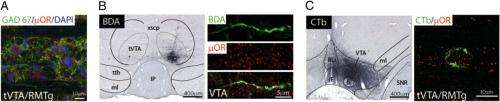
tVTA/RMTg efferents in the VTA express μORs. (A) Microphotographs illustrating the GAD67 and μOR double labeling in the tVTA/RMTg at a cellular level. GAD67, glutamic acid decarboxylase 67 kDa. (B) Following BDA injection into tVTA/RMTg (Left), μORs were detected within anterogradely labeled axons in the VTA (Right). (C) Following CTb injection into VTA (Left), μORs were observed in retrogradely labeled cell bodies in the tVTA/RMTg (Right). fr, fasciculus retroflexus; IF, interfascicular nucleus; ml, medial lemniscus; RLi, rostral linear nucleus of the raphe; tth, trigeminothalamic tract; xscp, superior cerebellar peduncle decussation. (c) PNAS, doi:10.1073/pnas.1105418108
(Medical Xpress) -- Morphine's analgesic properties are as potent as its addictive potential are problematic. The neural pathway for that addiction is typically associated with dopamine (DA) neurons of the ventral tegmental area (VTA), despite the fact that the specific neuronal mechanisms involved are not well articulated. Recently, however, research conducted at the Université de Bordeaux and Université de Strasbourg in France found that morphine increases the firing of dopamine neurons by activating μ opioid receptor (μOR) receptors on the rostromedial tegmental nucleus (the VTA's GABAergic tail) and that there is no morphine-induced activation of dopamine neurons in the absence of tonic VTA glutamatergic modulation.
The lead researcher, Marion Jalabert, Dr François Georges, and the multidisciplinary research team used in vivo electrophysiology, tract-tracing experiments, and targeted neuronal inactivation to successfully capture morphine activity in dopaminergic rat neurons. The project was made possible by collaboration between two groups with their own domain of expertise in vivo electrophysiology by Georges team in Bordeaux and neuroanatomy by Michel Barrots group in Strasbourg.
The main challenge they faced, notes Georges, was to work in an intact in vivo preparation in order to dissect the neuronal circuit responsible for the excitatory effect of morphine on dopamine neurons. To test our hypothesis that morphine will disrupt the excitatory/inhibitory balance in dopamine neurons we had to pharmacologically disconnect two closely-located brain structures. Another challenge, he continues, was to identify the molecular target of morphine onto the GABAergic tVTA/RMTg terminals innervating the VTA.
To address these challenges, Georges explains, the groups had to develop highly-targeted drug application methods to be able to record in vivo activity of dopamine neurons and at the same time apply drugs in their vicinity something made possible by the use of double-barrel pipette. The key insight, he adds, was to preserve the integrity of the neuronal network.
Georges identifies the next innovation to be developed and applied to the current experimental design as the use of optogenetic approaches to be able to activate or inhibit on demand the population of tVTA/RMTg neurons projecting to the VTA. Moreover, he points out, This optogenetic approach could be coupled to electrophysiological recordings in freely moving animals. This will allow us to evaluate the impact of the context on the excitatory effect of morphine on dopamine neurons.
Another innovative step will be developing virtual models. Based on our findings and the previous in vitro findings obtained in 1992 by Johnson and North, it will be possible and really interesting to elaborate a computational model of the impact of morphine on the regulation of dopamine neuron excitability properties. This in silico approach will help to predict the effect of various drugs of abuse on the dopamine neurons depending on their excitability state.
In terms of substance-dependence prevention and treatment, Georges cites the morphine-induced excitation of dopamine neurons that resulted from simultaneous NMDA/AMPA receptor activation and cessation of GABA receptor activation. Our findings suggest that the intrinsic excitability of VTA-DA neurons may be important for scaling morphine responses. Given that morphine has a high addictive potential in specific contexts, this indicates that the excitatory context of dopamine neurons may tune the addictive potency of morphine.
Our research, Georges stresses, is currently focusing on understanding how the context and the history of the animal that is, exposure to stress or to other drugs of abuse tune in vivo the intrinsic excitability of VTA-DA neurons may be important for scaling morphine responses.
Georges also sees their research having implications for a range of medical applications. Our study, he concludes, provides a better understanding of tVTA/RMTg neurophysiology. The impact of this newly discovered brain area on dopamine neurons may provide new neuroanatomical targets for treatment. This neuronal participates to the etiology of neurological and psychiatric diseases, such as addiction, schizophrenia, mood disorders or Parkinsons disease.
More information: Neuronal circuits underlying acute morphine action on dopamine neurons. Published online before print September 19, 2011, doi: 10.1073/pnas.1105418108, PNAS September 27, 2011 vol. 108 no. 39 16446-16450
Related: Opioids excite dopamine neurons by hyperpolarization of local interneurons. SW Johnson and RA North, The Journal of Neuroscience, 1 February 1992, 12(2): 483-488
Copyright 2011 PhysOrg.com.
All rights reserved. This material may not be published, broadcast, rewritten or redistributed in whole or part without the express written permission of PhysOrg.com.
-
Nicotine and cocaine leave similar mark on brain after first contact
May 03, 2011 |
not rated yet |
0
-
Cocaine-induced synaptic plasticity linked to persistent addictive behaviors
Aug 13, 2008 |
not rated yet |
0
-
Sniffing out Parkinson's
Sep 23, 2011 |
not rated yet |
0
-
Dissecting the machinery of nicotine's reward
Jun 14, 2006 |
not rated yet |
0
-
Phasic firing of dopamine neurons is key to brain's prediction of rewards
Apr 03, 2009 |
not rated yet |
0
-
Motion perception revisited: High Phi effect challenges established motion perception assumptions
Apr 23, 2013 |
3 / 5 (2) |
2
-
Anything you can do I can do better: Neuromolecular foundations of the superiority illusion (Update)
Apr 02, 2013 |
4.5 / 5 (11) |
5
-
The visual system as economist: Neural resource allocation in visual adaptation
Mar 30, 2013 |
5 / 5 (2) |
9
-
Separate lives: Neuronal and organismal lifespans decoupled
Mar 27, 2013 |
4.9 / 5 (8) |
0
-
Sizing things up: The evolutionary neurobiology of scale invariance
Feb 28, 2013 |
4.8 / 5 (10) |
14
-
How can there be a term called "intestinal metaplasia" of stomach
14 hours ago
-
Pressure-volume curve: Elastic Recoil Pressure don't make sense
May 18, 2013
-
If you became brain-dead, would you want them to pull the plug?
May 17, 2013
-
MRI bill question
May 15, 2013
-
Ratio of Hydrogen of Oxygen in Dessicated Animal Protein
May 13, 2013
-
Alcohol and acetaminophen
May 13, 2013
- More from Physics Forums - Medical Sciences
More news stories
Reducing caloric intake delays nerve cell loss
Activating an enzyme known to play a role in the anti-aging benefits of calorie restriction delays the loss of brain cells and preserves cognitive function in mice, according to a study published in the May ...
Neuroscience
4 hours ago |
5 / 5 (3) |
0
|
B vitamins could delay dementia
(Medical Xpress)—Despite spending billions of dollars on research and development, drug companies have been unable to come up with effective treatments for dementia and Alzheimer's Disease (AD). Now, A. ...
Neuroscience
7 hours ago |
4.8 / 5 (6) |
0
|
Waiting for a sign? Researchers find potential brain 'switch' for new behavior
You're standing near an airport luggage carousel and your bag emerges on the conveyor belt, prompting you to spring into action. How does your brain make the shift from passively waiting to taking action when ...
Neuroscience
8 hours ago |
5 / 5 (1) |
0
|
If you can remember it, you can remember it wrong
(Medical Xpress)—Native peoples in regions where cameras are uncommon sometimes react with caution when their picture is taken. The fear that something must have been stolen from them to create the photo ...
Neuroscience
9 hours ago |
4 / 5 (4) |
0
|
Study shows where scene context happens in our brain
In a remote fishing community in Venezuela, a lone fisherman sits on a cliff overlooking the southern Caribbean Sea. This man –– the lookout –– is responsible for directing his comrades on the water, ...
Neuroscience
11 hours ago |
4 / 5 (1) |
0
|
New sleeping pill poised to hit US markets
An experimental sleeping pill from US drug company Merck is effective at helping people fall and stay asleep, according to reviewers at the US Food and Drug Administration, which could soon approve the new drug.
Antidepressant reduces stress-induced heart condition
A drug commonly used to treat depression and anxiety may improve a stress-related heart condition in people with stable coronary heart disease, according to researchers at Duke Medicine.
Insight into the dazzling impact of insulin in cells
Australian scientists have charted the path of insulin action in cells in precise detail like never before. This provides a comprehensive blueprint for understanding what goes wrong in diabetes.
Changing cancer's environment to halt its spread
By studying the roles two proteins, thrombospondin-1 and prosaposin, play in discouraging cancer metastasis, a trans-Atlantic research team has identified a five-amino acid fragment of prosaposin that significantly reduces ...
Drugs found to both prevent and treat Alzheimer's disease in mice
Researchers at USC have found that a class of pharmaceuticals can both prevent and treat Alzheimer's Disease in mice.
Biomarkers discovered for inflammatory bowel disease
Using the Department of Defense Serum Repository (DoDSR), University of Cincinnati (UC) researchers have identified a number of biomarkers for inflammatory bowel disease (IBD), which could help with earlier diagnosis and ...
Oct 13, 2011
Rank: 5 / 5 (1)