IQ can rise or fall significantly during adolescence, brain scans confirm
IQ, the standard measure of intelligence, can increase or fall significantly during our teenage years, according to research funded by the Wellcome Trust, and these changes are associated with changes to the structure of our brains. The findings may have implications for testing and streaming of children during their school years.
Across our lifetime, our intellectual ability is considered to be stable, with Intelligence Quotient (IQ) scores taken at one point in time used to predict educational achievement and employment prospects later in life. However, in a study published today in the journal Nature, researchers at the Wellcome Trust Centre for Neuroimaging at UCL (University College London) and the Centre for Educational Neuroscience show for the first time that in fact our IQ is not constant.
The researchers, led by Professor Cathy Price, tested thirty-three healthy adolescents in 2004 when they were between the ages of 12 and 16 years. They then repeated the tests four years later when the same subjects were between 15 and 20 years old. On both occasions, the researchers took structural brains scans of the subjects using magnetic resonance imaging (MRI).
Professor Price and colleagues found significant changes in the IQ scores measured in 2008 compared to the 2004 scores. Some subjects had improved their performance relative to people of a similar age by as much as 20 points on the standardised IQ scale; in other cases, however, performance had fallen by a similar amount. In order to test whether these changes were meaningful, the researchers analysed the MRI scans to see if there was a correlation with changes in the structure of the subjects' brains.
"We found a considerable amount of change in how our subjects performed on the IQ tests in 2008 compared to four years earlier," explains Sue Ramsden, first author of the study. "Some subjects performed markedly better but some performed considerably worse. We found a clear correlation between this change in performance and changes in the structure of their brains and so can say with some certainty that these changes in IQ are real."
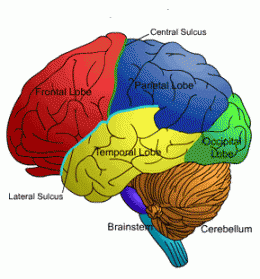
The researchers measured each subject's verbal IQ, which includes measurements of language, arithmetic, general knowledge and memory, and their non-verbal IQ, such as identifying the missing elements of a picture or solving visual puzzles. They found a clear correlation with particular regions of the brain. An increase in verbal IQ score correlated with an increase in the density of grey matter – the nerve cells where the processing takes place – in an area of the left motor cortex of the brain that is activated when articulating speech. Similarly, an increase in non-verbal IQ score correlated with an increase in the density of grey matter in the anterior cerebellum, which is associated with movements of the hand. However, an increase in verbal IQ did not necessarily go hand-in-hand with an increase in non-verbal IQ.
According to Professor Price, a Wellcome Trust Senior Research Fellow, it is not clear why IQ should have changed so much and why some people's performance improved whilst others' decline. It is possible that the differences are due to some of the subjects being early or late developers, but it is equally possible that education played a role in changing IQ, and this has implications for how schoolchildren are assessed.
"We have a tendency to assess children and determine their course of education relatively early in life, but here we have shown that their intelligence is likely to be still developing," says Professor Price. "We have to be careful not to write off poorer performers at an early stage when in fact their IQ may improve significantly given a few more years.
"It's analogous to fitness. A teenager who is athletically fit at 14 could be less fit at 18 if they stopped exercising. Conversely, an unfit teenager can become much fitter with exercise. "
Other studies from the Wellcome Trust Centre for Neuroimaging and other research groups have provided strong evidence that the structure of the brain remains 'plastic' even throughout adult life. For example, Professor Price showed recently that guerrillas in Columbia who had learned to read as adults had a higher density of grey matter in several areas of the left hemisphere of the brain than those who had not learned to read. Professor Eleanor Maguire, also from the Wellcome Trust Centre, showed that part of a brain structure called the hippocampus, which plays an important role in memory and navigation, has greater volume in licensed London taxi drivers.
"The question is, if our brain structure can change throughout our adult lives, can our IQ also change?" adds Professor Price. "My guess is yes. There is plenty of evidence to suggest that our brains can adapt and their structure changes, even in adulthood."
'Understanding the brain' is one of the Wellcome Trust's key strategic challenges. It funds a significant portfolio of neuroscience and mental health research, ranging from studies of molecular and cellular components to work on cognition and higher systems. At the Wellcome Trust Centre for Neuroimaging, clinicians and scientists study higher cognitive function to understand how thought and perception arise from brain activity, and how such processes break down in neurological and psychiatric disease.
"This interesting study highlights how 'plastic' the human brain is," said Dr John Williams, Head of Neuroscience and Mental Health at the Wellcome Trust. "It will be interesting to see whether structural changes as we grow and develop extend beyond IQ to other cognitive functions. This study challenges us to think about these observations and how they may be applied to gain insight into what might happen when individuals succumb to mental health disorders."
More information: Ramsden, S et al. Verbal and nonverbal intelligence changes in the teenage brain. Nature, October 20, 2011. DOI: 10.1038/nature10514


