Mexico tackles epidemic of childhood obesity
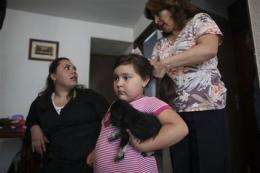
(AP) -- Anghella Torres is just 4 years old, but already she weighs 66 pounds (30 kilos) - twice what she should. Because of her excess girth, her little feet constantly hurt from bearing the extra weight.
Anghella knows she is obese and she doesn't like it. And now, even though she doesn't know how to read or count calories, she is on a diet. With the help of her grandmother and caretaker, Elizabeth Sucilla, Anghella is following a modest diet and exercise program established for her by a nurse at a local public hospital earlier this year.
"I have to stop eating candies," she said.
Her new regimen also requires her to cut down on the deep-fried potato wedges she ate every other day in the streets and spoonfuls of heavy cream she downed like yogurt.
Mexico, which claims to have the fattest children in the world, is trying to encourage others to follow Anghella's lead. Public schools have banned junk food and are requiring more hours of physical education while the federal government has launched a media campaign that invites families to enroll their kids in a public weight-loss program.
Yet three-quarters of Mexico City's 2,400 public schools don't have playgrounds or gyms for exercise. And 80 percent of the schools don't have water fountains. Experts stress the importance of drinking more water and fewer sugary drinks to prevent and reverse weight gain.
President Felipe Calderon said earlier this year that Mexico had the highest rate of obesity for children ages 5 to 19 in the world. And although he did not cite any source, University of North Carolina nutrition professor Barry Popkin, who has studied childhood obesity in many countries, agrees that it "is the highest I know of in the world."
While a large number of children in Mexico's poor, rural villages are still underweight, the country as a whole has seen the second-fastest growth rate for childhood obesity of nine countries examined by Popkin in a 2007 study, including the United States. The fastest growth rate of the nine is in Australia, according to the study, which compares health statistics in the countries over the past two decades.
The problem in Mexico is especially pronounced in the capital, Mexico City, and near the U.S.-Mexico border, according to a study by Mexico's National Institute of Public Health.
Children and teenagers make up Mexico's largest age group, representing 39 percent of the country's 112 million people. More than 28 percent of children between 5 and 9, and 38 percent of preteens and teenagers ages 10 to 19, are overweight or obese, according to statistics from the Mexican Social Security Institute.
In the U.S., the Centers for Disease Control and Prevention says 12.5 million, or 17 percent, of children and adolescents ages 2 to 19 are obese. First lady Michelle Obama has tackled the issue with her "Let's Move" campaign, pushing for better school lunches, more access to fruits and vegetables and more physical activity. And Congress last year passed a new law requiring school lunches to be healthier.
In Brazil, a newly industrialized nation like Mexico, 19 percent of children ages 5 to 9 are overweight, and 15 percent are obese, according to government statistics. Officials did not have statistics available for teenagers.
Mexico's public health institute says the problem lies not just with children: Seventy percent of Mexican adults are overweight or obese as well. Officials have decided to target children and teens first, however, because they are the largest age group and fighting their habits now would prevent large numbers of diabetes cases and other illnesses in the future, the officials said.
"The earlier obesity shows up, the higher the risk the kid will become an obese adult and contract other diseases like diabetes, hypertension," said Leticia Martinez, chief nutritionist for Mexico's public health institute. "We see this as an emergency."
Health officials define obesity as having too much body fat. In Mexico, the U.S. and elsewhere, obesity is determined through BMI, a measure of body fat based on height and weight.
Mexico's childhood obesity spans social classes, though the poor are less informed and equipped to deal with the epidemic.
Starting this year, pre-kindergarten and elementary schools completely banned the sale of soft drinks and junk food and replaced previous breakfast programs with dishes rich in vegetables, such as squash blossoms and carrots. Middle schools are only selling sugar-free drinks, low-calorie snacks and small bags of chips that appear in new food guidelines approved by the departments of health and education.
During recess at the Republica Italiana elementary school, children run out of classrooms and form three lines, each one of which leads to a different food option.
Their choices include a turkey hot dog on a wheat bun with tomatoes and no mayonnaise; "nopales," or edible cactus paddles, with sliced peppers on a corn tortilla; sunflower seeds or a scoop of unsweetened lemon sorbet; and slices of cucumbers and carrots.
Principal Yamile Bobadilla says there's nothing she can do about vendors who still gather outside of the school gates to sell sodas, greasy pizzas and chips.
Some of the children, and even some parents, have complained about the junk food ban, she said, adding, "They see me as the witch."
The country's healthy-weight campaign has other challenges: Officials acknowledge there aren't enough dietitians in the public schools to help all of the children in need. They also note a prevailing cultural notion that a chubby baby is a healthy baby.
"Any efforts to improve the school environment are very important to combat the epidemic," said Chessa Lutter, a regional adviser on food and nutrition for the Pan American Health Organization.
Starting in the 2010-2011 school year, education officials began increasing the number of physical education hours from one to three per week based on their conclusion that some children are obese because they don't exercise. On a recent morning at Republica Italiana, several groups of kids were sent out to the school yard to run, play softball or twirl hula-hoops.
Bobadilla said some children still faint and suffer from extreme fatigue because of their weight problems.
Guillermo Ayala, who leads the food guidelines' task force at the Education Department, also heads an effort to have every child in Mexico City weighed and measured by a team of physical education coaches and nurses. Schools with a high number of children who have gained or not lost weight will face administrative sanctions, he said.
Outside the classroom, government-sponsored TV spots show kids struggling under heavy sacks of grain, symbols of the extra pounds (kilos) many are carrying around with them. The ads invite parents to enroll their children in a government-run program of diet and exercise. About 5.3 million children participate every year, but officials don't keep track of how many of them are overweight.
Anghella's grandmother Sucilla took her to a public hospital in May at the suggestion of the girl's day care providers, who said something would have to be done about the child's diet and exercise before she started school in August.
A nurse at the hospital suggested that Anghella start taking regular walks, drinking a lot of water and eating more whole grains, vegetables and fruits.
She goes often to visit the nurse, who weighs her regularly.
At home, when her small hand tries to reach for a sweet roll on the table, Sucilla slaps it and says, "You know why, my little girl."
Anghella said she doesn't like it when adults say she's fat.
"No, sweetheart. You are cuddly," Sucilla tells her. But she then adds, "I worry because I don't want my little girl to be an obese girl."
©2011 The Associated Press. All rights reserved. This material may not be published, broadcast, rewritten or redistributed.


