Charging toward better neural implants
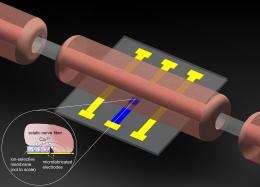
Electrical implants that shut down excessive activity in brain cells hold great potential for treating epilepsy and chronic pain. Likewise, devices that enhance neurons’ activity may help restore function to people with nerve damage.
A new technology developed at MIT and Harvard Medical School may overcome the primary drawback to this approach, known as functional electrical stimulation: When electrical current is applied, it can spread to nearby nerves, causing painful side effects.
Nerves, the long bundles of neuronal extensions that carry instructions to the muscles — as well as sensory information such as pain — communicate via extremely rapid electrical signals. By manipulating the concentration of charged ions surrounding a nerve, the researchers were able to dramatically reduce the current needed to keep an impulse going; they could also interrupt an impulse as it traveled along a nerve.
“Functional electrical stimulation, as an idea, has been around for a long time, but its implementation in our body as a prosthetic is still in its infancy,” says Jongyoon Han, associate professor of electrical engineering and computer science and biological engineering at MIT and a member of MIT’s Research Laboratory of Electronics (RLE). “There are a lot of technological reasons for that, and I think our work is helping to relieve some of those technological bottlenecks.”
Han and his colleagues described the new technology in the Oct. 23 online edition of Nature Materials. Lead author of the paper is Yong-Ak Song, a research scientist in RLE.
Treating damage with electricity
Functional electrical stimulation involves implantation into the body of an electrode that comes into contact with a nerve. When a small current passes through the electrode, it activates the nerve. This approach has been used successfully in cochlear implants, which capture sound waves and transform them into electrical signals that can stimulate the auditory nerves, allowing some deaf people to hear.
Researchers now hope to use a similar strategy to stimulate damaged nerves that signal muscles to contract. “The problem is that the electricity can go everywhere, because our bodies are conductors,” Han says.
This is of particular concern in the face, because the nerves that control facial movements and the sensory nerves that carry pain signals are so close together. Samuel Lin, an assistant professor of surgery at Harvard Medical School and an author of the paper, is a plastic surgeon who sees many patients with facial nerve damage.
Lin, Han, Song and their colleagues set out to find a way to reduce the amount of current needed to stimulate the motor nerves, which would diminish the effect on nearby nerves. To do this, they decided to make it easier to provoke nerve impulses by manipulating the concentration of ions that surround the nerves.
The key to a neuron’s ability to carry an electric current is its negatively charged interior, relative to the fluid surrounding it. It was already known that closing this gap in voltage makes neurons easier to excite, so the MIT team decided to alter the ion concentrations by coating the electrode with a thin layer of an ion-selective membrane. These membranes, commercially available, are like filters for ions: They allow certain ions, such as potassium or calcium, to pass through, but not others.
The researchers achieved their best results with a membrane that removes positively charged calcium ions from the fluid surrounding the nerves. This calcium depletion influences voltage-gated ion channels and reduces membrane resistance, making it easier to activate the neuron when an electric current is applied. Using this technology, the researchers were able to reduce the amount of electrical current needed by about 70 percent, from 7.4 to 2.2 microamperes.
They were also able to stop electrical impulses from traveling along a nerve, using about half of the current previously needed. This could have important applications in shutting off the haywire electrical activity characteristic of epilepsy, and in relieving chronic pain.
This technology could make existing functional electrical stimulation devices more efficient, says Peter Kjäll, project leader of the organic bioelectronics group at the Swedish Medical Nanoscience Center. Though more work is needed to make the implants suitable for human tests, “I’m sure that this technology will form the basis of many future neuroprosthetic devices,” says Kjäll, who was not part of the research team.
This story is republished courtesy of MIT News (web.mit.edu/newsoffice/), a popular site that covers news about MIT research, innovation and teaching.


