More than 1 in 10 parents skip, delay kids' shots
October 3, 2011 By LINDSEY TANNER , AP Medical Writer in Health
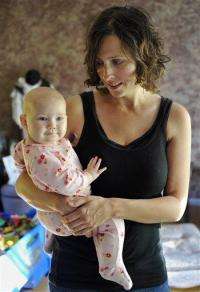
In this Sept. 29, 2011 photo, Kandace O'Neill poses with her 7-month-old daughter, in Lakeville, Minn. O'Neill's views on child vaccinations are shared by many parents who don't follow federal vaccine advice. Her 5-year-old son has had no vaccinations since he turned 1 and the baby girl has received none of the recommended shots. (AP Photo/Jim Mone)
(AP) -- By age 6, children should have vaccinations against 14 diseases, in at least two dozen separate doses, the U.S. government advises. More than 1 in 10 parents reject that, refusing some shots or delaying others mainly because of safety concerns, a national survey found.
Worries about vaccine safety were common even among parents whose kids were fully vaccinated: 1 in 5 among that group said they think delaying shots is safer than the recommended schedule. The results suggest that more than 2 million infants and young children may not be fully protected against preventable diseases, including some that can be deadly or disabling.
The nationally representative online survey of roughly 750 parents of kids age 6 and younger was done last year and results were released online Monday in the journal Pediatrics. They are in line with a larger federal survey released last month, showing that at least 1 in 10 toddlers and preschoolers lagged on vaccines that included chickenpox and the measles-mumps-rubella combination shots. That survey, also for 2010, included more than 17,000 households.
The Pediatrics survey follows other recent news raising concerns among infectious disease specialists, including a study showing the whooping cough vaccine seems to lose much of its effectiveness after just three years - faster than doctors have thought - perhaps contributing to recent major outbreaks, most notably in California. Also, data reported in September show that a record number of kindergartners' parents in California last year used a personal belief exemption to avoid vaccination requirements.
Kandace O'Neill is a Lakeville, Minn., mom whose views are shared by many parents who don't follow federal vaccine advice. Her 5-year-old son has had no vaccinations since he turned 1, and her 7-month-old daughter has received none of the recommended shots.
"I have to make sure that my child is healthy, and I do not want to put medications in my child that I think are going to harm them," said O'Neill, who was not involved in the survey appearing in Pediatrics.
O'Neill said she's not an extreme anti-vaccine zealot. She just thinks that parents - not doctors or schools - should make medical decisions for their children.
Study author Dr. Amanda Dempsey, a pediatrician and researcher at the University of Michigan, said vaccine skepticism is fueled by erroneous information online and media reports that sensationalize misconceptions. These include the persistent belief among some parents about an autism-vaccine link despite scientific evidence to the contrary and the debunking of one of the most publicized studies that first fueled vaccine fears years ago.
Some parents also dismiss the severity of vaccine-preventable diseases because they've never seen a child seriously ill with those illnesses.
But vaccine-preventable diseases including flu and whooping cough can be deadly, especially in infants, said Dr. Buddy Creech, associate director of Vanderbilt University's Vaccine Research Program. Creech has two school-aged children who are fully vaccinated and a newborn he said will be given all the recommended vaccinations.
"From being someone in the trenches seeing children die every year from influenza and its complications ... I would not do a single thing to risk the health of my kids," he said. Creech has served on advisory boards for vaccine makers and has accepted their research money.
Dempsey, the survey's lead author, has been a paid adviser to Merck on issues regarding a vaccine for older children but said that company made no contributions to the survey research.
Knowledge Networks conducted the survey, which had an error margin of plus or minus 5 percentage points.
Dr. Larry Pickering, an infectious disease specialist at the Centers for Disease Control and Prevention, said the new survey is important and well done, and indicates that doctors need to do a better job of communicating vaccine information to patients.
Pickering said he supports the idea of parents being actively involved in medical care for their children, but cautioned: "If they're going to do that, they need to be fully informed about the risks and benefits of vaccines and need to obtain the information from a valid source."
The CDC, the American Academy of Pediatrics and the American Academy of Family Physicians are among groups that provide online vaccine information based on medical research.
More information:
American Academy of Pediatrics: http://www.aap.org
CDC: http://www.cdc.gov
American Academy of Family Physicians: http://www.aafp.org
©2011 The Associated Press. All rights reserved. This material may not be published, broadcast, rewritten or redistributed.
-
Vaccinations are high, but measles shots decline
Sep 16, 2010 |
not rated yet |
0
-
1 in 4 parents believes vaccine-autism link
Mar 01, 2010 |
not rated yet |
0
-
The Medical Minute: A true or false quiz on vaccines
Aug 06, 2009 |
not rated yet |
0
-
Parents trust doctors most when it comes to information about vaccine safety
Apr 01, 2011 |
not rated yet |
0
-
2 swine flu vaccine doses for kids under 10 likely
Oct 14, 2009 |
not rated yet |
0
-
Motion perception revisited: High Phi effect challenges established motion perception assumptions
Apr 23, 2013 |
3 / 5 (2) |
2
-
Anything you can do I can do better: Neuromolecular foundations of the superiority illusion (Update)
Apr 02, 2013 |
4.5 / 5 (11) |
5
-
The visual system as economist: Neural resource allocation in visual adaptation
Mar 30, 2013 |
5 / 5 (2) |
9
-
Separate lives: Neuronal and organismal lifespans decoupled
Mar 27, 2013 |
4.9 / 5 (8) |
0
-
Sizing things up: The evolutionary neurobiology of scale invariance
Feb 28, 2013 |
4.8 / 5 (10) |
14
-
Classical and Quantum Mechanics via Lie algebras
Apr 15, 2011
- More from Physics Forums - Independent Research
More news stories
New research identifies risks, interventions for children's GI health
An increasing number of U.S. children are experiencing gastrointestinal issues that require interventions to resolve, according to research presented at Digestive Disease Week (DDW).
Health
May 18, 2013 |
not rated yet |
0
|
Youth who have their first drink during puberty have higher levels of later drinking
Research shows that the earlier the age at which youth take their first alcoholic drink, the greater the risk of developing alcohol problems. Thus, age at first drink (AFD) is generally considered a powerful predictor of ...
Health
May 17, 2013 |
not rated yet |
0
British MPs concerned about parliamentary boozing
One quarter of British lawmakers believe there is an "unhealthy" drinking culture in the Houses of Parliament, according to a survey published on Friday.
Health
May 17, 2013 |
not rated yet |
0
Patient openness to research can depend on race and sex of study personnel
Researchers at the University of Cincinnati (UC) have found that the race and sex of study personnel can influence a patient's decision on whether or not to participate in clinical research.
Health
May 17, 2013 |
not rated yet |
0
Clinical support for patient self-management is rhetoric rather than reality
The processes to allow people to self-manage their own illness are not being used appropriately by health professionals to the benefit of their patients, new research suggests.
Health
May 17, 2013 |
not rated yet |
0
Researchers identify a potential new risk for sleep apnea: Asthma
Researchers at the University of Wisconsin have identified a potential new risk factor for obstructive sleep apnea: asthma. Using data from the National Institutes of Health (Heart, Lung, and Blood Institute)-funded Wisconsin ...
'Gap' for HIV vaccine efforts after latest setback
The hunt for an HIV vaccine has gobbled up $8 billion in the past decade, and the failure of the most recent efficacy trial has delivered yet another setback to 26 years of efforts.
Study finds that sleep apnea and Alzheimer's are linked
A new study looking at sleep-disordered breathing (SDB) and markers for Alzheimer's disease (AD) risk in cerebrospinal fluid (CSF) and neuroimaging adds to the growing body of research linking the two.
Computational tool translates complex data into simplified 2-dimensional images
In their quest to learn more about the variability of cells between and within tissues, biomedical scientists have devised tools capable of simultaneously measuring dozens of characteristics of individual ...
New theory on genesis of osteoarthritis comes with successful therapy in mice
Scientists at Johns Hopkins have turned their view of osteoarthritis (OA) inside out. Literally. Instead of seeing the painful degenerative disease as a problem primarily of the cartilage that cushions joints, ...
Alzheimer's leaves bilingual victims stranded in Canada
The devastating effect of Alzheimer's disease on bilingual people has been thrown into focus in Canada, where the sudden loss of a second language can leave sufferers feeling like strangers in their own country.
Oct 03, 2011
Rank: 5 / 5 (1)
Because everyone has been vaccinated for so long, they don't see any "sick" people, so they then decide the vaccine isn't needed for their child.
This goes to another fearmongering Tea Party-ish movement, lead by Michelle Bachmann.
I wonder what the child mortality rate would be without the vaccine, even with otherwise modern medicine? Probably pretty high, I would imagine...