Controlling patterns of DNA methylation
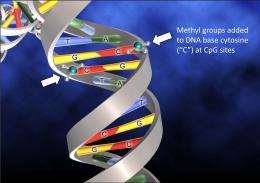
Putting the DNA back into DNA methylation. Credit: Adrian Bird
A study performed by scientists in Dirk Schübeler's team at the Friedrich Miescher Institute for Biomedical Research in Basel identifies DNA sequences that autonomously determine DNA methylation patterns. Genomic patterns of cytosine methylation are important for the proper functioning of cells during self renewal and development, and are often disrupted in disease. In a study published in the latest issue of the scientific journal Nature Genetics, Schübeler and his team show that the binding of transcription factors to specific DNA sequences determines DNA methylation levels at gene regulatory regions.
The addition of a small methyl molecule to cytosine, one of the four bases of DNA, can have far reaching consequences. It can epigenetically inactivate gene expression and thereby regulate cell fate.
In the last couple of years, scientists have analyzed DNA methylation patterns in many different situations in healthy and diseased cells. Further studies analyzed the processes and proteins that add or remove methyl groups. Despite the wealth of knowledge gained in these areas, many of the basic principles governing the patterns of DNA modifications have remain ill-defined. In the words of Dirk Schübeler, a Group leader at the FMI, "We have a fair understanding of which nucleotide is methylated at a particular stage and how the methylation is achieved, but it was unclear why one particular regulatory region was methylated and the neighboring one was not".
An analysis of the promoter regions of several genes performed by the FMI graduate student, Florian Lienert, has now identified how DNA sequence itself controls DNA methylation. "We were surprised to see that the DNA sequence of promoter regions controls its own DNA methylation fairly autonomously," said Lienert. Using gene targeting in mouse stem cells the scientists have been able to isolate small sequence modules, which they termed methylation determining regions (MDRs), that allow the recapitulation of methylation patterns. MDRs can mediate both the protection of promoters from DNA methylation as well as their methylation in a different cell type. Their activity depends on the developmental stage and the presence of motifs for the binding of regulatory proteins as well as on the base distribution in a promoter. "It is exciting to see that DNA sequence regulates this important process and to learn the basic constraints of this regulation", said Schübeler. "It predicts that sequence variations between individuals can lead to different methylation patterns. This will be relevant when analyzing and understanding methylation differences in health and disease."
More information: Lienert F, et al. (2011) Identification of genetic elements that autonomously determine DNA methylation states, Nature Genetics 43, 1091-1097, doi:10.1038/ng.946
Provided by Friedrich Miescher Institute for Biomedical Research
-
Stem cell researchers uncover previously unknown patterns in DNA methylation
Jun 02, 2010 |
not rated yet |
0
-
Research reveals how dynamic changes in methylation can determine cell fate
Sep 26, 2011 |
not rated yet |
0
-
Work with fungus uncovering keys to DNA methylation
Dec 15, 2008 |
not rated yet |
0
-
Epigenetic signals differ across alleles
Feb 12, 2010 |
not rated yet |
0
-
Why only some former smokers develop lung cancer
Nov 17, 2008 |
not rated yet |
0
-
Motion perception revisited: High Phi effect challenges established motion perception assumptions
Apr 23, 2013 |
3 / 5 (2) |
2
-
Anything you can do I can do better: Neuromolecular foundations of the superiority illusion (Update)
Apr 02, 2013 |
4.5 / 5 (11) |
5
-
The visual system as economist: Neural resource allocation in visual adaptation
Mar 30, 2013 |
5 / 5 (2) |
9
-
Separate lives: Neuronal and organismal lifespans decoupled
Mar 27, 2013 |
4.9 / 5 (8) |
0
-
Sizing things up: The evolutionary neurobiology of scale invariance
Feb 28, 2013 |
4.8 / 5 (10) |
14
-
Classical and Quantum Mechanics via Lie algebras
Apr 15, 2011
- More from Physics Forums - Independent Research
More news stories
Patenting the human genome
Can human genes be patented? That was the question posed by Alan J. Snyder, vice president and associate provost for research and graduate studies at Lehigh, and Lee Kaplan, scientific director of cellular and molecular genetics ...
Genetics
4 hours ago |
4 / 5 (1) |
0
Researchers complete largest genetic sequencing study of human disease
Researchers from Queen Mary, University of London have led the largest sequencing study of human disease to date, investigating the genetic basis of six autoimmune diseases.
Genetics
May 22, 2013 |
4.5 / 5 (4) |
0
|
Researchers develop model for better testing, targeting of malignant peripheral nerve sheath tumors
University of Minnesota Medical School researchers from the Masonic Cancer Center, University of Minnesota, in partnership with the University's Brain Tumor Program, have developed a new mouse model of malignant peripheral ...
Genetics
May 20, 2013 |
5 / 5 (1) |
0
|
Researchers identify new circadian clock component
Northwestern University scientists have shown a gene involved in neurodegenerative disease also plays a critical role in the proper function of the circadian clock.
Genetics
May 16, 2013 |
3 / 5 (1) |
1
|
Returning genetic incidental findings without patient consent violates basic rights, experts say
Informed consent is the backbone of patient care. Genetic testing has long required patient consent and patients have had a "right not to know" the results. However, as 21st century medicine now begins to use the tools of ...
Genetics
May 16, 2013 |
5 / 5 (1) |
3
|
Hormone levels may provide key to understanding psychological disorders in women
Women at a particular stage in their monthly menstrual cycle may be more vulnerable to some of the psychological side-effects associated with stressful experiences, according to a study from UCL.
Going live: Immune cell activation in multiple sclerosis
Biological processes are generally based on events at the molecular and cellular level. To understand what happens in the course of infections, diseases or normal bodily functions, scientists would need to ...
ACOG: Hormone therapy not recommended to prevent CHD
(HealthDay)—Menopausal hormone therapy should not be used for prevention of coronary heart disease, according to a Committee Opinion from the American College of Obstetricians and Gynecologists (ACOG) published ...
Youth with type 2 diabetes at much higher risk for heart, kidney disease
The news about youth and diabetes keeps getting worse. The latest data from the national TODAY diabetes study shows that children who develop Type 2 diabetes are at high risk to develop heart, kidney and eye problems faster ...
New animal model gives insights into mechanisms of Parkinson's disease pathogenesis
In Parkinson's disease, the protein "alpha-synuclein" aggregates and accumulates within neurons. Specific areas of the brain become progressively affected as the disease develops and advances. The mechanism underlying this ...
Audiologists recommend smart phone apps to monitor noise levels
After studying noise in one French Quarter neighborhood of New Orleans to determine whether or not noise levels exceeded municipal ordinances, Annette Hurley, PhD, Assistant Professor of Audiology at LSU Health Sciences Center ...