Penn Study Explains Paradox of Insulin Resistance Genetics
October 25, 2011 in Medical research

Penn Study Explains Paradox of Insulin Resistance Genetics

Enlarge

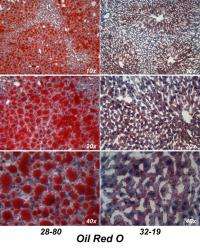
Sections of liver from an obese mouse at increasing magnifications (left panels). Red is the lipid in the cell in the form of stained droplets. Sections of liver from an obese mouse lacking Akt (right panels), which blocks the massive accumulation of fat, mimicking the appearance of a normal liver. Blue are liver cell nuclei and the white is space between cells, such as blood vessels, and ducts. Credit: Rachael Easton, Perelman School of Medicine, University of Pennsylvania

(Medical Xpress) -- Obesity and insulin resistance are almost inevitably associated with increases in lipid accumulation in the liver, a serious disease that can deteriorate to hepatitis and liver failure.  A real paradox in understanding insulin resistance is figuring out why insulin-resistant livers make more fat.  Insulin resistance occurs when the body does a poor job of lowering blood sugars.

The signals to make lipid after a meal come from hormones - most notably insulin - and the direct effect of nutrients on the liver. In a recent issue of Cell Metabolism, Morris Birnbaum, MD, PhD, professor of Medicine at the Perelman School of Medicine, University of Pennsylvania, describes the pathway that insulin uses to change the levels of gene expression that control lipid metabolism. Birnbaum is also associate director of the Institute of Diabetes, , and Metabolism at Penn.
 
Since insulin normally stimulates fat synthesis in the liver, the expectation is that an insulin-resistant liver would not be able to make lipid. Insulin normally shuts off glucose output and during output is too high. This contributes to the high blood sugar of diabetes. In order to treat the lipid accumulation as well as the glucose abnormalities in type 2 diabetes, it is important to understand the pathways that regulate lipid metabolism.
 
Researchers have suggested that two transcription factors, proteins called FoxA2 and FoxO1, act downstream of, and are negatively regulated by, an enzyme stimulated by insulin called kinase Akt/PKB. Birnbaum had previously shown that this kinase is required for lipid accumulation in the liver. This system is proposed by researchers as a key determinant of liver triglyceride content, one indicator of increased lipids.
 
In the current study, the team used a technique of introducing mutations into specific genes to show that having these transcriptions factors turned on all the time cannot account for the protection from lipid accumulation in the liver afforded by deleting Akt2 in the liver.
 
The researchers showed that the major downstream path that insulin uses to regulate these genes converges with the pathways that the body uses to metabolize nutrients. In addition, another arm of insulin signaling (which is probably independent of the nutrient pathway) is also required for the increase in lipid metabolism. Another downstream target turned on by Akt, the mTORC1 protein complex, is required for the body to make lipid. Having multiple pathways is probably a way that the makes sure that lipid synthesis is activated only when there is an increase in nutrients and there is a signal from insulin, surmise the researchers.
 
"Since a therapeutic goal is to prevent this , any time we identify a novel pathway it raises the hope that there is a previously unknown target out there for a new type of drug," concludes Birnbaum.

Provided by University of Pennsylvania School of Medicine search and more info website

5 /5 (1 vote)  

Rank 5 /5 (1 vote)
Relevant PhysicsForums posts

More news stories

Medical researchers discover new ways to target, develop and design drugs to prevent and treat viral infection

Researchers at the University of Alberta have discovered a new drug target, developed a new drug and identified a new way to design drugs—all of which could be a winning combination in the battle against viruses.

Medical research created 15 minutes ago | popularity not rated yet | comments 0 | with audio podcast

Targeting the X-factor to tackle cardiovascular disease

New research at The University of Nottingham aimed at preventing harmful blood clots associated with heart disease and stroke has recently received a major funding boost from the British Heart Foundation.

Medical research created 40 minutes ago | popularity not rated yet | comments 0

Italy approves law on controversial stem cell therapy

Italian lawmakers on Wednesday gave their final approval to a law that allows limited use of a controversial type of stem cell therapy which has been condemned by many scientists but has given hope to families of terminally-ill ...

Medical research created 55 minutes ago | popularity 5 / 5 (1) | comments 0

H. pylori, smoking trends, and gastric cancer in US men

Trends in Helicobacter pylori (H. pylori) and smoking explain a significant proportion of the decline of intestinal-type noncardia gastric adenocarcinoma (NCGA) incidence in US men between 1978 and 2008, and are estimated ...

Medical research created 15 hours ago | popularity not rated yet | comments 0

Common food supplement fights degenerative brain disorders

Widely available in pharmacies and health stores, phosphatidylserine is a natural food supplement produced from beef, oysters, and soy. Proven to improve cognition and slow memory loss, it's a popular treatment for older ...

Medical research created 19 hours ago | popularity 5 / 5 (3) | comments 0 | with audio podcast


Beta-blockers may boost chemo effect in childhood cancer

Beta-blockers, normally used for high blood pressure, could enhance the effectiveness of chemotherapies in treating neuroblastoma, a type of children's cancer, according to a new study published in the British Jo ...

Cancer survivors need more support to stop smoking and drinking

Cancer survivors are no more likely to stop smoking, cut down on alcohol, or exercise more often than the general population, according to new research published in the British Journal of Cancer today (Wednesday)

Ethicists' behavior not more moral, study finds

(Medical Xpress)—Do ethicists engage in better moral behavior than other professors? The answer is no. Nor are they more likely than nonethicists to act according to values they espouse, according to researchers from the ...

Japan hospital tests powerful breast cancer therapy

A Japanese cancer specialist said Wednesday she has started the world's first clinical trial of a powerful, non-surgical, short-term radiation therapy for breast cancer.

Life-saving face transplant performed in Poland

(AP)—Doctors in Poland say they have performed an urgent total face transplant on a 33-year-old man whose face was torn off in an accident which also crushed his jaws.

Study focuses on new mums' sleepiness and injury risk on the road

New mothers throughout Australia are needed to help QUT sleep researchers investigate whether the disrupted sleep experienced by mothers when caring for their new baby raises the risk of injury while driving.