Psychologists chase down sleep demons
October 17, 2011 in Psychology & Psychiatry
Psychologists chase down sleep demons

Enlarge

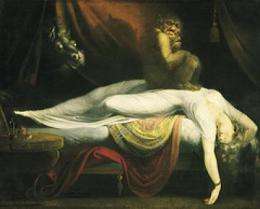
This is The Nightmare. Credit: John Henry Fuseli

What do Moby Dick, the Salem witch trials and alien abductions all have in common? They all circle back to sleep paralysis.

Less than 8 percent of the general population experiences sleep paralysis, but it is more frequent in two groups -- students and -- according to a new study by psychologists at Penn State and the University of Pennsylvania.

Sleep paralysis is defined as "a discrete period of time during which voluntary is inhibited, yet ocular and respiratory movements are intact," the researchers state in the current issue of Reviews. Hallucinations may also be present in these transitions to or from sleep.

Alien abductions and incubi and succubi, as well as other demons that attack while people are asleep, are implicated as different cultural interpretations of sleep paralysis. The Salem witch trials are now thought possibly to involve the townspeople experiencing sleep paralysis. And in the 19th-century novel Moby Dick, the main character Ishmael experiences an episode of sleep paralysis in the form of a malevolent presence in the room.

Brian A. Sharpless, clinical assistant professor of psychology and assistant director of the psychological clinic at Penn State, noted that some people who experience these episodes may regularly try to avoid going to sleep because of the unpleasant sensations they experience. But other people enjoy the sensations they feel during sleep paralysis.

"I realized that there were no real sleep paralysis prevalence rates available that were based on large and diverse samples," Sharpless said. "So I combined data from my previous study with 34 other studies in order to determine how common it was in different groups."

He looked at a total of 35 published studies from the past 50 years to find lifetime sleep paralysis rates. These studies surveyed a total of 36,533 people. Overall he found that about one-fifth of these people experienced an episode at least once. Frequency of sleep paralysis ranged from once in a lifetime to every night.

When looking at specific groups, 28 percent of students reported experiencing sleep paralysis, while nearly 32 percent of psychiatric patients reported experiencing at least one episode. People with panic disorder were even more likely to experience sleep paralysis, and almost 35 percent of those surveyed reported experiencing these episodes. Sleep paralysis also appears to be more common in non-Caucasians.

"Sleep paralysis should be assessed more regularly and uniformly in order to determine its impact on individual functioning and better articulate its relation to other psychiatric and medical conditions," said Sharpless. He looked at a broad range of samples, and papers were included from many different countries.

People experience three basic types of during sleep paralysis -- the presence of an intruder, pressure on the chest sometimes accompanied by physical and/or sexual assault experiences and levitation or out-of-body experiences.
Up to this point there has been little research conducted on how to alleviate sleep paralysis or whether or not people experience episodes throughout their lives.

"I want to better understand how sleep paralysis affects people, as opposed to simply knowing that they experience it," said Sharpless. "I want to see how it impacts their lives."

Sharpless hopes to look at relationships between sleep paralysis and post-traumatic stress disorder in the future.

This research was supported in part by the National Institute of Mental Health.

Provided by Pennsylvania State University search and more info website

4.3 /5 (6 votes)  

Filter


Move the slider to adjust rank threshold, so that you can hide some of the comments.


Display comments: newest first

A_Paradox
Oct 19, 2011

Rank: not rated yet
this happened to me a couple of times, long ago. I had been practicing complete relaxation as a possible means of getting to sleep more easily. The technique involves first clenching muscles tightly so as to then let them relax completely, starting with the toes, feet, calves, thighs, etc, then doing the arms, working up to the head. Probably most people of heard of this.

So, effectively, I was teaching my body how to not move at all while lying supine. I think I just learned it too well; I habituated my brain and muscles to an extreme of relaxation, although it never seemed to help me actually get to sleep, if I recall correctly. But as is normal with dreams, this new [in]activity spontaneously occurred while I was dreaming. Probably an example of newly learned behaviour being consolidated during sleep but it backfired because made so immobile that normal shifting of the body during sleep just didn't happen.
A_Paradox
Oct 19, 2011

Rank: not rated yet
... cont And I can vouch that it scared the crap out of me as I slowly became aware of being paralysed. Even after I opened my eyes I was stuck until a rush of adrenaline [I guess] woke me up enough for the motor cortex to muscles connections to be restored.

Mark
Rank 4.3 /5 (6 votes)
Relevant PhysicsForums posts
  • Potential Breakthrough in Seizure Control
    created8 hours ago
  • Popping/Cracked sternum.
    created13 hours ago
  • Which Mental Illness Encompasses This Problem?
    created13 hours ago
  • A question about drug tolerance
    createdMay 23, 2012
  • Poor nutrition leading to overeating?
    createdMay 23, 2012
  • Math and dyslexia?
    createdMay 21, 2012
  • More from Physics Forums - Medical Sciences

More news stories

More mental health care urged for kids who self-harm

(HealthDay) -- Doctors have long known that some kids suffering severe emotional turmoil find relief in physical pain -- cutting or burning or sticking themselves with pins to achieve a form of release.

Psychology & Psychiatry created May 25, 2012 | popularity not rated yet | comments 0

Questionable research practices surprisingly common

(Medical Xpress) -- Not all scientific misconduct is flat-out fraud. Much falls into the murkier realm of “questionable research practices.” A new study finds that in one field, psychology, these practices are surprisingly ...

Psychology & Psychiatry created May 25, 2012 | popularity 5 / 5 (1) | comments 0 | with audio podcast

Feeling strong emotions makes peoples' brains 'tick together'

Experiencing strong emotions synchronises brain activity across individuals, research team at Aalto University and Turku PET Centre in Finland has revealed.

Psychology & Psychiatry created May 24, 2012 | popularity 5 / 5 (1) | comments 0

Formal recognition of PMDD will lift stigma for women

A decision to recognise premenstrual dysphoric disorder as a genuine psychiatric condition will finally provide “validation for this awful and poorly understood” syndrome and alleviate the stigma ...

Psychology & Psychiatry created May 24, 2012 | popularity 2 / 5 (1) | comments 1

Long-term meditation leads to different brain organization

(Medical Xpress) -- People who practice mindfulness meditation learn to accept their feelings, emotions, and states of mind without judging or resisting them. They simply live in the moment.

Psychology & Psychiatry created May 24, 2012 | popularity 5 / 5 (5) | comments 0 | with audio podcast


Travel to high altitudes tied to Crohn's, colitis flare-ups

(HealthDay) -- People with inflammatory bowel disease, which includes Crohn's disease and colitis, may be at increased risk for flare-ups when they fly or travel to high altitudes for skiing or mountain climbing, ...

Family history of Alzheimer's affects functional connectivity

(HealthDay) -- Cognitively normal individuals with a family history of late-onset Alzheimer's disease (AD) may display lower resting state functional connectivity in the default mode network (DMN) of the brain, ...

Transvaginal mesh op restores pelvic organ prolapse at price

(HealthDay) -- Transvaginal mesh (TVM) procedures are effective for anatomical restoration of pelvic organ prolapse (POP), but patients report a worsening of sexual function following surgery, according to ...

Tongue analysis software uses ancient Chinese medicine to warn of disease

For 5,000 years, the Chinese have used a system of medicine based on the flow and balance of positive and negative energies in the body. In this system, the appearance of the tongue is one of the measures used to classify ...

Skp2 activates cancer-promoting, glucose-processing Akt

HER2 and its epidermal growth factor receptor cousins mobilize a specialized protein to activate a major player in cancer development and sugar metabolism, scientists report in the May 25 issue of Cell.

Early physical therapist treatment associated with reduced risk of healthcare utilization and reduced overall healthcare

A new study published in Spine shows that early treatment by a physical therapist for low back pain (LBP), as compared to delayed treatment, was associated with reduced risk of subsequent healthcare utilization and lower ...