'Rejuvenated' stem cells coaxed from centenarian
October 31, 2011 by Marlowe Hood in Genetics

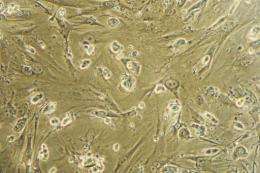
Embryonic stem cells are pictured through a microscope viewfinder in a laboratory, in 2008

Enlarge

Embryonic stem cells are pictured through a microscope viewfinder in a laboratory, in 2008. Scientists said Tuesday they had transformed age-worn cells in people over 90 -- including a centenarian -- into rejuvenated stemcells that were "indistinguishable" from those found in embryos.

Scientists said Tuesday they had transformed age-worn cells in people over 90 -- including a centenarian -- into rejuvenated stemcells that were "indistinguishable" from those found in embryos.

The technical feat, reported in the peer-reviewed journal & Development, opens a new path toward regenerative medicine, especially for the elderly, the researchers said.

"This is a new paradigm for cell rejuvenation," said Jean-Marc Lemaitre, a researcher at the Institute of Functional Genomics at the University of Montpellier and the main architect of the study.

"The age of is definitely not a barrier to reprogramming," he told AFP by phone.

That human embryonic stem cells (ESC) can potentially become any type of cell in the body has long held out the tantalizing promise of diseased organs or tissue being repaired or replaced with healthy, lab-grown cells.

But the leap from theory to practice has proven difficult, and fraught with ethical and moral concerns because any such procedure requires the destruction of a human embryo.

The discovery in 2007 that it is possible to coax certain adult cells back into their immature, pre-specialised state has fuelled renewed efforts to generate brand new muscle, heart or even brain cells, this time from raw material provided by the patient.

Experiments to date, however, have shown that the usual chemical recipe for generating these so-called induced pluripotent (iPSC) works less well or not at all with the elderly and very elderly -- precisely the cohort with the most to gain from regenerative therapies.

The barrier was cellular senescence, a natural process linked to ageing that can trigger cell death when certain mechanisms within the cell become too degraded to function properly.

Lemaitre and colleagues decided to alter the standard genetic starter kit used to generate adult stemcells by adding two new ingredients -- known as transcription factors -- called NANOG and LIN28.

Experiments with human subjects ranging in age from 74 to 101 showed that the new cocktail worked.

Several critical markers of ageing in cells were "reset", including the size of telomeres, the tiny protective caps found on the ends of chromosomes that wear down with age, the researchers reported.

Telomeres and telomerase, the enzyme that control them, are a key agent in longevity.

Every time a cell divides, the telomeres get worn down a little bit. The enzyme's job is to partially rebuild them. Eventually, when the telomeres are worn beyond repair, a cell dies.

Gene expression profiles, levels of oxidative stress, and the metabolism of the cell's energy-generating mitochondria were all likewise rejuvenated, according to the study.

"The age markers in the cell has been erased," said Lemaitre. "The iPSC stemcells we got can produce functional cells of all types with a capacity to proliferate and enhance longevity."

By reversing the age-altered physiology of the cells, he added, the new reprogramming technique "may constitute an optimal strategy for developing cell-based therapies for aged patients."

A large gap remains between this "proof-of-concept" study and therapeutic applications, the researchers cautioned.

And recent experiments with mice suggests that generating adult stemcells may yet face unexpected barriers.

Certain kinds of iPSC may be rejected by the immune system even if they are derived from the same organism, the experiments showed.

(c) 2011 AFP

5 /5 (24 votes)  

Filter


Move the slider to adjust rank threshold, so that you can hide some of the comments.


Display comments: newest first

Vendicar_Decarian
Oct 31, 2011

Rank: 3 / 5 (2)
If I was a stem cell, I wouldn't want to be living in a centenarian either.

Wouldn't take much coaxing for me to leave.

Rank 5 /5 (24 votes)
Relevant PhysicsForums posts

More news stories

Researchers develop model for better testing, targeting of malignant peripheral nerve sheath tumors

University of Minnesota Medical School researchers from the Masonic Cancer Center, University of Minnesota, in partnership with the University's Brain Tumor Program, have developed a new mouse model of malignant peripheral ...

Genetics created May 20, 2013 | popularity 5 / 5 (1) | comments 0 | with audio podcast

Researchers identify new circadian clock component

Northwestern University scientists have shown a gene involved in neurodegenerative disease also plays a critical role in the proper function of the circadian clock.

Genetics created May 16, 2013 | popularity 3 / 5 (1) | comments 1 | with audio podcast

Returning genetic incidental findings without patient consent violates basic rights, experts say

Informed consent is the backbone of patient care. Genetic testing has long required patient consent and patients have had a "right not to know" the results. However, as 21st century medicine now begins to use the tools of ...

Genetics created May 16, 2013 | popularity 5 / 5 (1) | comments 3 | with audio podcast

Ethicists provide framework supporting new recommendations on reporting incidental findings in gene sequencing

In a paper published in Science Express, a group of experts led by bioethicists in the Center for Medical Ethics and Health Policy at Baylor College of Medicine provide a framework for the new American College of Medical Geneti ...

Genetics created May 16, 2013 | popularity not rated yet | comments 0

Experts urge caution over use of new genetic sequencing techniques

The use of genome-wide analysis (GWA), where the entirety of an individual's DNA is examined to look for the genomic mutations or variants which can cause health problems is a massively useful technology for diagnosing disease. ...

Genetics created May 16, 2013 | popularity not rated yet | comments 0


Study says empathy plays a key role in moral judgments

Is it permissible to harm one to save many? Those who tend to say "yes" when faced with this classic dilemma are likely to be deficient in a specific kind of empathy, according to a report published in the scientific journal ...

Phthalates: Study links chemicals widely found in plastics, processed food to elevated blood pressure in children, teens

Plastic additives known as phthalates (pronounced THAL-ates) are odorless, colorless and just about everywhere: They turn up in flooring, plastic cups, beach balls, plastic wrap, intravenous tubing and—according to the ...

If you can remember it, you can remember it wrong

(Medical Xpress)—Native peoples in regions where cameras are uncommon sometimes react with caution when their picture is taken. The fear that something must have been stolen from them to create the photo ...

B vitamins could delay dementia

(Medical Xpress)—Despite spending billions of dollars on research and development, drug companies have been unable to come up with effective treatments for dementia and Alzheimer's Disease (AD). Now, A. ...

Insight into the dazzling impact of insulin in cells

Australian scientists have charted the path of insulin action in cells in precise detail like never before. This provides a comprehensive blueprint for understanding what goes wrong in diabetes.

Reducing caloric intake delays nerve cell loss

Activating an enzyme known to play a role in the anti-aging benefits of calorie restriction delays the loss of brain cells and preserves cognitive function in mice, according to a study published in the May ...