Can a short leg cause knee or hip pain?
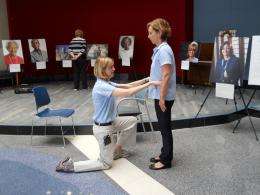
If one of your legs is shorter than the other, that may increase your risk of pain in your knees or hips, some researchers suspect. UNC’s Yvonne Golightly, PT, PhD, explains what researchers do and don’t know about this surprisingly common condition.
If you have ever looked closely at a people’s faces, you know that most of us aren’t perfectly symmetrical. An eyebrow may arch slightly higher on the right side, or a dimple might appear only on the left cheek.
As many as 70 percent of people also have legs that are slightly different in length. Usually, the discrepancy is small – less than a centimeter – and it probably doesn’t make a difference to your health.
But some researchers suspect that larger discrepancies could play a role in knee and hip pain. They call the phenomenon “short-leg syndrome” or “leg-length inequality.”
Researchers still disagree about exactly how prevalent leg length inequality is or how much of an inequality is necessary to cause problems, said Yvonne Golightly, PT, PhD, a postdoctoral fellow and physical therapist at the UNC Rheumatology/Thurston Arthritis Research Center.
But a study published in 2005 in the journal Chiropractic & Osteopathy suggested that about 20 percent of people may have a leg-length inequality of one centimeter (0.4 inch) or more.
Short-leg syndrome can begin in childhood as a result of an injury, infection or a difference in growth rates between the legs. Adults can also develop an inequality because of surgery, such as hip replacement.
The asymmetry between the legs can subtly change a person’s gait, altering the forces acting on the legs as he or she walks or runs.
Golightly hypothesized that such changes could increase the risk of osteoarthritis, a painful joint condition, in the knee and hip.
To find out, she and another UNC researcher, Dr. Joanne Jordan, principal investigator of the Johnston County Osteoarthritis Project, examined about 1,500 Johnston County, N.C., residents aged 45 or older. In the 1990s, they measured participants’ legs with a tape measure and, using X-rays, checked their knees and hips for osteoarthritis. Then, about six years later, the researchers conducted the same measurements.
They found that participants who had a limb-length inequality of two centimeters (0.8 inch) or more were more likely to develop osteoarthritis in the knee. They were also slightly more likely to develop osteoarthritis in the hip, but that association was not as strong. The researchers’ work was published last year in The Journal of Rheumatology.
Their findings are consistent with another study, published in 2010 in Annals of Internal Medicine, that examined 3,026 people between the ages of 50 and 79. That study, too, found that participants with at least a one-centimeter difference in leg length based on X-ray measurements were more likely have osteoarthritis in the knee.
Jordan recently received a $3.5 million grant from the Centers for Disease Control and Prevention to continue the Johnston County Osteoarthritis Project, and Golightly and Jordan will further examine the relationship between leg length inequality and lower extremity problems among participants of the project.
Other researchers have suggested that short-leg syndrome may increase the risk of lower back pain, stress fractures and running injuries. But Golightly said that researchers haven’t yet conducted large studies to evaluate those hypotheses over time, so it’s hard to know for sure what role the syndrome plays in those conditions.
If you suspect you have a short leg
A difference in leg length of an inch or less can be difficult to detect on your own, so if you suffer from knee or hip pain, it’s worth talking to your doctor or physical therapist about leg-length inequality.
The length of your legs is easy to assess using a simple tape measure. Your doctor may also ask for an X-ray, because that is the most accurate and reliable method of measurement, Golightly said.
And there’s good news about leg-length inequality: “It is easy to treat for most individuals,” she said.
If you are an adult, your doctor will likely ask you to wear a lift, which can be inserted into the shoe or added to the sole of the shoe to effectively increase the length of the shorter leg. A physical therapist can also help you stretch tight muscles and strengthen muscles that may be weak as a result of the inequality.
For children with significant leg-length inequalities, doctors can use surgical techniques to lengthen the shorter limb or shorten or slow down the growth of the longer leg, so that eventually the legs match in length.


