Brain circuits connected with memory discovered
November 7, 2011 by Deborah Braconnier in Neuroscience report

Brain

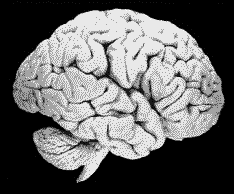
(Medical Xpress) -- A new study published last week in Science reveals the discovery of a brain pathway that helps us link events that happen close together and play a role in memories.

The research, led by Dr. Junghyup Suh from the Massachusetts Institute of Technology found the connection between the and the . The entorhinal cortex receives the information from areas around the brain and then passes the information to the hippocampus.

To test this pathway, the researchers used specifically bred mice. These mice had a which allowed the cells in the entorhinal cortex to be disabled by removing from the food the mice were fed.

When mice are presented with a sound and then within 20 seconds given a shock, they quickly learn to associate this sound with the coming shock and freeze in their tracks when the sound is heard. This experiment was conducted on the mice with the disabled entorhinal cortex and researchers discovered that the mutant mice were less likely to react to the sound.

However, when the researchers administered the shock at the same time as the sound, both mice behaved the same. This shows that there is a connection between the connection of time and the entorhinal cortex.

Another experiment used a water maze and a small platform where the mice could find to stop swimming and rest. They were allowed to find the platform and then 30 seconds later placed in the water maze. The were less likely to be able to find the platform even though they had just found it 30 seconds prior. The linking of memories to what was currently happening appeared difficult for these mice.

When it comes to Alzheimer’s disease, patients have difficulty with memory. In Alzheimer’s, the entorhinal cortex is one of the first areas of the brain that is damaged.

More information: Entorhinal Cortex Layer III Input to the Hippocampus Is Crucial for Temporal Association Memory, Science DOI: 10.1126/science.1210125

ABSTRACT
Associating temporally discontinuous elements is crucial for the formation of episodic and working memories that depend on the hippocampal-entorhinal network. However, the neural circuits subserving these associations have remained unknown. The layer III inputs of the entorhinal cortex to the hippocampus may contribute to this process. To test this hypothesis, we generated a transgenic mouse in which these inputs are specifically inhibited. The mutant mice displayed significant impairments in spatial working memory tasks and in the encoding phase of trace fear-conditioning. These results indicate a critical role of the entorhinal cortex layer III inputs to the hippocampus in temporal association memory.

© 2011 Medical Xpress

4.7 /5 (11 votes)  

Rank 4.7 /5 (11 votes)
Relevant PhysicsForums posts

More news stories

For combat veterans suffering from post-traumatic stress disorder, 'fear circuitry' in the brain never rests

Chronic trauma can inflict lasting damage to brain regions associated with fear and anxiety. Previous imaging studies of people with post-traumatic stress disorder, or PTSD, have shown that these brain regions can over-or ...

Neuroscience created 20 hours ago | popularity 5 / 5 (1) | comments 0 | with audio podcast

Temporal processing in the olfactory system

The neural machinery underlying our olfactory sense continues to be an enigma for neuroscience. A recent review in Neuron seeks to expand traditional ideas about how neurons in the olfactory bulb might encode information about ...

Neuroscience created May 17, 2013 | popularity not rated yet | comments 0 | with audio podcast report

Melon focus headband turns to Kickstarter for rollout plans

(Medical Xpress)—What if the quality of your work depends more on your focus on the piano keys or canvas or laptop than your musical or painting or computing skills? If target users can be convinced, they ...

Neuroscience created May 17, 2013 | popularity 3.7 / 5 (3) | comments 0 | with audio podcast weblog

Deep brain stimulation: A fix when the drugs don't work

Neurological disorders can have a devastating impact on the lives of sufferers and their families.

Neuroscience created May 17, 2013 | popularity 5 / 5 (1) | comments 0 | with audio podcast

Brain makes call on which ear is used for cell phone

If you're a left-brain thinker, chances are you use your right hand to hold your cell phone up to your right ear, according to a newly published study from Henry Ford Hospital in Detroit.

Neuroscience created May 16, 2013 | popularity 2 / 5 (2) | comments 0 | with audio podcast


New research identifies risks, interventions for children's GI health

An increasing number of U.S. children are experiencing gastrointestinal issues that require interventions to resolve, according to research presented at Digestive Disease Week (DDW).

US psychiatry gets makeover in new manual

The latest makeover to a massive psychiatric tome honored by some, reviled by others and even called the "Bible" of mental disorders is being released Saturday with a host of new changes.

New case of SARS-like virus in Saudi: ministry

A new case of the deadly coronavirus has been detected in Saudi Arabia where 15 people have already died after contracting it, the health ministry announced on Saturday on its Internet website.

AIDS science at 30: 'Cure' now part of lexicon

Big names in medicine are set to give an upbeat assessment of the war on AIDS on Tuesday, 30 years after French researchers identified the virus that causes the disease.

New colonoscope provides ground-breaking view of colon

A ground-breaking advance in colonoscopy technology signals the future of colorectal care, according to research presented today at Digestive Disease Week(DDW). Additional research focuses on optimizing the minimal withdrawal ...

Flesh-eating disease victim gets prosthetic hands

(AP)—A woman who lost both hands, her left leg and right foot after contracting a flesh-eating disease has been fitted with prosthetic hands.