Research finds HIV-killing compound
November 24, 2011 in HIV & AIDS
(Medical Xpress) -- A powerful topical preventative for HIV, the virus that causes AIDS, could soon be in the works thanks to a newly discovered molecular compound that research at Texas A&M University and the Scripps Research Institute shows dissolves the virus on contact.
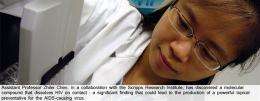
The ability of the synthetic compound known as PD 404,182 to break apart the AIDS-causing virus before it can infect cells was discovered by Zhilei Chen, assistant professor in the universitys Artie McFerrin Department of Chemical Engineering, and her team of researchers. Their findings appear in the November online edition of Antimicrobial Agents and Chemotherapy, a journal of the American Society for Microbiology.
This is a virucidal small-molecule compound, meaning that it has the ability to kill a virus; in this case that virus is HIV, Chen says. Basically, it acts by breaking the virus open. We found that when HIV comes in contact with this compound, it breaks open and loses its genetic material. In a sense, the virus dissolves, and its RNA becomes exposed. Since RNA is pretty unstable, once it is exposed its gone very quickly and the virus is rendered non-infectious.
This video is not supported by your browser at this time.
In other words, the compound works by quickly ripping open the virus before it can inject its genetic material into a human cell. Whats more and perhaps even more important - the compound, Chen explains, achieves this by acting on something within the virus other than its viral envelope protein, meaning that the virus cant alter its proteins to bolster its resistance - something thats made HIV notoriously difficult to treat.We believe this compound is not working on the viral protein of the viruses but on something else common in all the viruses on which we tested it -- some cellular material common in these viruses, Chen notes. Because this compound is acting on a component that is not encoded by the virus, it will be difficult for the virus to evolve resistance against this compound.
While not a cure for HIV, the compound demonstrates significant potential for use as a preventative, specifically in the form of a topical gel that could be applied in the vaginal canal, Chen explains.
We conducted a number of tests to demonstrate that this compound remains active in vaginal fluid and is not rendered ineffective, Chen says. In the form of a vaginal gel, the compound would serve as a barrier, acting almost instantaneously to destroy the virus before it could infect a cell, thereby preventing HIV transmission from one person to another.
Surprisingly, Chen and her team did not set out to discover an HIV preventative. Instead, they were conducting screenings of molecules for use in potential drug therapies targeting hepatitis C virus, which causes the dangerous and often fatal disease of the liver. Employing a screening system developed by Chen, the team screened thousands of molecular compounds, in search of those that could block aspects of the HCV life cycle.
During the course of the screenings, the team made an interesting discovery: Not only was PD 404,182 an HCV inhibitor, it also worked on lentiviruses (the groups negative control in its experimental procedures). Intrigued by that finding, Chen then tested PD 404,182 on HIV, which itself is a lentivirus and found the compound to be even more effective on HIV than on HCV.
We believe PD 404,182 acts through a unique and important mechanism, Chen notes. Most of the known virucidal compounds interact with the virus membrane, but our compound does not appear to interact with the virus membrane. Instead, it bypasses interaction with the membrane and still compromises the structural integrity of the virus.
The ability of the compound to avoid interaction with the virus membrane is important because human cells have similar membranes, Chen notes. If the compound were to disrupt the structure of the virus membrane, it could also disrupt and ultimately kill human cells. PD 404,182 doesnt interact with these membranes and is therefore a more attractive option for clinical treatment, Chen says.
As is the case with any potential pharmaceutical, several key steps are still needed before it winds up on drug store shelves. In addition to several rounds of animal studies to ensure the compound is safe for humans, further collaborations with chemists are needed to continue to improve the efficiency of the compound. Chen says. Whats more, Chen also plans to further explore the mechanism by which PD 404,182 breaks apart HIV.
Provided by Texas A&M University
-
Insight into HIV immunity may lead to vaccine
May 06, 2011 |
not rated yet |
0
-
HIV study identifies key cellular defence mechanism
Nov 07, 2011 |
not rated yet |
0
-
New compound could be alternative strategy for preventing HIV infection
Jan 25, 2010 |
not rated yet |
0
-
Small molecule hobbles dengue in vitro and in vivo
Sep 19, 2011 |
not rated yet |
0
-
Understanding the link between HIV and dementia
Jun 29, 2011 |
not rated yet |
0
-
Motion perception revisited: High Phi effect challenges established motion perception assumptions
Apr 23, 2013 |
3 / 5 (2) |
2
-
Anything you can do I can do better: Neuromolecular foundations of the superiority illusion (Update)
Apr 02, 2013 |
4.5 / 5 (11) |
5
-
The visual system as economist: Neural resource allocation in visual adaptation
Mar 30, 2013 |
5 / 5 (2) |
9
-
Separate lives: Neuronal and organismal lifespans decoupled
Mar 27, 2013 |
4.9 / 5 (8) |
0
-
Sizing things up: The evolutionary neurobiology of scale invariance
Feb 28, 2013 |
4.8 / 5 (10) |
14
-
Classical and Quantum Mechanics via Lie algebras
Apr 15, 2011
- More from Physics Forums - Independent Research
More news stories
After a decade, global AIDS program looks ahead
(AP)—The decade-old law that transformed the battle against HIV and AIDS in developing countries is at a crossroads. The dream of future generations freed from the epidemic is running up against an era ...
HIV & AIDS
7 hours ago |
not rated yet |
0
'Gap' for HIV vaccine efforts after latest setback
The hunt for an HIV vaccine has gobbled up $8 billion in the past decade, and the failure of the most recent efficacy trial has delivered yet another setback to 26 years of efforts.
HIV & AIDS
May 19, 2013 |
5 / 5 (1) |
0
AIDS science at 30: 'Cure' now part of lexicon
Big names in medicine are set to give an upbeat assessment of the war on AIDS on Tuesday, 30 years after French researchers identified the virus that causes the disease.
HIV & AIDS
May 18, 2013 |
5 / 5 (2) |
0
Peer-referral programs can increase HIV-testing in emergency departments
Researchers at the University of Cincinnati (UC) have found that incorporating a peer-referral program for HIV testing into emergency departments can reach new groups of high-risk patients and brings more patients into the ...
HIV & AIDS
May 17, 2013 |
not rated yet |
0
HIV no barrier to getting liver transplant, study finds
(HealthDay)—Liver transplants to treat a common type of liver cancer are a viable option for people infected with HIV, according to new research.
HIV & AIDS
May 17, 2013 |
not rated yet |
0
If you can remember it, you can remember it wrong
(Medical Xpress)—Native peoples in regions where cameras are uncommon sometimes react with caution when their picture is taken. The fear that something must have been stolen from them to create the photo ...
Insight into the dazzling impact of insulin in cells
Australian scientists have charted the path of insulin action in cells in precise detail like never before. This provides a comprehensive blueprint for understanding what goes wrong in diabetes.
Study finds vitamin C can kill drug-resistant TB (w/ video)
In a striking, unexpected discovery, researchers at Albert Einstein College of Medicine of Yeshiva University have determined that vitamin C kills drug-resistant tuberculosis (TB) bacteria in laboratory culture. The finding ...
New search engine finds rare diagnoses
Doctors are trained to think "common disease" when they meet patients in their practices, and as they rarely or never meet a rare disease, it often takes many years to reach the right diagnosis. A new search tool called FindZebra ...
Challenges encountered in surgical management of spine trauma in morbidly obese patients
Physicians at Monash University and The Alfred Hospital in Melbourne, Australia describe the logistic, medical, and societal challenges faced in treating spine trauma in morbidly obese patients. Based on a case series of ...
Study looks at risk factors for rupture or bleeding of arachnoid cysts in children
Arachnoid cysts are a common type of brain lesion that is usually harmless, but with a risk of rupture or bleeding. A new study identifies risk factors for rupture or bleeding in children with "incidentally" detected arachnoid ...
Nov 24, 2011
Rank: 4.6 / 5 (10)
Nov 24, 2011
Rank: 1.8 / 5 (5)
After all, we're not talking about some kind of a marginal discovery here.
Nov 24, 2011
Rank: 5 / 5 (4)
Nov 24, 2011
Rank: not rated yet
Nov 25, 2011
Rank: not rated yet
Nov 28, 2011
Rank: not rated yet
Nov 30, 2011
Rank: 1 / 5 (6)
Government funded? By a Texas college and a PRIVATE foundation? Try again.
Nov 30, 2011
Rank: 1 / 5 (6)
PD 404,182 is not new. It's been in active research for more than a decade. Chen was looking for an agent effective against Hep. C. The HIV connection was serendipitous. This is still very preliminary.
Apparently no one had thought of smearing it on a woman's sexual organs prior to this. Go figure.
Another question: is it safe for humans? No word on that yet. Several rounds of safety studies have been proposed.