Mimicking the brain, in silicon: New computer chip models how neurons communicate
November 15, 2011 by Anne Trafton in Neuroscience
Mimicking the brain, in silicon

Enlarge

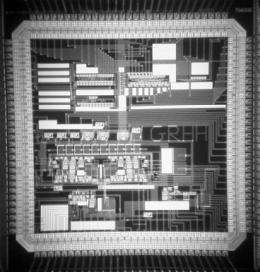
Fabricated analog very-large-scale integration (VLSI) chip used to mimic neuronal processes involved in memory and learning. Image: Guy Rachmuth

For decades, scientists have dreamed of building computer systems that could replicate the human brain’s talent for learning new tasks.

MIT researchers have now taken a major step toward that goal by designing a computer that mimics how the brain’s neurons adapt in response to new information. This phenomenon, known as plasticity, is believed to underlie many brain functions, including learning and memory.

With about 400 transistors, the silicon chip can simulate the activity of a single brain synapse — a connection between two neurons that allows information to flow from one to the other. The researchers anticipate this chip will help neuroscientists learn much more about how the brain works, and could also be used in neural prosthetic devices such as artificial retinas, says Chi-Sang Poon, a principal research scientist in the Harvard-MIT Division of Health Sciences and Technology.

Poon is the senior author of a paper describing the chip in the Proceedings of the National Academy of Sciences the week of Nov. 14. Guy Rachmuth, a former postdoc in Poon’s lab, is lead author of the paper. Other authors are Mark Bear, the Picower Professor of Neuroscience at MIT, and Harel Shouval of the University of Texas Medical School.

Modeling synapses

There are about 100 billion neurons in the brain, each of which forms synapses with many other neurons. A synapse is the gap between two neurons (known as the presynaptic and postsynaptic neurons). The presynaptic neuron releases neurotransmitters, such as glutamate and GABA, which bind to receptors on the postsynaptic cell membrane, activating . Opening and closing those channels changes the cell’s electrical potential. If the potential changes dramatically enough, the cell fires an electrical impulse called an action potential.

All of this synaptic activity depends on the ion channels, which control the flow of charged atoms such as sodium, potassium and calcium. Those channels are also key to two processes known as long-term potentiation (LTP) and long-term depression (LTD), which strengthen and weaken synapses, respectively.

The MIT researchers designed their computer chip so that the transistors could mimic the activity of different ion channels. While most chips operate in a binary, on/off mode, current flows through the transistors on the new brain chip in analog, not digital, fashion. A gradient of electrical potential drives current to flow through the transistors just as ions flow through ion channels in a cell.

“We can tweak the parameters of the circuit to match specific ion channels,” Poon says. “We now have a way to capture each and every ionic process that’s going on in a neuron.”

Previously, researchers had built circuits that could simulate the firing of an action potential, but not all of the circumstances that produce the potentials. “If you really want to mimic brain function realistically, you have to do more than just spiking. You have to capture the intracellular processes that are ion channel-based,” Poon says.

The new chip represents a “significant advance in the efforts to incorporate what we know about the biology of neurons and synaptic plasticity onto CMOS [complementary metal-oxide-semiconductor] chips,” says Dean Buonomano, a professor of neurobiology at the University of California at Los Angeles, adding that “the level of biological realism is impressive.

The MIT researchers plan to use their chip to build systems to model specific neural functions, such as the visual processing system. Such systems could be much faster than digital computers. Even on high-capacity , it takes hours or days to simulate a simple brain circuit. With the analog chip system, the simulation is even faster than the biological system itself.

Another potential application is building chips that can interface with biological systems. This could be useful in enabling communication between neural prosthetic devices such as artificial retinas and the brain. Further down the road, these chips could also become building blocks for artificial intelligence devices, Poon says.

Debate resolved

The MIT researchers have already used their chip to propose a resolution to a longstanding debate over how LTD occurs.

One theory holds that LTD and LTP depend on the frequency of action potentials stimulated in the postsynaptic cell, while a more recent theory suggests that they depend on the timing of the action potentials’ arrival at the synapse.

Both require the involvement of ion channels known as NMDA receptors, which detect postsynaptic activation. Recently, it has been theorized that both models could be unified if there were a second type of receptor involved in detecting that activity. One candidate for that second receptor is the endo-cannabinoid receptor.

Endo-cannabinoids, similar in structure to marijuana, are produced in the brain and are involved in many functions, including appetite, pain sensation and memory. Some neuroscientists had theorized that endo-cannabinoids produced in the postsynaptic cell are released into the synapse, where they activate presynaptic endo-cannabinoid receptors. If NMDA receptors are active at the same time, LTD occurs.

When the researchers included on their chip transistors that model endo-cannabinoid receptors, they were able to accurately simulate both LTD and LTP. Although previous experiments supported this theory, until now, “nobody had put all this together and demonstrated computationally that indeed this works, and this is how it works,” Poon says.


This story is republished courtesy of MIT News (http://web.mit.edu/newsoffice/), a popular site that covers news about MIT research, innovation and teaching.

Journal reference: Proceedings of the National Academy of Sciences search and more info website

Provided by Massachusetts Institute of Technology search and more info website

5 /5 (13 votes)  

Filter


Move the slider to adjust rank threshold, so that you can hide some of the comments.


Display comments: newest first

Vendicar_Decarian
Nov 15, 2011

Rank: 2.3 / 5 (3)
A valuable tool to discover how groups of existing neurons function but entirely unnecessary for the development of neuron based AI simulation.

They should instead be developing chips that can simulate with hardware assistance the non-linear summation of hundreds of inputs to cause the triggering of hundreds of outputs, with each input and output having a programmed trigger threshold sensitivity.

The chip should have multiple processing cores capable of churning through large numbers of such "vectors" at neuronal like speeds so that one chip can emulate - although not exactly - thousands of neurons.

Then you build a series of brains, starting from the most primitive organisms and then working up the complexity through worms, Republicans, mice and eventually the brain of an ape.
Isaacsname
Nov 15, 2011

Rank: not rated yet
The ENIAC of our generation ?
socean
Nov 15, 2011

Rank: not rated yet

Then you build a series of brains, starting from the most primitive organisms and then working up the complexity through worms, Republicans, mice and eventually the brain of an ape.


Nicely done.
Code_Warrior
Nov 15, 2011

Rank: 5 / 5 (1)
A valuable tool to discover how groups of existing neurons function but entirely unnecessary for the development of neuron based AI simulation.

They should instead be developing chips that can simulate with hardware assistance the non-linear summation of hundreds of inputs to cause the triggering of hundreds of outputs, with each input and output having a programmed trigger threshold sensitivity.

The chip should have multiple processing cores capable of churning through large numbers of such "vectors" at neuronal like speeds so that one chip can emulate - although not exactly - thousands of neurons.

Then you build a series of brains, starting from the most primitive organisms and then working up the complexity through worms, Republicans, mice and eventually the brain of an ape.

Decari-Tard, striving desperately to raise himself to Quantum Conundrum levels of intellect with his post, only achieves worm status, falling short of his dream to become a Republican.
Deesky
Nov 15, 2011

Rank: 5 / 5 (2)
A valuable tool to discover how groups of existing neurons function but entirely unnecessary for the development of neuron based AI simulation.

Disagree, somewhat. Yes, you can use conventional supercomputers to simulate neurons, but the problem is, they're still way too slow to simulate fully biologically accurate neurons with a large number of interconnections (project BlueBrain not withstanding).

If they can do this in hardware and achieve decent densities (ie, large numbers of interconnected neurons), then I think this will prove to be very valuable indeed for AI research.

Also remember, even animals with miniscule brains (few neurons) are capable of doing some amazing things that current computers struggle to do.
Deesky
Nov 15, 2011

Rank: 5 / 5 (1)
They should instead be developing chips that can simulate with hardware assistance the non-linear summation of hundreds of inputs to cause the triggering of hundreds of outputs, with each input and output having a programmed trigger threshold sensitivity

I thought that's what they were doing - potentials leading to trigger events and neural rewiring.

The chip should have multiple processing cores capable of churning through large numbers...

Cores? I don't think so. That's precisely what they're trying to move away from with this architecture.

...at neuronal like speeds so that one chip can emulate - although not exactly - thousands of neurons.

Neural speeds are slow compared to electronics. This research points out that they can emulate in analog fashion what real neurons do, but much faster. And the whole point is to increase the faithfulness of the simulation, not to take shortcuts leading to less accuracy.
hush1
Nov 16, 2011

Rank: not rated yet
Where to start? At the beginning? First breath maybe? Portable fMRI the newborn before, during, and after whacking him/her.

Breathing is really, really complicated. So getting those first pictures of a brain 'springing or going into action' will shed light on where, what, how, and when a 'newbie' handles such a humongous first task.

Of course, all newborns make this look 'easy'.
Those images will make the moon landing look insignificant.
And enjoy more viewers too. NCC fans will go ape s..t and be thankful too. Something worth modeling: breath of life.

Were you conscious? Of your first breath? Do you have to be conscious to take your first breath?

Digressing and daydreaming again. Nothing new from me.
Vendicar_Decarian
Nov 16, 2011

Rank: 1 / 5 (1)
"I thought that's what they were doing - potentials leading to trigger events and neural rewiring." - Deesky

400 transistors is way too many. At current levels of integration you might be able to get to 1 million neurons per wafer that way. So you would need 100,000 or so wafers to build a human brain provided you could get the chips wired in 3d.

One downside is that it would operate thousands of times faster than a human brain making it difficult to diagnose problems, etc.

Better to put the speed to use in reducing the number of silicon neurons required. That way you may sacrifice 999 time the speed but reduce your chip count to 100.

In any case, simulating neurons with precision is certainly not necessary. If it was needed then intelligence would never have evolved in the first place.

Intelligence is plastic and must be reasonably independent on the underlying processing elements. It must be robust because neurons are quite unstable in their response to stimuli.

cont
Vendicar_Decarian
Nov 16, 2011

Rank: 1 / 5 (1)
For the study of how existing systems of neurons function this chip will probably make life easier.

However for the construction of a brain variations on the perceptron are all that should be needed.
Vendicar_Decarian
Nov 16, 2011

Rank: 1 / 5 (1)
"Breathing is really, really complicated." - hush1

Is it? It can be emulated with a 4004.

Problem solved.
Vendicar_Decarian
Nov 16, 2011

Rank: 1 / 5 (1)
"Cores? I don't think so. That's precisely what they're trying to move away from with this architecture." - Deesky

They want to move away from traditional general purpose cores.

Specifically designed neural processing cores make much more sense, where one long 2000 entry vector assigns in one go all of the synapse connections, input and output weights, thresholds, and trigger sensitivities, and in one clock cycle all of those values are churned together in parallel and made available at the outputs, and written out to a local on chip store.

The next cycle does the next neuron, etc, etc until a logical array of n by n by n neurons is computed.

Vendicar_Decarian
Nov 16, 2011

Rank: 1 / 5 (1)
"Decari-Tard, striving desperately to raise himself to Quantum Conundrum levels of intellect with his post" - Code Warrior

Nerual nets have been a mixed success primarily because their programming is time consuming making large arrays of them impractical.

They are essentially layers of matrix multipliers where the input is multiplied by some matrix to produce an output to another layer. Over several layers a desired output is programmed into the layers by a method called back propagation.

The multiplication isn't linear though. If it were then all of the layers could be reduced to a single layer by simply multiplying all of the intermediate matrices together.

The multiplications are made non-linear and a single perceptron threshold is generally thrown in for good measure to swizzle up the mix.

The technique remains valid but requires higher speeds so that more and larger layers can be produced, and then layered themselves to produce ever higher levels of heuristic logic.
hush1
Nov 16, 2011

Rank: not rated yet
The project faces failure.
The researchers must account for microglia.

http://medicalxpr...une.html

This comment is without digression or daydreaming.
larkforsure
Nov 16, 2011

Rank: not rated yet
[ Begging for helps ] Complaint about Human Rights Violations by IBM China on Centennial

Please Google:

IBM detained mother of ex-employee on the day of centennial
or
How Much IBM Can Get Away with is the Responsibility of the Media
or
Tragedy of Labor Rights Repression in IBM China
Deesky
Nov 16, 2011

Rank: not rated yet
One downside is that it would operate thousands of times faster than a human brain making it difficult to diagnose problems, etc.

I think you're looking at this from the 'old school' engineering perspective, where everything is designed, controlled and timed to a set specification. These types of circuits (while still needing to function as designed) are about forming connections and modes of operation that emerge 'organically', ie, not programmed in. As such, the system as a whole would be inherently difficult, if not impossible, to diagnose.

Better to put the speed to use in reducing the number of silicon neurons required.

But that is the opposite of what this research is trying to attempt.

In any case, simulating neurons with precision is certainly not necessary.

Tell that to the BlueBrain project! Even with neural nets, more faithful neural simulations have led to more 'intelligent' behaviors.
hush1
Nov 17, 2011

Rank: not rated yet
This is what this project must perform and accomplish on the same grand scale the brain functions:

http://www.newsci...und.html

Every physical object assessable to all the percepts from all the senses must have a representation (association) of every physical object/event a human being will encounter on earth.

Once those original physical objects and/or events are 'imprinted'(committed to and occupied by neuronal pathways), each and every single physical object/event must have an interchangeable representational association (pathway)to each percept under each other representing the original physical objects/events:

Seeing with sound, hearing with sight, and so forth.

Once that grand original foundation is established, all additional informational percepts/inputs from physical objects/events must undergo the same process as was used to establish the original grand foundation.

cont...
hush1
Nov 17, 2011

Rank: not rated yet
cont...
That is the tip of the iceberg... we move on:

The assignment of the physiological representations committed to and occupied by neuronal pathways are to be added to the grand original foundation as well as to the expected future additional inputs sourced from the continuous physical objects/events.

And we stop only here because of character limit. And sum up the entire two comments written by me with the first sentence the article:

MIT researchers have now taken a major step toward that goal by designing a computer chip that mimics how the brains neurons adapt in response to new information. This phenomenon, known as plasticity, is believed to underlie many brain functions, including learning and memory.


...with a single correction to the quote - where you read the word "major", you must imagine the word "minor" instead.

The word "major" is a journalistic favor/ploy done on behalf, and for the MIT researchers, so as not to discourage the public and fans ...
cont...
hush1
Nov 17, 2011

Rank: not rated yet
cont...
...not to discourage the public and fans from losing their interest after the truth is told that the researchers have, in the most optimistic of all scenarios, another 100 hundred years to go.
Rank 5 /5 (13 votes)
Relevant PhysicsForums posts
  • Potential Breakthrough in Seizure Control
    created10 hours ago
  • Popping/Cracked sternum.
    created15 hours ago
  • Which Mental Illness Encompasses This Problem?
    created15 hours ago
  • A question about drug tolerance
    createdMay 23, 2012
  • Poor nutrition leading to overeating?
    createdMay 23, 2012
  • Math and dyslexia?
    createdMay 21, 2012
  • More from Physics Forums - Medical Sciences

More news stories

Of mice and mental models: Neuroscientific implications of risk-optimized behavior in the mouse

(Medical Xpress) -- Regardless of an organism’s biological complexity, every encephalized animal continuously makes under-informed behavioral choices that can have serious consequences. Despite its ubiquity, ...

Neuroscience created May 25, 2012 | popularity not rated yet | comments 0 | with audio podcast feature

Persistent sensory experience is good for aging brain

Despite a long-held scientific belief that much of the wiring of the brain is fixed by the time of adolescence, a new study shows that changes in sensory experience can cause massive rewiring of the brain, even as one ages. ...

Neuroscience created May 24, 2012 | popularity not rated yet | comments 0

Boundary stops molecule right where it needs to be

A molecule responsible for the proper formation of a key portion of the nervous system finds its way to the proper place not because it is actively recruited, but instead because it can't go anywhere else.

Neuroscience created May 24, 2012 | popularity not rated yet | comments 0 | with audio podcast

Locating ground zero: How the brain's emergency workers find the disaster area

Like emergency workers rushing to a disaster scene, cells called microglia speed to places where the brain has been injured, to contain the damage by 'eating up' any cellular debris and dead or dying neurons. ...

Neuroscience created May 24, 2012 | popularity 5 / 5 (2) | comments 0 | with audio podcast

Genetic 'reset switch' enables signaling pathway to induce multiple developmental outcomes for olfactory neurons

Within the nervous system, a handful of signaling pathways modulate development of a cornucopia of different neuronal subtypes. “Even small alterations in neuron differentiation pathways can disrupt subsequent ...

Neuroscience created May 24, 2012 | popularity not rated yet | comments 0


Travel to high altitudes tied to Crohn's, colitis flare-ups

(HealthDay) -- People with inflammatory bowel disease, which includes Crohn's disease and colitis, may be at increased risk for flare-ups when they fly or travel to high altitudes for skiing or mountain climbing, ...

Family history of Alzheimer's affects functional connectivity

(HealthDay) -- Cognitively normal individuals with a family history of late-onset Alzheimer's disease (AD) may display lower resting state functional connectivity in the default mode network (DMN) of the brain, ...

Transvaginal mesh op restores pelvic organ prolapse at price

(HealthDay) -- Transvaginal mesh (TVM) procedures are effective for anatomical restoration of pelvic organ prolapse (POP), but patients report a worsening of sexual function following surgery, according to ...

Tongue analysis software uses ancient Chinese medicine to warn of disease

For 5,000 years, the Chinese have used a system of medicine based on the flow and balance of positive and negative energies in the body. In this system, the appearance of the tongue is one of the measures used to classify ...

Skp2 activates cancer-promoting, glucose-processing Akt

HER2 and its epidermal growth factor receptor cousins mobilize a specialized protein to activate a major player in cancer development and sugar metabolism, scientists report in the May 25 issue of Cell.

Early physical therapist treatment associated with reduced risk of healthcare utilization and reduced overall healthcare

A new study published in Spine shows that early treatment by a physical therapist for low back pain (LBP), as compared to delayed treatment, was associated with reduced risk of subsequent healthcare utilization and lower ...