Polarized filter may reduce unnecessary cervical biopsies and surgeries
November 29, 2011 in Other
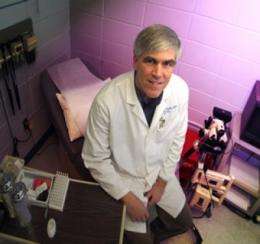
Dr. Daron G. Ferris at Georgia Health Sciences University is leading a National Cancer Institute-funded study to determine whether a polarized filter can help reduce unnecessary cervical biopsies and surgeries. Credit: Phil Jones, GHSU Photographer
The same filtered light that enables sunglasses to reduce glare may improve a physician's ability to detect early signs of cervical cancer, reducing unnecessary biopsies and surgery.
Polarized light is more focused than traditional radial light which scatters in all directions, said Dr. Daron G. Ferris, colposcopist, family medicine physician and Director of the Gynecologic Cancer Prevention Center at Georgia Health Sciences University.
When a woman gets an abnormal Pap smear, it's often followed by a colposcopic exam where radial light and magnification are used to view the cervix then biopsies are performed on suspicious areas.
A National Cancer Institute-funded study is helping determine whether also taking a look through a polarized filter improves the ability to detect precancerous changes, enhancing efficacy while reducing needless biopsies and the discomfort and cost that may result.
"Using both types of light to examine the cervix may give us additional perspective so we can find more disease and avoid treating something that does not need it," Ferris said.
In the study of 300 women age 18 and older, Ferris is first using the standard approach, including marking suspicious areas, then taking another look with the polarized filter to see how the findings correlate before doing a biopsy. "If we use polarized light, how does that change what we can see?" he said.
The approach might be most effective in young women where normal immature cell types in the cervix are more difficult to discriminate from neoplastic cells. This extremely thin skin is an easy target for infection by human papillomavirus, the primary cause of cervical cancer, Ferris said.
"If polarized light eliminates cases where it's not clear whether the area is worrisome or not, that is going to reduce the number of biopsies," Ferris said. "We want to see if it adds value." And the confusion may not end with the biopsy: sometimes biopsies also are misinterpreted, leading to unnecessary surgery.
Just as polarized glasses help fisherman see fish swimming below the water surface, polarized light, which focuses its energy in one direction, also enables physicians to better see beneath the surface of the cervix for telltale signs of trouble. In suspicious areas, blood vessels tend to be more dilated, farther apart and more randomly distributed. "We normally look at superficial blood vessels, but this takes us to a level we have not been able to see," said Ferris of the ability to see 1 millimeter (.04 inches) below the surface with the polarized filter.
Ferris got the idea that polarized light might enhance colposcopy from studying hundreds of images of the cervix taken for fluorescent spectroscopy, which uses a polarized filter to reduce the reflection created by fluorescent light. "I started seeing things that I had never seen before and it struck me that it might be of use in colposcopy," said Ferris, who was part of a study trying to teach computers to recognize cervical lesions.
Dermatologists have been using polarized filters for years to look at external skin surfaces. Some colposcopy machines, where the cervix is viewed through a monitor rather than a microscope, already are equipped with a polarized light filter to reduce glare. Most colposcopes now have green filters that block red light so blood vessels appear black and are easier to detect.
Studies have questioned colposcopy's accuracy. Two National Cancer Institute researchers concluded in a 2006 article in the American Journal of Obstetrics and Gynecology that colposcopy was missing cancerous lesions and efforts to improve accuracy were needed.
The bagel-shaped cervix is the door to the uterus, which produces mucus and helps keep a fetus in the womb during pregnancy. Biopsies of the thin-skinned organ can result in bleeding and increase infection risk.
Journal reference:
American Journal of Obstetrics and Gynecology
Provided by Georgia Health Sciences University
-
New HPV vaccine under study
Nov 19, 2007 |
not rated yet |
0
-
Study: Squid are masters of disguise
Sep 25, 2006 |
not rated yet |
0
-
Student Develops First Polarized LED
Mar 03, 2008 |
not rated yet |
0
-
Light vortex: Circularly polarized luminescence from a stirred and gelled solution of dye
Oct 26, 2011 |
not rated yet |
0
-
Beetles stand out using Avatar tech
Apr 14, 2010 |
not rated yet |
0
-
Of mice and mental models: Neuroscientific implications of risk-optimized behavior in the mouse
May 25, 2012 |
not rated yet |
0
-
Limits to growth: Scientists identify key metastasis-enabling enzyme
May 22, 2012 |
5 / 5 (4) |
0
-
Seeing is as seeing does: Spatially-structured retinal input in early development of cortical maps
Apr 26, 2012 |
5 / 5 (4) |
1
-
Dreamless nights: Brain activity during nonrapid eye movement sleep
Apr 09, 2012 |
4.4 / 5 (12) |
0
-
Take your time: Neurobiology sheds light on the superiority of spaced vs. massed learning
Mar 28, 2012 |
4.5 / 5 (21) |
3
-
Classical and Quantum Mechanics via Lie algebras
Apr 15, 2011
- More from Physics Forums - Independent Research
More news stories
Transvaginal mesh op restores pelvic organ prolapse at price
(HealthDay) -- Transvaginal mesh (TVM) procedures are effective for anatomical restoration of pelvic organ prolapse (POP), but patients report a worsening of sexual function following surgery, according to ...
Other
7 hours ago |
not rated yet |
0
Tongue analysis software uses ancient Chinese medicine to warn of disease
For 5,000 years, the Chinese have used a system of medicine based on the flow and balance of positive and negative energies in the body. In this system, the appearance of the tongue is one of the measures used to classify ...
Other
22 hours ago |
1 / 5 (1) |
0
|
Neck strength, cervical spine mobility don't predict pain
(HealthDay) -- Neither isometric neck muscle strength nor passive mobility of the cervical spine, two physical capacity parameters found to be associated with neck pain in other studies, predicts later neck ...
Other
May 25, 2012 |
not rated yet |
0
Pool access for the disabled sparks controversy
(AP) -- The Obama administration is sidestepping an election-year confrontation with the hotel industry and other pool owners to give them more time to comply with access rules for the disabled.
Other
May 25, 2012 |
not rated yet |
0
Chile to cover sex change operations
Chile will soon cover sex change surgeries under its public health plan in order to allow citizens of limited means to "recover their true sexual identity," Health Minister Jaime Manalich said.
Other
May 25, 2012 |
not rated yet |
0
Travel to high altitudes tied to Crohn's, colitis flare-ups
(HealthDay) -- People with inflammatory bowel disease, which includes Crohn's disease and colitis, may be at increased risk for flare-ups when they fly or travel to high altitudes for skiing or mountain climbing, ...
Family history of Alzheimer's affects functional connectivity
(HealthDay) -- Cognitively normal individuals with a family history of late-onset Alzheimer's disease (AD) may display lower resting state functional connectivity in the default mode network (DMN) of the brain, ...
Of mice and mental models: Neuroscientific implications of risk-optimized behavior in the mouse
(Medical Xpress) -- Regardless of an organism’s biological complexity, every encephalized animal continuously makes under-informed behavioral choices that can have serious consequences. Despite its ubiquity, ...
Weight struggles? Blame new neurons in your hypothalamus
New nerve cells formed in a select part of the brain could hold considerable sway over how much you eat and consequently weigh, new animal research by Johns Hopkins scientists suggests in a study published in the May issue ...
Most occupational injury and illness costs are paid by the government and private payers
UC Davis researchers have found that workers' compensation insurance is not used nearly as much as it should be to cover the nation's multi-billion dollar price tag for workplace illnesses and injuries. Instead, almost 80 ...
Thioridazine kills cancer stem cells in human while avoiding toxic side-effects of conventional cancer treatments
A team of scientists at McMaster University has discovered a drug, thioridazine, successfully kills cancer stem cells in the human while avoiding the toxic side-effects of conventional cancer treatments.