Stop signal discovered for skin cancer
November 15, 2011 in Cancer

Stop signal discovered for skin cancer

Enlarge

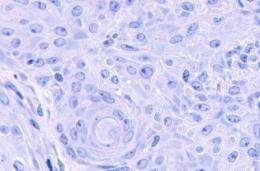
Developing SCC on the skin. Cells are growing in an uncontrolled fashion after damaging the tumour suppressor.

(Medical Xpress) -- An extraordinary breakthrough in understanding what stops a common form of skin cancer from developing could make new cancer treatments and prevention available to the public in five years. 

In research published today in the leading international cancer journal, Cancer Cell, an international team of scientists led by Professor Stephen Jane and Dr Charbel Darido of Monash University's Department of Medicine at the Alfred Hospital, has discovered a gene that helps protect the body from squamous cell cancer (SCC) of the skin.

The Cancer Council estimates that two in three Australians will be diagnosed with before the age of 70 with SCC being one of the most common forms. Up until now, its genetic basis has not been well understood, with surgical treatments the only option.

Professor Jane said the team discovered that a gene with an important role in skin development in the foetus is missing in adult SCC tumour cells. Although the researchers initially focused on skin cancer, they found that the protective gene is also lost in SCC that arises in other tissues, including head and neck cancers, that are often associated with a very poor outcome for the patient.

"Virtually every SCC tumour we looked at had almost undetectable levels of this particular gene, so its absence is a very profound driver of these cancers," Professor Jane said.

In collaboration with Associate Professor Rick Pearson from the Peter MacCallum Cancer Center, the Monash researchers showed that loss of this particular gene knocks out the signal to stop skin cells from growing. Without this stop signal, the cells keep increasing in number and eventually forms a cancer.

Identifying this driver of cancer in skin and other organs provides a clear direction for developing strategies for both prevention and treatment in the relatively near future.

"Our research indicates that drugs already in clinical trials for other cancers may actually be effective in treating SCC - they just need to be applied to skin or head and neck cancers. 

"This means that a number of the usual hurdles in getting therapies to trial have already been cleared, so patients could be reaping the benefits of this research in under five years," Professor Jane said.

"It's a similar case with prevention. There are strategies by which we could increase the expression of this gene that will likely afford some protection from skin cancer, for example in the form of a supplement in sun-cream. The molecules that would increase this expression, are very well validated, so there would be few barriers to applying them in clinical trials."

Collaborating institutions on the paper include the Polish Academy of Sciences, Royal Melbourne Hospital, Walter and Eliza Hall Institute, Harvard Medical School, Peter MacCallum Cancer Centre, and the Alfred Hospital. 

Provided by Monash University search and more info website

5 /5 (7 votes)  

Filter


Move the slider to adjust rank threshold, so that you can hide some of the comments.


Display comments: newest first

Aliceee
Nov 17, 2011

Rank: not rated yet
Thats Great News! It will replace the well-recognized inefficient medication and will give hope for cancer patients
Congratulations for all and especially for Dr Darido who led the work and made the breakthrough.
Rank 5 /5 (7 votes)
Related Stories
Relevant PhysicsForums posts

More news stories

New smartphone application improves colonoscopy preparation

The use of a smartphone application significantly improves patients' preparation for a colonoscopy, according to new research presented today at Digestive Disease Week (DDW). The preparation process, which begins days in ...

Cancer created 21 hours ago | popularity not rated yet | comments 0

Research examines new methods for managing digestive health

Research presented at Digestive Disease Week (DDW) explores new methods for managing digestive health through diet and lifestyle.

Cancer created 21 hours ago | popularity not rated yet | comments 1

New colonoscope provides ground-breaking view of colon

A ground-breaking advance in colonoscopy technology signals the future of colorectal care, according to research presented today at Digestive Disease Week(DDW). Additional research focuses on optimizing the minimal withdrawal ...

Cancer created May 18, 2013 | popularity 5 / 5 (2) | comments 0

ASCO: combo antibody therapy effective for melanoma

(HealthDay)—Concurrent use of two immune checkpoint antibodies—ipilimumab and nivolumab—may be effective for the treatment of advanced melanoma, according to a proof-of-principal study presented in ...

Cancer created May 17, 2013 | popularity not rated yet | comments 0

Risk factors ID'd for poor cutaneous cell CA outcomes

(HealthDay)—The risks of metastasis and death associated with cutaneous squamous cell carcinoma (CSCC) are low, but significant, and risk factors for poor outcome include tumor diameter, invasion beyond ...

Cancer created May 17, 2013 | popularity not rated yet | comments 0 | with audio podcast


Researchers identify a potential new risk for sleep apnea: Asthma

Researchers at the University of Wisconsin have identified a potential new risk factor for obstructive sleep apnea: asthma. Using data from the National Institutes of Health (Heart, Lung, and Blood Institute)-funded Wisconsin ...

Computational tool translates complex data into simplified 2-dimensional images

In their quest to learn more about the variability of cells between and within tissues, biomedical scientists have devised tools capable of simultaneously measuring dozens of characteristics of individual ...

New theory on genesis of osteoarthritis comes with successful therapy in mice

Scientists at Johns Hopkins have turned their view of osteoarthritis (OA) inside out. Literally. Instead of seeing the painful degenerative disease as a problem primarily of the cartilage that cushions joints, ...

Study finds that sleep apnea and Alzheimer's are linked

A new study looking at sleep-disordered breathing (SDB) and markers for Alzheimer's disease (AD) risk in cerebrospinal fluid (CSF) and neuroimaging adds to the growing body of research linking the two.

'Gap' for HIV vaccine efforts after latest setback

The hunt for an HIV vaccine has gobbled up $8 billion in the past decade, and the failure of the most recent efficacy trial has delivered yet another setback to 26 years of efforts.

Ginger compounds may be effective in treating asthma symptoms

Gourmands and foodies everywhere have long recognized ginger as a great way to add a little peppery zing to both sweet and savory dishes; now, a study from researchers at Columbia University shows purified components of the ...