Tweaking a gene makes muscles twice as strong
November 10, 2011 in Genetics

Tweaking a gene makes muscles twice as strong

Enlarge

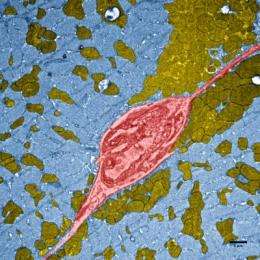
This image shows dramatically enhanced muscle tissue in a high performing mouse, which has greater numbers of mitochondria (brown), the energy factories of cells. Through genetic engineering, the mouse developed stronger muscles than normal, even though it was inactive. In the image, a blood vessel (seen in cross section) is red and muscle fibers are blue. Credit: Courtesy of Salk Institute for Biological Studies

A team of researchers at EPFL, the University of Lausanne and the Salk Institute created super strong, marathon mice and nematodes by reducing the function of a natural inhibitor, suggesting treatments for age-related or genetically caused muscle degeneration are within reach.

It turns out that a tiny inhibitor may be responsible for how strong and powerful our muscles can be. This is the surprising conclusion reached by scientists in EPFL's Laboratory of Integrative Systems Physiology (LISP), in collaboration with a group in the Center for Integrative Genomics at the University of Lausanne and at the Salk Institute in California. By acting on a receptor (NCoR1), they were able to modulate the transcription of certain genes, creating a strain of mighty whose muscles were twice a strong as those of normal mice.

Two protein-building regulators

The process of transcription, in which proteins are manufactured by an organism in response to instructions contained in its DNA, is modulated by co-factors. These either favor (coactivators) or inhibit (corepressors) transcription, in principle by responding to the concentration of certain hormones in the body, which are in turn associated with the organism's environment.

In an article appearing today in the journal Cell, a team led by EPFL professor Johan Auwerx reports on the results of experiments done in parallel on mice and nematodes. By genetically manipulating the offspring of these species, the researchers were able to suppress the NCoR1 corepressor, which normally acts to inhibit the buildup of muscle tissues.

Better muscles

In the absence of the inhibitor, the developed much more effectively. The mice with the mutation became true marathoners, capable of running faster and longer before showing any signs of fatigue. In fact, they were able to cover almost twice the distance run by mice that hadn't received the treatment. They also exhibited better cold tolerance.

Unlike previous experiments with so-called super mice, this study addresses the way energy is burned in the muscle and the way the muscle is built. Examination under a microscope confirmed that the muscle fibers of the modified mice are denser, the muscles are more massive, and the cells in the tissue contain higher numbers of mitochondria--cellular organelles that deliver energy to the muscles.

Similar results were also observed in worms, allowing the scientists to conclude that their results could be applicable to a large range of living creatures.

Obese but not diabetic

According to a second article published in the same journal and also involving EPFL's LISP Laboratory, suppressing the NCoR1 receptor in adipose tissues (fat) also led to interesting results. By acting on this corepressor, it was possible to fundamentally change the corpulence of the mice being studied without inducing weight-related diseases. "The specimens that became obese via this treatment did not suffer from diabetes, unlike mice who become obese for other reasons," notes Auwerx.

The scientists have not yet detected any deleterious side effects associated with eliminating the NCoR1 receptor from muscle and fat tissues, and although the experiments involved genetic manipulations, the researchers are already investigating potential drug molecules that could be used to reduce the receptor's effectiveness.

Treating degeneration

The researchers say their results are a milestone in our understanding of certain fundamental mechanisms of living , in particular the little-studied role of corepressors. In addition, they give a glimpse at possible long-term therapeutic applications. "This could be used to combat weakness in the elderly, which leads to falls and contributes to hospitalizations," emphasizes Auwerx. "In addition, we think that this could be used as a basis for developing a treatment for genetic muscular dystrophy."

If these results are confirmed in humans, there's no question it will attract interest from athletes as well as medical experts. "It will be important for anti-doping authorities to monitor that these treatments are not used in an unauthorized manner," concludes Auwerx.

Provided by Ecole Polytechnique Federale de Lausanne

5 /5 (6 votes)  

Filter


Move the slider to adjust rank threshold, so that you can hide some of the comments.


Display comments: newest first

Vendicar_Decarian
Nov 11, 2011

Rank: 1 / 5 (1)
Kaaaaaaaaaaaaaaaaaaaahhhhhhhhhhhnnnnnnnnnnnn!!!!!!!!!!!!
rubberman
Nov 11, 2011

Rank: 1 / 5 (1)
LMAO!!!!!
It's very cold in space.......
jimbo92107
Nov 11, 2011

Rank: not rated yet
Kaaaaaaaaaaaaaaaaaaaahhhhhhhhhhhnnnnnnnnnnnn!!!!!!!!!!!!


Best strap-on pects I ever seen...in movies.
Rank 5 /5 (6 votes)
Related Stories
Relevant PhysicsForums posts

More news stories

Researchers identify first drug targets in childhood genetic tumor disorder

Two mutations central to the development of infantile myofibromatosis (IM)—a disorder characterized by multiple tumors involving the skin, bone, and soft tissue—may provide new therapeutic targets, according to researchers ...

Genetics created 11 hours ago | popularity 3 / 5 (2) | comments 0 | with audio podcast

Patenting the human genome

Can human genes be patented? That was the question posed by Alan J. Snyder, vice president and associate provost for research and graduate studies at Lehigh, and Lee Kaplan, scientific director of cellular and molecular genetics ...

Genetics created 18 hours ago | popularity 4 / 5 (1) | comments 0

Researchers complete largest genetic sequencing study of human disease

Researchers from Queen Mary, University of London have led the largest sequencing study of human disease to date, investigating the genetic basis of six autoimmune diseases.

Genetics created May 22, 2013 | popularity 4.5 / 5 (4) | comments 0 | with audio podcast

Researchers develop model for better testing, targeting of malignant peripheral nerve sheath tumors

University of Minnesota Medical School researchers from the Masonic Cancer Center, University of Minnesota, in partnership with the University's Brain Tumor Program, have developed a new mouse model of malignant peripheral ...

Genetics created May 20, 2013 | popularity 5 / 5 (1) | comments 0 | with audio podcast

Researchers identify new circadian clock component

Northwestern University scientists have shown a gene involved in neurodegenerative disease also plays a critical role in the proper function of the circadian clock.

Genetics created May 16, 2013 | popularity 3 / 5 (1) | comments 1 | with audio podcast


Engineered cytomegalovirus protects monkeys from HIV equivalent

(Medical Xpress)—A new study by researchers in the US has shown that an ancient virus can be modified to help in the fight against the simian immunodeficiency virus SIV, which is the equivalent in monkeys ...

Hormone levels may provide key to understanding psychological disorders in women

Women at a particular stage in their monthly menstrual cycle may be more vulnerable to some of the psychological side-effects associated with stressful experiences, according to a study from UCL.

Going live: Immune cell activation in multiple sclerosis

Biological processes are generally based on events at the molecular and cellular level. To understand what happens in the course of infections, diseases or normal bodily functions, scientists would need to ...

Help at hand for people with schizophrenia

How can healthy people who hear voices help schizophrenics? Finding the answer for this is at the centre of research conducted at the University of Bergen.

Alzheimer's disease, the soft target of the euthanasia debate

(Medical Xpress)—The way Alzheimer's disease is portrayed by advocacy groups and the media is having undue influence on the euthanasia debate, according to a Deakin University nursing ethics professor.

Depression raises diabetics' risk of severe low blood sugar episodes

(Medical Xpress)—Patients with diabetes who are depressed are much more likely to develop episodes of dangerously low blood sugars, or hypoglycemia, than are those who are not depressed, a new study has ...