Century-old brains may hold future of treatment for mentally ill, pathologist says
December 6, 2011 in Medical research
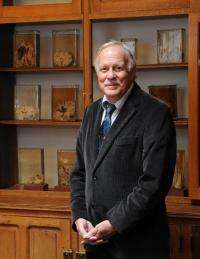
This is George Sandusky, D.V.M., Ph.D., senior research professor of pathology and laboratory science at the Indiana University School of Medicine, with brain samples on display at the Indiana Medical History Museum in Indianapolis. Credit: Indiana University School of Medicine
Visitors to the Indiana Medical History Museum in Indianapolis may find the 19th-century brains on display a strange reminder of the building's past as an insane asylum, but a recent breakthrough using these samples by a pathologist from the Indiana University School of Medicine could spell the future of detecting mental illness.
George Sandusky, D.V.M., Ph.D., senior research professor of pathology and laboratory science at the IU School of Medicine, is working to extract DNA from brains preserved more than 100 years ago and displayed in jars at the museum. The goal is to improve diagnosis and treatment for psychological illnesses such as bipolar disorder, schizophrenia and post-traumatic stress disorder using a simple blood test.
"This work could make an impact on patient care a huge impact," said Dr. Sandusky. "It's going to help diagnose patients with mental disorders quicker and faster."
Using brain donors from traditional sources to advance this goal only brings in about 12 new subjects per year. The museum collection, which includes over 400 specimens, could speed the arrival of new diagnoses and treatments for the mentally ill by decades, he added.
The brain samples under investigation come from turn-of-the-century patients who suffered from mental disorders at Central State Hospital, an asylum established in the mid-1800s to house the state's mentally ill. The museum is located in the former pathology building at Central State on the near west side of Indianapolis.
John Pless, M.D., Culbertson Professor Emeritus of Pathology at the IU School of Medicine and former chair of the museum board of trustees, first proposed the brains might be able to help advance modern medicine. Dr. Sandusky, who also serves on the museum board, was originally trying to simply determine whether the aging specimens contained viable genetic information. All tissues used in this research received ethical and legal approval from an internal review board at the state and at the university.
The key breakthrough in the project arrived last summer after Dr. Sandusky and two undergraduate student researchers, Erin Niland and Audrey McGuire, discovered that functional DNA could be isolated and extracted from the museum's brain samples, despite their extreme age and the preservation techniques used by 19th-century doctors.
"They preserved the brains with the best science of their time," said Dr. Sandusky. "The preservation techniques from the era were almost as good as ours from the 1970s, 1980s, 1990s and 2000s. I was shocked by the quality."
Earlier tests conducted in 2010 yielded unusable results, but new technology as well as experienced lab workers and cutting-edge test methods ultimately "cracked the code." The lab facilities used to achieve this breakthrough are managed by the Indiana Clinical and Translational Sciences Institute.
The results support work by Alexander Niculescu, M.D., Ph.D., associate professor of psychiatry at the IU School of Medicine, who is seeking to advance personalized medicine in the treatment of mental illness using biomarkers for bipolar disorder, schizophrenia and PTSD. A biomarker is a specific region on a gene that suggests susceptibility to a certain illness. They are an increasingly common tool in the fight against cancer and other diseases, but no reliable test exists for psychiatric disorders.
Dr. Niculescu, however, is making significant advances in pinpointing potential biomarkers for mental illness through research conducted at the Richard L. Roudebush VA Medical Center in Indianapolis. The samples from the Indiana Medical History Museum are being tested for the same telltale signs.
The goal is to use data from both studies to assist future physicians in creating a personal genetic profile for people suffering from psychiatric illnesses to ensure they are diagnosed quickly and accurately. The search for identifiable biomarkers will pioneer new, innovative treatments in clinical practice by eliminating the current system of diagnosis, which requires significant trial and error.
"If you come in with a psychiatric illness today, you can't really separate different mental disorders," Dr. Sandusky said. "You have to try several drugs before finding one that even works and that may take months."
Provided by Indiana University School of Medicine
-
Blood testing for mood disorders
Feb 25, 2008 |
not rated yet |
0
-
Researchers refine DNA testing for predisposition to bipolar disorder
Apr 12, 2010 |
not rated yet |
0
-
High rates of substance abuse exist among veterans with mental illness
Apr 19, 2011 |
not rated yet |
0
-
Epigenetic changes discovered in major psychosis
Mar 11, 2008 |
not rated yet |
0
-
Fish oil may have positive effects on mood, alcohol craving, new study shows
May 26, 2011 |
not rated yet |
0
-
Motion perception revisited: High Phi effect challenges established motion perception assumptions
Apr 23, 2013 |
3 / 5 (2) |
2
-
Anything you can do I can do better: Neuromolecular foundations of the superiority illusion (Update)
Apr 02, 2013 |
4.5 / 5 (11) |
5
-
The visual system as economist: Neural resource allocation in visual adaptation
Mar 30, 2013 |
5 / 5 (2) |
9
-
Separate lives: Neuronal and organismal lifespans decoupled
Mar 27, 2013 |
4.9 / 5 (8) |
0
-
Sizing things up: The evolutionary neurobiology of scale invariance
Feb 28, 2013 |
4.8 / 5 (10) |
14
-
How can there be a term called "intestinal metaplasia" of stomach
7 hours ago
-
Pressure-volume curve: Elastic Recoil Pressure don't make sense
May 18, 2013
-
If you became brain-dead, would you want them to pull the plug?
May 17, 2013
-
MRI bill question
May 15, 2013
-
Ratio of Hydrogen of Oxygen in Dessicated Animal Protein
May 13, 2013
-
Alcohol and acetaminophen
May 13, 2013
- More from Physics Forums - Medical Sciences
More news stories
Common food supplement fights degenerative brain disorders
Widely available in pharmacies and health stores, phosphatidylserine is a natural food supplement produced from beef, oysters, and soy. Proven to improve cognition and slow memory loss, it's a popular treatment for older ...
Medical research
2 hours ago |
5 / 5 (1) |
0
|
Finding a family for a pair of orphan receptors in the brain
Researchers at Emory University have identified a protein that stimulates a pair of "orphan receptors" found in the brain, solving a long-standing biological puzzle and possibly leading to future treatments for neurological ...
Medical research
2 hours ago |
not rated yet |
0
|
Insight into the dazzling impact of insulin in cells
Australian scientists have charted the path of insulin action in cells in precise detail like never before. This provides a comprehensive blueprint for understanding what goes wrong in diabetes.
Medical research
3 hours ago |
4.5 / 5 (2) |
0
|
Do men's and women's hearts burn fuel differently?
Researchers at the University of Illinois at Chicago College of Medicine will study gender differences in how the heart uses and stores fat—its main energy source—and how changes in fat metabolism play ...
Medical research
5 hours ago |
not rated yet |
0
Study suggests new source of kidneys for transplant
Nearly 20 percent of kidneys that are recovered from deceased donors in the U.S. are refused for transplant due to factors ranging from scarring in small blood vessels of the kidney's filtering units to the organ going too ...
Medical research
22 hours ago |
5 / 5 (2) |
0
|
B vitamins could delay dementia
(Medical Xpress)—Despite spending billions of dollars on research and development, drug companies have been unable to come up with effective treatments for dementia and Alzheimer's Disease (AD). Now, A. ...
Drugs found to both prevent and treat Alzheimer's disease in mice
Researchers at USC have found that a class of pharmaceuticals can both prevent and treat Alzheimer's Disease in mice.
Enrichment therapy effective among children with autism, study finds
Children with autism showed significant improvement after six months of simple sensory exercises at home using everyday items such as scents, spoons and sponges, according to UC Irvine neurobiologists.
Poliovirus vaccine trial shows early promise for recurrent glioblastoma
An attack on glioblastoma brain tumor cells that uses a modified poliovirus is showing encouraging results in an early study to establish the proper dose level, researchers at Duke Cancer Institute report.
'Doctor shopping' by obese patients negatively affects health
Overweight and obese patients are significantly more likely than their normal-weight counterparts to repeatedly switch primary care doctors, a practice that disrupts continuity of care and leads to more emergency room visits, ...
Decisions to forgo life support may depend heavily on the ICU where patients are treated
The decision to limit life support in patients in the intensive care unit (ICU) appears to be significantly influenced by physician practices and/or the culture of the hospital, suggests new findings from researchers at the ...