Characterizing a toxic offender
December 9, 2011 in Neuroscience
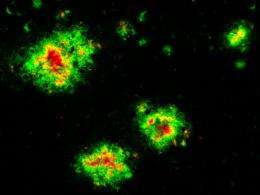
Figure 1: Amyloid plaque in the brain of a human suffering from Alzheimer's disease in which Aβ43 forms the plaque core. Green shows the total Aβ peptide. Red shows the Aβ43 peptide and yellow shows these colors merged. Credit: 2011 Takashi Saito
The brains of individuals with Alzheimer's disease contain protein aggregates called plaques and tangles, which interfere with normal communication between nerve cells and cause progressive learning and memory deficits. Now, a research team led by Takaomi Saido from the RIKEN Brain Science Institute in Wako has identified a particular fragment of the amyloid precursor protein (APP) that contributes to the formation of plaques in the brain.
Enzymes cut APP to form shorter protein fragments and, in Alzheimer's patients, these sticky fragments clump together to form amyloid plaques. Most current research on this disease focuses on a 42 amino acid-long fragment called Aβ42, in part because other researchers had shown that APP mutations that increase Aβ42 cause Alzheimer's disease in some families. Other APP fragments are also found in the brain of individuals with Alzheimer's disease, but their role in disease was unclear.
Saido and colleagues studied a 43 amino acid-long fragment called Aβ43 because other groups have shown that it can form aggregates as readily as Aβ42 (Fig. 1). The researchers generated mice that have a mutation in the presenilin-1 gene that contributes to the cleavage of APP, and showed that it led to increased formation of Aβ43 in cell culture experiments.
The research team then mated these presenilin-1 mutant mice to APP mutant mice, which display many symptoms of Alzheimer's disease, such as deposition of plaques in the brain and a gradual loss of memory. APP mutant mice generally exhibit plaque formation at one year of age. However, with the increase in Aβ43 caused by the presence of the presenilin-1 mutation, these so-called 'double-mutant mice' had plaques in their brain six months earlier than usual. The double-mutant mice also seemed to show memory deficits at an even earlier age than APP mutant mice. Furthermore, the research team showed that Aβ43 is even more prone to aggregate and to cause neuronal damage than is Aβ42.
The findings therefore suggest that Aβ43 plays a role in accelerating Alzheimer's disease. Saido and colleagues argue that therapies that specifically prevent Aβ43 accumulation, such as by enhancing the cleavage of Aβ43 into shorter Aβ fragments, or by stimulating the immune system to clear Aβ43, could therefore be beneficial in slowing the progression of Alzheimer's disease.
Aβ43 could also be a diagnostic marker for Alzheimer's disease, explains Takashi Saito, the first author of the study. We would now like to develop it along these lines.
More information: Saito, T., et al. Potent amyloidogenicity and pathogenicity of Aβ43. Nature Neuroscience 14, 10231032 (2011)
Provided by
RIKEN
-
Overlooked peptide reveals clues to causes of Alzheimer's disease
Jul 03, 2011 |
not rated yet |
0
-
Variant form of amyloid beta hinders amyloidogenesis, development of Alzheimer's disease
Mar 12, 2009 |
not rated yet |
0
-
Potential new drug candidate found for Alzheimer's disease
May 31, 2011 |
not rated yet |
0
-
New key factor identified in the development of Alzheimer's disease
Jan 04, 2010 |
not rated yet |
0
-
Gladstone scientists identify process by which Alzheimer's disease creeps through the brain
Nov 03, 2010 |
not rated yet |
0
-
Motion perception revisited: High Phi effect challenges established motion perception assumptions
Apr 23, 2013 |
3 / 5 (2) |
2
-
Anything you can do I can do better: Neuromolecular foundations of the superiority illusion (Update)
Apr 02, 2013 |
4.5 / 5 (11) |
5
-
The visual system as economist: Neural resource allocation in visual adaptation
Mar 30, 2013 |
5 / 5 (2) |
9
-
Separate lives: Neuronal and organismal lifespans decoupled
Mar 27, 2013 |
4.9 / 5 (8) |
0
-
Sizing things up: The evolutionary neurobiology of scale invariance
Feb 28, 2013 |
4.8 / 5 (10) |
14
-
Pressure-volume curve: Elastic Recoil Pressure don't make sense
May 18, 2013
-
If you became brain-dead, would you want them to pull the plug?
May 17, 2013
-
MRI bill question
May 15, 2013
-
Ratio of Hydrogen of Oxygen in Dessicated Animal Protein
May 13, 2013
-
Alcohol and acetaminophen
May 13, 2013
-
Marie Curie's leukemia
May 13, 2013
- More from Physics Forums - Medical Sciences
More news stories
For combat veterans suffering from post-traumatic stress disorder, 'fear circuitry' in the brain never rests
Chronic trauma can inflict lasting damage to brain regions associated with fear and anxiety. Previous imaging studies of people with post-traumatic stress disorder, or PTSD, have shown that these brain regions can over-or ...
Neuroscience
May 18, 2013 |
5 / 5 (1) |
0
|
Temporal processing in the olfactory system
The neural machinery underlying our olfactory sense continues to be an enigma for neuroscience. A recent review in Neuron seeks to expand traditional ideas about how neurons in the olfactory bulb might encode information about ...
Neuroscience
May 17, 2013 |
4 / 5 (1) |
0
|
Melon focus headband turns to Kickstarter for rollout plans
(Medical Xpress)—What if the quality of your work depends more on your focus on the piano keys or canvas or laptop than your musical or painting or computing skills? If target users can be convinced, they ...
Neuroscience
May 17, 2013 |
3.7 / 5 (3) |
0
|
Deep brain stimulation: A fix when the drugs don't work
Neurological disorders can have a devastating impact on the lives of sufferers and their families.
Neuroscience
May 17, 2013 |
5 / 5 (1) |
0
|
Brain makes call on which ear is used for cell phone
If you're a left-brain thinker, chances are you use your right hand to hold your cell phone up to your right ear, according to a newly published study from Henry Ford Hospital in Detroit.
Neuroscience
May 16, 2013 |
2 / 5 (2) |
0
|
Blame your parents for bunion woes
A novel study reports that white men and women of European descent inherit common foot disorders, such as bunions (hallux valgus) and lesser toe deformities, including hammer or claw toe. Findings from the Framingham Foot ...
Commonly used catheters double risk of blood clots in ICU and cancer patients
Touted for safety, ease and patient convenience, peripherally inserted central catheters have become many clinicians' go-to for IV delivery of antibiotics, nutrition, chemotherapy, and other medications.
New theory on genesis of osteoarthritis comes with successful therapy in mice
Scientists at Johns Hopkins have turned their view of osteoarthritis (OA) inside out. Literally. Instead of seeing the painful degenerative disease as a problem primarily of the cartilage that cushions joints, ...
Computational tool translates complex data into simplified 2-dimensional images
In their quest to learn more about the variability of cells between and within tissues, biomedical scientists have devised tools capable of simultaneously measuring dozens of characteristics of individual ...
Researchers identify a potential new risk for sleep apnea: Asthma
Researchers at the University of Wisconsin have identified a potential new risk factor for obstructive sleep apnea: asthma. Using data from the National Institutes of Health (Heart, Lung, and Blood Institute)-funded Wisconsin ...
Study finds that sleep apnea and Alzheimer's are linked
A new study looking at sleep-disordered breathing (SDB) and markers for Alzheimer's disease (AD) risk in cerebrospinal fluid (CSF) and neuroimaging adds to the growing body of research linking the two.