New study fundamentally alters our understanding of lung growth
December 6, 2011 in Medical research
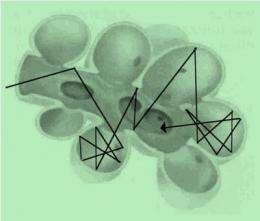
This is an illustration of a helium molecule bouncing off alveolar walls. Credit: University of Leicester
A ground-breaking international study into the ways lungs grow and develop has challenged existing medical understanding that our lungs are completely formed by the age of three.
The researchers, led by a team at the University of Leicester, put forward a theory for the first time based on research evidence that new air sacs, called alveoli, are constantly being formed. This contradicts information in most medical textbooks that explain that the tiny air sacs begin to develop before birth (around the 6th month of pregnancy) and continue to increase in number until the age of about 3 years.
Dr. Manjith Narayanan, one of the leaders of the study from the University of Leicester, said: "It was believed that there was no further increase in the number of alveoli beyond that age, and that the existing alveoli just expanded as the lungs grew bigger until final adult size was reached."
"Our study has challenged this by suggesting that new alveoli continue to be formed as the lungs grow."
The study, published online ahead of print in the American Journal of Respiratory and Critical Care Medicine, was a collaboration between researchers in the Department of Infection, Immunity and Inflammation, University of Leicester, the Department of Physics and Astronomy, University of Nottingham, and the University of Bern. It was funded by The Wellcome Trust1.
The researchers studied over 100 healthy volunteers aged between 7 and 21 years. Each volunteer had a range of breathing tests in Leicester, and was then accompanied to Nottingham for a special magnetic resonance (MR) scan, during which they breathed in hyperpolarised helium and held their breaths.
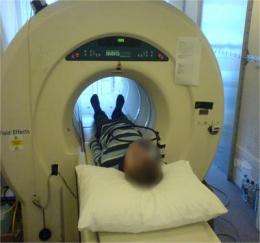
MR scanner with an anonymous subject. Credit: University of Leicester
Dr. Narayanan, a Clinical Research Fellow, explains:"The helium is hyperpolarised, which means that the molecules all line up in one direction and it then behaves like a magnetised gas. Within the scanner, we can measure how the magnetism decays, and this in turn depends on the size of the air sacs alveoli which contain the helium. The technique is safe and not painful or uncomfortable in any way."
Senior Lecturer at Leicester Dr. Caroline Beardsmore describes the study:
"We studied small children, whose lungs contain approximately one litre of air, and full-grown adults with lung volumes of around four litres. We found very little difference in the size of the alveoli across everyone we studied. If the size of the alveoli are hardly changing, this can only mean one thing as our lungs increase in size, we must be growing new alveoli."
Professor Mike Silverman, Emeritus Professor of Child Health at Leicester, adds:
"This research has important implications. If we can continue to develop new alveoli beyond early childhood, going on through adolescence, there is the potential for lung repair following injury that was never realised before. Conversely, external factors (possibly including inhaled pollution) could have a negative impact on lung development. We now have the basis for looking at many factors with the potential to impact on lung health in the future."
More information: Manjith Narayanan, John Owers-Bradley, Caroline S. Beardsmore, Marius Mada, Iain Ball, Ruslan Garipov, Kuldeep Panesar, Claudia E. Kuehni, Ben Spycher, Sian E. Williams, Michael Silverman. Alveolarization continues during childhood and adolescence: new evidence from 3He magnetic resonance. Am. J. Respir. Crit Care Med In Press published ahead of print on October 27, 2011 as doi:10.1164/rccm.201107-1348OC
Provided by
University of Leicester
-
New technique reveals insights into lung disease
Dec 13, 2007 |
not rated yet |
0
-
Stem cells repair lung damage after flu infection
Oct 27, 2011 |
not rated yet |
0
-
US researchers identify first human lung stem cell
May 11, 2011 |
not rated yet |
0
-
Secondhand smoke damages lungs, MRIs show
Nov 26, 2007 |
not rated yet |
0
-
New insights come from tracing cells that irreversibly scar lungs
Dec 01, 2011 |
not rated yet |
0
-
Of mice and mental models: Neuroscientific implications of risk-optimized behavior in the mouse
May 25, 2012 |
not rated yet |
0
-
Limits to growth: Scientists identify key metastasis-enabling enzyme
May 22, 2012 |
5 / 5 (4) |
0
-
Seeing is as seeing does: Spatially-structured retinal input in early development of cortical maps
Apr 26, 2012 |
5 / 5 (4) |
1
-
Dreamless nights: Brain activity during nonrapid eye movement sleep
Apr 09, 2012 |
4.4 / 5 (12) |
0
-
Take your time: Neurobiology sheds light on the superiority of spaced vs. massed learning
Mar 28, 2012 |
4.5 / 5 (21) |
3
-
Potential Breakthrough in Seizure Control
13 hours ago
-
Popping/Cracked sternum.
18 hours ago
-
Which Mental Illness Encompasses This Problem?
18 hours ago
-
A question about drug tolerance
May 23, 2012
-
Poor nutrition leading to overeating?
May 23, 2012
-
Math and dyslexia?
May 21, 2012
- More from Physics Forums - Medical Sciences
More news stories
Implantable pain disk may help those with cancer
An estimated 3.5 million cancer patients around the globe are in severe pain from their disease, but many get no relief.
Medical research
May 25, 2012 |
not rated yet |
0
|
Energy levels link sleep control mechanisms
Sleep, or lack of it, can determine level of cognitive performance which is linked with accidents as well as increased risk of serious health problems. Links between cell energy levels, gene transcription ...
Medical research
May 25, 2012 |
not rated yet |
0
Researchers identify key brain cell in antidepressant action
(Medical Xpress) -- Antidepressant medications such as Prozac have helped improve mood and lessen anxiety in millions of people with major depression. But scientists know surprisingly little about how these drugs work.
Medical research
May 25, 2012 |
4.7 / 5 (3) |
0
|
Rockefeller scientists pioneer new method to determine mechanisms of drug action
(Medical Xpress) -- Knowing that a drug works is great. Knowing how it works is a luxury. And until now, determining a drugs mechanism of action has been a tedious and difficult process for scientists.
Medical research
May 25, 2012 |
not rated yet |
0
|
Like curry? New biological role identified for compound used in ancient medicine
Scientists have just identified a new reason why some curry dishes, made with spices humans have used for thousands of years, might be good for you.
Medical research
May 25, 2012 |
4.5 / 5 (12) |
2
|
Travel to high altitudes tied to Crohn's, colitis flare-ups
(HealthDay) -- People with inflammatory bowel disease, which includes Crohn's disease and colitis, may be at increased risk for flare-ups when they fly or travel to high altitudes for skiing or mountain climbing, ...
Family history of Alzheimer's affects functional connectivity
(HealthDay) -- Cognitively normal individuals with a family history of late-onset Alzheimer's disease (AD) may display lower resting state functional connectivity in the default mode network (DMN) of the brain, ...
Transvaginal mesh op restores pelvic organ prolapse at price
(HealthDay) -- Transvaginal mesh (TVM) procedures are effective for anatomical restoration of pelvic organ prolapse (POP), but patients report a worsening of sexual function following surgery, according to ...
Tongue analysis software uses ancient Chinese medicine to warn of disease
For 5,000 years, the Chinese have used a system of medicine based on the flow and balance of positive and negative energies in the body. In this system, the appearance of the tongue is one of the measures used to classify ...
Of mice and mental models: Neuroscientific implications of risk-optimized behavior in the mouse
(Medical Xpress) -- Regardless of an organism’s biological complexity, every encephalized animal continuously makes under-informed behavioral choices that can have serious consequences. Despite its ubiquity, ...
Weight struggles? Blame new neurons in your hypothalamus
New nerve cells formed in a select part of the brain could hold considerable sway over how much you eat and consequently weigh, new animal research by Johns Hopkins scientists suggests in a study published in the May issue ...
