Neuroscientists identify a master controller of memory
December 22, 2011 by Anne Trafton in Neuroscience

Neuroscientists identify a master controller of memory

Enlarge

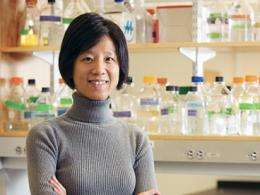
Yingxi Lin, a member of the McGovern Institute for Brain Research and the the Frederick and Carole Middleton Career Development Assistant Professor of Brain and Cognitive Sciences. Photo courtesy Kent Dayton

When you experience a new event, your brain encodes a memory of it by altering the connections between neurons. This requires turning on many genes in those neurons. Now, MIT neuroscientists have identified what may be a master gene that controls this complex process.

The findings, described in the Dec. 23 issue of Science, not only reveal some of the molecular underpinnings of memory formation — they may also help neuroscientists pinpoint the exact locations of memories in the .

The research team, led by Yingxi Lin, a member of the McGovern Institute for Brain Research at MIT, focused on the Npas4 gene, which previous studies have shown is turned on immediately following new experiences. The gene is particularly active in the hippocampus, a brain structure known to be critical in forming long-term memories.

Lin and her colleagues found that Npas4 turns on a series of other genes that modify the brain’s internal wiring by adjusting the strength of synapses, or connections between . “This is a gene that can connect from experience to the eventual changing of the circuit,” says Lin, the Frederick and Carole Middleton Career Development Assistant Professor of Brain and Cognitive Sciences.

To investigate the genetic mechanisms of memory formation, the researchers studied a type of learning known as contextual fear conditioning: Mice receive a mild electric shock when they enter a specific chamber. Within minutes, the mice learn to fear the chamber, and the next time they enter it, they freeze.

The researchers showed that Npas4 is turned on very early during this conditioning. “This sets Npas4 apart from many other activity-regulated genes,” Lin says. “A lot of them are ubiquitously induced by all these different kinds of stimulations; they are not really learning-specific.”

Furthermore, Npas4 activation occurs primarily in the CA3 region of the hippocampus, which is already known to be required for fast learning.

“We think of Npas4 as the initial trigger that comes on, and then in turn, in the right spot in the brain, it activates all these other downstream targets. Eventually they’re going to modify synapses in a way that’s likely changing synaptic inhibition or some other process that we’re trying to figure out,” says Kartik Ramamoorthi, a graduate student in Lin’s lab and lead author of the paper.

Genetic regulation

So far, the researchers have identified only a few of the genes regulated by Npas4, but they suspect there could be hundreds more. Npas4 is a transcription factor, meaning it controls the copying of other genes into messenger RNA — the genetic material that carries protein-building instructions from the nucleus to the rest of the cell. The MIT experiments showed that Npas4 binds to the activation sites of specific genes and directs an enzyme called RNA polymerase II to start copying them.

“Npas4 is providing this instructive signal,” Ramamoorthi says. “It’s telling the polymerase to land at certain genes, and without it, the polymerase doesn’t know where to go. It’s just floating around in the nucleus.”

When the researchers knocked out the gene for Npas4, they found that mice could not remember their fearful conditioning. They also found that this effect could be produced by knocking out the gene just in the CA3 region of the hippocampus. Knocking it out in other parts of the hippocampus, however, had no effect. Though they focused on contextual fear conditioning, the researchers believe that Npas4 will also prove critical for other types of learning.

Gleb Shumyatsky, an assistant professor of genetics at Rutgers University, says that an important next step is to identify more of the controlled by Npas4, which should reveal more of its role in . “It’s definitely one of the major players,” says Shumyatsky, who was not involved in this research. “Future experiments will show how major a player it is.”

The MIT team also plans to investigate whether the same neurons that turn on Npas4 when memories are formed also turn it on when memories are retrieved. This could help them pinpoint the exact neurons that are storing particular memories.

“We’re hunting for the memory, and we think we can use Npas4 to mark where it is,” Ramamoorthi says. “That’s because it’s turned on specifically and now we can label the cells and maybe fish out where in the brain the memory is sitting.”

More information: Npas4 Regulates a Transcriptional Program in CA3 Required for Contextual Memory Formation, Science, 23 December 2011:
Vol. 334 no. 6063 pp. 1669-1675. DOI: 10.1126/science.1208049

Journal reference: Science search and more info website

Provided by Massachusetts Institute of Technology search and more info website

This story is republished courtesy of MIT News (web.mit.edu/newsoffice/), a popular site that covers news about MIT research, innovation and teaching.

5 /5 (17 votes)  

Filter


Move the slider to adjust rank threshold, so that you can hide some of the comments.


Display comments: newest first

BobKob
Dec 23, 2011

Rank: 5 / 5 (2)
Kevin, you're the epitome of ignorance. Your reasoning is that you cannot fathom the possibility of evolution, therefore it must be false - and I suspect no amount of evidence will convince you otherwise.

The only solution is that you'll eventually be bred or killed out of existence.
satanfornoreason
Dec 23, 2011

Rank: 5 / 5 (5)
kevinrtrs

You have a fundamental misunderstanding of evolution. Fortunately, evolution does not mean whatever you say it does.

You would be absolutely correct and responding reasonably if evolution did work by chance, but it does not. It is the opposite of chance.

Mutation is random, and most mutations are bad for a working organism, so most organisms with mutations in their genes that natural selection can work on do not make it very far in evolution (by their definition, bad mutations are bad). However, some random mutations, which occur by chance, have an adaptive advantage to the organism, which allows natural selection to work on it. That means that natural selection assures that - over time and on average - genes that confer a survival or reproductive advantage onto the organism in which they are contained will tend to - ahem, survive and reproduce and make it into the next generation.

That is predictable, not random.

Before you continue spouting your ignorance, read.
kochevnik
Dec 23, 2011

Rank: not rated yet
Fundies like kevinrtrs strategically place their posts like suicide bombers. They implant these rhetorical devises at the beginning of articles, then run far away before the inevitable BOOM from rational readers. In so disappearing they avoid any risk of overcoming their ignorance.
Tausch
Dec 24, 2011

Rank: not rated yet
This reminds me of pathway analysis.
Here a few fully and partial known pathways(5200 pathways):
http://www.genego...;show=20

Perhaps they are mapping a new pathway specific for memory.
Sinister1811
Dec 26, 2011

Rank: not rated yet
So they could, in effect, boost this gene somehow and allow for easy memorization of things. But I suspect that there are many other genes that also come into play. That's still fascinating, however.
Rank 5 /5 (17 votes)
Relevant PhysicsForums posts

More news stories

For combat veterans suffering from post-traumatic stress disorder, 'fear circuitry' in the brain never rests

Chronic trauma can inflict lasting damage to brain regions associated with fear and anxiety. Previous imaging studies of people with post-traumatic stress disorder, or PTSD, have shown that these brain regions can over-or ...

Neuroscience created 19 hours ago | popularity 5 / 5 (1) | comments 0 | with audio podcast

Temporal processing in the olfactory system

The neural machinery underlying our olfactory sense continues to be an enigma for neuroscience. A recent review in Neuron seeks to expand traditional ideas about how neurons in the olfactory bulb might encode information about ...

Neuroscience created May 17, 2013 | popularity not rated yet | comments 0 | with audio podcast report

Melon focus headband turns to Kickstarter for rollout plans

(Medical Xpress)—What if the quality of your work depends more on your focus on the piano keys or canvas or laptop than your musical or painting or computing skills? If target users can be convinced, they ...

Neuroscience created May 17, 2013 | popularity 3.7 / 5 (3) | comments 0 | with audio podcast weblog

Deep brain stimulation: A fix when the drugs don't work

Neurological disorders can have a devastating impact on the lives of sufferers and their families.

Neuroscience created May 17, 2013 | popularity 5 / 5 (1) | comments 0 | with audio podcast

Brain makes call on which ear is used for cell phone

If you're a left-brain thinker, chances are you use your right hand to hold your cell phone up to your right ear, according to a newly published study from Henry Ford Hospital in Detroit.

Neuroscience created May 16, 2013 | popularity 2 / 5 (2) | comments 0 | with audio podcast


New research identifies risks, interventions for children's GI health

An increasing number of U.S. children are experiencing gastrointestinal issues that require interventions to resolve, according to research presented at Digestive Disease Week (DDW).

US psychiatry gets makeover in new manual

The latest makeover to a massive psychiatric tome honored by some, reviled by others and even called the "Bible" of mental disorders is being released Saturday with a host of new changes.

New case of SARS-like virus in Saudi: ministry

A new case of the deadly coronavirus has been detected in Saudi Arabia where 15 people have already died after contracting it, the health ministry announced on Saturday on its Internet website.

AIDS science at 30: 'Cure' now part of lexicon

Big names in medicine are set to give an upbeat assessment of the war on AIDS on Tuesday, 30 years after French researchers identified the virus that causes the disease.

New colonoscope provides ground-breaking view of colon

A ground-breaking advance in colonoscopy technology signals the future of colorectal care, according to research presented today at Digestive Disease Week(DDW). Additional research focuses on optimizing the minimal withdrawal ...

Flesh-eating disease victim gets prosthetic hands

(AP)—A woman who lost both hands, her left leg and right foot after contracting a flesh-eating disease has been fitted with prosthetic hands.