Remembrance of things future: Long-term memory sets the stage for visual perception
December 28, 2011
by Stuart Mason Dambrot
in Neuroscience
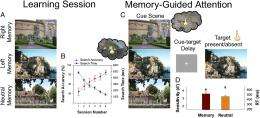
Experimental protocol for memory-guided attention. (A) In both EEG and fMRI experiments, participants first completed a learning task in which they searched for a target stimulus that was embedded within naturalistic scenes. Targets were presented on the right (Right Memory), left (Left Memory) or not at all (Neutral Memory). (B) Over repeated sessions, participants found, and learned, the location of target stimuli. The learning profile from the EEG experiment is plotted for search accuracy (left y axis, red) and search time (right y axis, blue) as a function of training session number (x axis). (C) On the following day, participants performed an attention task in which scenes from the initial learning task were used to cue the location of a subsequent target. The first scene was always presented without the target stimulus, whereas the second scene contained a target on 50% of trials. On target-present trials, previously learned locations were 100% predictive of the subsequent target location. Consequently, valid memory cue scenes could be used to predict the precise location of the subsequent target, whereas memories for neutral cues contained no task-relevant spatial information. (D) Behavioral data are shown for the EEG experiment, with sensitivity (left y axis, bars) and RT (right y axis, triangles) plotted as a function memory condition (memory vs. neutral). Detection sensitivity was higher for spatially predictive memories, and RTs were shorter. Error bars represent ±1 SEM. Copyright © PNAS, doi: 10.1073/pnas.1108555108
(Medical Xpress) -- Rather than being a passive state, perception is an active process fueled by predictions and expectations about our environment. In the latter case, memory must be a fundamental component in the way our brain generates these precursors to the perceptual experience – but how the brain integrates long-term memory with perception has not been determined. Recently, however, researchers in the Department of Experimental Psychology at the University of Oxford, by devising a method for integrating memory and attention, showed how LTM optimizes perception by varying brain states associated with anticipation of spatial localization in the visual field. The scientists also used fMRI to articulate a neural network involving a number of cortical areas likely to be active in the predictive use of memory in the visual cortex.
Lead researcher Mark G. Stokes, working with Kathryn Atherton, Eva Zita Patai, and Anna Christina Nobre, explains that to study how memory guides attention, it was first necessary to train each participant of the experiment to remember a large number of associations that can then be used to guide attention. “In this study,” Stokes tells Medical Xpress, “we exploited the brain’s inherent ability to remember specific spatial locations within natural scenes. Despite the enormous visual complexity in such scenes, the brain is extremely adept at processing this kind of information, and can store essential details in long-term memory with little apparent effort. This ability is an ideal route for us to experimentally manipulate the contents of long-term memory to test the effects of attention on visual performance, and explore the underlying brain basis with EEG and fMRI.”
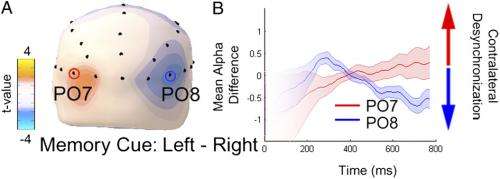
Memory predictions trigger contralateral alpha-desynchronization in posterior electrodes. (A) EEG recordings demonstrate that memory cues trigger spatially specific desynchronization of alpha-band oscillations in posterior electrodes, including PO7/PO8. The scalp topography of cue-specific differences (left − right cue; 650-750 ms) in alpha power is shown projected across a 3D scalp surface. (B) Time-course analysis of alpha power in lateralized posterior electrodes, PO7 (in red) and PO8 (in blue), illustrates how contralateral desynchronization emerges at approximately 400 ms after the cue onset. Positive values reflect contralateral desynchronization in the left hemisphere, whereas negative values reflect desynchronization in the right hemisphere, and shading represents ±1 SEM. Copyright © PNAS, doi:10.1073/pnas.1108555108
To accomplish this, says Stokes, the key methodological development in their research was to specifically measure how long-term memories modulate preparatory brain activity. “For the fMRI experiment, this involved a technique called event-related fMRI, which allows us to separate statistically the brain response to distinct cognitive events. Incorporating high-temporal resolution EEG was also a key innovation in this research, providing a more direct real-time measure of memory related changes in preparatory brain activity.”The next step in the team’s research was to determine how an integrated circuit of attention and memory related brain areas – the frontoparietal cortex, and hippocampus, respectively – are coordinated for memory-guided attention. “So far we’ve demonstrated which brain areas are active,” Stokes notes, “but more detailed imaging data could also tell us how these areas communicate. Moreover, disruption methods like Transcranial Magnetic Stimulation can pinpoint which nodes of the frontoparietal network are necessary for memory guided attention.”
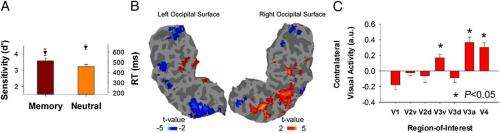
Memory predictions increase BOLD-related activity in contralateral visual areas. (A) Behavioral analysis of fMRI experiment confirmed that detection sensitivity was enhanced for targets presented at memory-predicted locations, relative to memory-neutral locations. Detection sensitivity (left y axis, bars) and RT (right y axis, triangles) are plotted as a function memory condition (memory valid vs. neutral). (B) Analysis of the BOLD response revealed evidence of spatially specific biases in preparatory visual activity: memory cues elicited increased activity in contralateral subregions of visual cortex, particularly in extrastriate visual areas. Data contrasting left vs. right views are shown on the occipital surface, extracted and flattened using Freesurfer (Materials and Methods) (C) Spatially specific cue-related activity is shown for specific visual areas (text provides details). Error bars represent ±1 SEM. Copyright © PNAS, doi:10.1073/pnas.1108555108
Commenting on how their findings might impact other areas, Stokes points out that integrating high-spatial resolution fMRI and high-temporal resolution EEG would be a powerful approach for a range of cognitive neuroscience applications. It also might be possible, Stokes agrees, to transition to a completely in silico model based on optogenetics-derived data.More information: Long-term memory prepares neural activity for perception, PNAS, Published online before print November 22, 2011, doi: 10.1073/pnas.1108555108
Copyright 2011 Medical Xpress.
All rights reserved. This material may not be published, broadcast, rewritten or redistributed in whole or part without the express written permission of PhysOrg.com.
-
Human working memory is based on dynamic interaction networks in the brain
Apr 13, 2010 |
not rated yet |
0
-
Sea snails help researchers explore a way to enhance memory
Dec 26, 2011 |
not rated yet |
0
-
Study indicates how we maintain visual details in short-term memory
Feb 20, 2009 |
not rated yet |
0
-
Echoes discovered in early visual brain areas play role in working memory
Feb 18, 2009 |
not rated yet |
0
-
Regulation of attention and concentration in brain unravelled
Aug 11, 2011 |
not rated yet |
0
-
Motion perception revisited: High Phi effect challenges established motion perception assumptions
Apr 23, 2013 |
3 / 5 (2) |
2
-
Anything you can do I can do better: Neuromolecular foundations of the superiority illusion (Update)
Apr 02, 2013 |
4.5 / 5 (11) |
5
-
The visual system as economist: Neural resource allocation in visual adaptation
Mar 30, 2013 |
5 / 5 (2) |
9
-
Separate lives: Neuronal and organismal lifespans decoupled
Mar 27, 2013 |
4.9 / 5 (8) |
0
-
Sizing things up: The evolutionary neurobiology of scale invariance
Feb 28, 2013 |
4.8 / 5 (10) |
14
-
Pressure-volume curve: Elastic Recoil Pressure don't make sense
May 18, 2013
-
If you became brain-dead, would you want them to pull the plug?
May 17, 2013
-
MRI bill question
May 15, 2013
-
Ratio of Hydrogen of Oxygen in Dessicated Animal Protein
May 13, 2013
-
Alcohol and acetaminophen
May 13, 2013
-
Marie Curie's leukemia
May 13, 2013
- More from Physics Forums - Medical Sciences
More news stories
Neurons that can multitask greatly enhance the brain's computational power, study finds
Over the past few decades, neuroscientists have made much progress in mapping the brain by deciphering the functions of individual neurons that perform very specific tasks, such as recognizing the location ...
Neuroscience
17 minutes ago |
not rated yet |
0
|
For combat veterans suffering from post-traumatic stress disorder, 'fear circuitry' in the brain never rests
Chronic trauma can inflict lasting damage to brain regions associated with fear and anxiety. Previous imaging studies of people with post-traumatic stress disorder, or PTSD, have shown that these brain regions can over-or ...
Neuroscience
May 18, 2013 |
5 / 5 (1) |
0
|
Temporal processing in the olfactory system
The neural machinery underlying our olfactory sense continues to be an enigma for neuroscience. A recent review in Neuron seeks to expand traditional ideas about how neurons in the olfactory bulb might encode information about ...
Neuroscience
May 17, 2013 |
4 / 5 (1) |
0
|
Melon focus headband turns to Kickstarter for rollout plans
(Medical Xpress)—What if the quality of your work depends more on your focus on the piano keys or canvas or laptop than your musical or painting or computing skills? If target users can be convinced, they ...
Neuroscience
May 17, 2013 |
3.7 / 5 (3) |
0
|
Deep brain stimulation: A fix when the drugs don't work
Neurological disorders can have a devastating impact on the lives of sufferers and their families.
Neuroscience
May 17, 2013 |
5 / 5 (1) |
0
|
Team finds mechanism linking key inflammatory marker to cancer
In a new study described in the journal Oncogene, researchers reveal how a key player in cell growth, immunity and the inflammatory response can be transformed into a primary contributor to tumor growth.
New study identifies risk factors for depression among COPD patients
Patients suffering from chronic obstructive pulmonary disease (COPD) typically suffer from depression more frequently than those without COPD, resulting in higher levels of disability and illness and increasing the overall ...
Youth bullying because of perceived sexual orientation widespread and damaging
(Medical Xpress)—Bullying because of perceived sexual orientation is prevalent among school-aged youths, according to a study led by Donald Patrick, professor of health services at the UW School of Public ...
Inflammatory bowel disease raises risk of melanoma
Patients with inflammatory bowel disease (IBD) are at higher risk of melanoma, a form of skin cancer, report researchers at Mayo Clinic. Researchers found that IBD is associated with a 37 percent greater risk for the disease. ...
Pharmaceutical advances offer new options for health outcomes
Research presented at Digestive Disease Week (DDW) explores pharmaceutical advances for treating irritable bowel syndrome with diarrhea (IBS-D) and hepatitis C.
Stress test may help predict increased mortality risk in sleep apnea patients
Many studies have shown that men and women who suffer from obstructive sleep apnea (OSA) - a disorder that causes breathing to halt intermittently during sleep – have a higher mortality rate than those who do not have the ...


Dec 29, 2011
Rank: 5 / 5 (2)
Dec 29, 2011
Rank: not rated yet
I sometimes wonder what the purpose of eidetic memory is in regards to this ?
I feel like having unusual memory skills makes the world very ...predictable.
Dec 30, 2011
Rank: not rated yet
Dec 30, 2011
Rank: not rated yet