Scientists may be able to double efficacy of radiation therapy
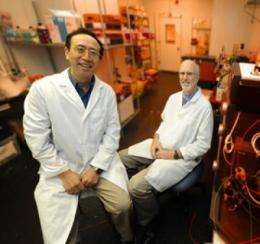
These are Drs. Shuyi Li and William S. Dynan of Georgia Health Sciences University. Credit: Phil Jones, GHSU Photographer
Scientists may have a way to double the efficacy and reduce the side effects of radiation therapy.
Georgia Health Sciences University scientists have devised a way to reduce lung cancer cells' ability to repair the lethal double-strand DNA breaks caused by radiation therapy.
"Radiation is a great therapy the problem is the side effects," said Dr. William S. Dynan, biochemist and Associate Director of Research and Chief, Nanomedicine and Gene Regulation at the GHSU Institute of Molecular Medicine and Genetics. "We think this is a way to get the same amount of cancer cell death with less radiation or use the same amount and maybe cure a patient that could not be cured before."
Radiation therapy capitalizes on radiation's ability to kill cells by causing double-strand breaks in DNA. But the fact that varying levels of radiation are essentially everywhere food, air, the ground, etc. means all cells, including cancer cells, have internal mechanisms to prevent the lethal breakage.
GHSU scientists are targeting the natural defense mechanisms by packaging a piece of an antibody against one of them with folate, which has easy access to most cells, particularly cancer cells. Many cancers, including the lung cancer cells they studied, have large numbers of folate receptors so that cancer cells get a disproportionate share of the package.
Previous efforts to destroy cancer cells' ability to avoid radiation damage have focused on receptors on their surface, said Dr. Shuyi Li, molecular biologist, pediatrician and corresponding author on the study in the International Journal of Radiation Oncology.
To get a more direct hit, the scientists took advantage of folate receptors as a point of entry by chemically binding folate with the small piece of their antibody, ScFv 18-2. The package heads straight for the cell nucleus where a different chemical environment breaks the bond, freeing ScFv 18-2 to attack the regulatory region of DNA-dependent protein kinase, an enzyme essential to DNA repair.
"We are joining a targeting molecule with a cargo," said Dynan. "This strategy targets one of the key enzymes so it's harder to repair," Li said. This makes cancer cells more vulnerable to radiation.
Dynan and Li say the approach could be used to deliver any number of drugs directly inside cancer cells. Future studies include looking at other cell entry points as well as other targets to ensure they have the most effective package. Studies to date have been in human lung cancer cells in culture, so next steps also need to include animal studies.
Their approach mimics a natural process called endocytosis in which cells engulf proteins and other substances they want to let inside but can't fit through normal doorways.
Folate receptors already are being used as direct entry points for chemotherapeutic drugs, including clinical studies of a new strategy for ovarian cancer. GHSU is participating in clinical trials of a therapy that pairs an agent too toxic to be delivered through the bloodstream with folate to better target one of the most deadly cancers.
Provided by Georgia Health Sciences University
-
Folate receptors may serve as a front door to ovarian cancer treatment
Oct 28, 2011 |
not rated yet |
0
-
Soy increases radiation's ability to kill lung cancer cells, study shows
Apr 01, 2011 |
not rated yet |
0
-
Soy increases effectiveness of radiation at killing lung cancer, study shows
Apr 07, 2011 |
not rated yet |
0
-
Molecular corkscrew
Nov 08, 2011 |
not rated yet |
0
-
Blocking DNA repair protein could lead to targeted, safer cancer therapy
Jun 01, 2010 |
not rated yet |
0
-
Motion perception revisited: High Phi effect challenges established motion perception assumptions
Apr 23, 2013 |
3 / 5 (2) |
2
-
Anything you can do I can do better: Neuromolecular foundations of the superiority illusion (Update)
Apr 02, 2013 |
4.5 / 5 (11) |
5
-
The visual system as economist: Neural resource allocation in visual adaptation
Mar 30, 2013 |
5 / 5 (2) |
9
-
Separate lives: Neuronal and organismal lifespans decoupled
Mar 27, 2013 |
4.9 / 5 (8) |
0
-
Sizing things up: The evolutionary neurobiology of scale invariance
Feb 28, 2013 |
4.8 / 5 (10) |
14
-
Pressure-volume curve: Elastic Recoil Pressure don't make sense
May 18, 2013
-
If you became brain-dead, would you want them to pull the plug?
May 17, 2013
-
MRI bill question
May 15, 2013
-
Ratio of Hydrogen of Oxygen in Dessicated Animal Protein
May 13, 2013
-
Alcohol and acetaminophen
May 13, 2013
-
Marie Curie's leukemia
May 13, 2013
- More from Physics Forums - Medical Sciences
More news stories
New smartphone application improves colonoscopy preparation
The use of a smartphone application significantly improves patients' preparation for a colonoscopy, according to new research presented today at Digestive Disease Week (DDW). The preparation process, which begins days in ...
Cancer
18 hours ago |
not rated yet |
0
Research examines new methods for managing digestive health
Research presented at Digestive Disease Week (DDW) explores new methods for managing digestive health through diet and lifestyle.
Cancer
18 hours ago |
not rated yet |
1
New colonoscope provides ground-breaking view of colon
A ground-breaking advance in colonoscopy technology signals the future of colorectal care, according to research presented today at Digestive Disease Week(DDW). Additional research focuses on optimizing the minimal withdrawal ...
Cancer
May 18, 2013 |
5 / 5 (2) |
0
ASCO: combo antibody therapy effective for melanoma
(HealthDay)—Concurrent use of two immune checkpoint antibodies—ipilimumab and nivolumab—may be effective for the treatment of advanced melanoma, according to a proof-of-principal study presented in ...
Cancer
May 17, 2013 |
not rated yet |
0
Risk factors ID'd for poor cutaneous cell CA outcomes
(HealthDay)—The risks of metastasis and death associated with cutaneous squamous cell carcinoma (CSCC) are low, but significant, and risk factors for poor outcome include tumor diameter, invasion beyond ...
Cancer
May 17, 2013 |
not rated yet |
0
|
Researchers identify a potential new risk for sleep apnea: Asthma
Researchers at the University of Wisconsin have identified a potential new risk factor for obstructive sleep apnea: asthma. Using data from the National Institutes of Health (Heart, Lung, and Blood Institute)-funded Wisconsin ...
Study finds that sleep apnea and Alzheimer's are linked
A new study looking at sleep-disordered breathing (SDB) and markers for Alzheimer's disease (AD) risk in cerebrospinal fluid (CSF) and neuroimaging adds to the growing body of research linking the two.
Computational tool translates complex data into simplified 2-dimensional images
In their quest to learn more about the variability of cells between and within tissues, biomedical scientists have devised tools capable of simultaneously measuring dozens of characteristics of individual ...
New theory on genesis of osteoarthritis comes with successful therapy in mice
Scientists at Johns Hopkins have turned their view of osteoarthritis (OA) inside out. Literally. Instead of seeing the painful degenerative disease as a problem primarily of the cartilage that cushions joints, ...
Ginger compounds may be effective in treating asthma symptoms
Gourmands and foodies everywhere have long recognized ginger as a great way to add a little peppery zing to both sweet and savory dishes; now, a study from researchers at Columbia University shows purified components of the ...
'Gap' for HIV vaccine efforts after latest setback
The hunt for an HIV vaccine has gobbled up $8 billion in the past decade, and the failure of the most recent efficacy trial has delivered yet another setback to 26 years of efforts.