Study: Babies try lip-reading in learning to talk
January 16, 2012 By LAURAN NEERGAARD , AP Medical Writer in Autism spectrum disorders
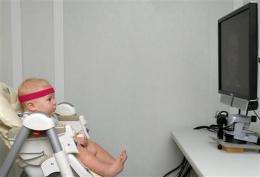
This undated handout photo provided by Florida Atlantic University shows a baby, looking at a monitor, wearing a band that contains a little magnet that the head-tracker, under the monitor uses to determine head position which, in turn, enables the eye tracker to find the eye and the pupil. New research suggests babies don't learn to talk just from hearing sounds _ they're lip-readers, too. It happens during that magical stage when a baby's babbling gradually changes from gibberish into syllables and eventually into that first "mama" or "dada." (AP Photo/Florida Atlantic University)
Babies don't learn to talk just from hearing sounds. New research suggests they're lip-readers too.
It happens during that magical stage when a baby's babbling gradually changes from gibberish into syllables and eventually into that first "mama" or "dada."
Florida scientists discovered that starting around age 6 months, babies begin shifting from the intent eye gaze of early infancy to studying mouths when people talk to them.
"The baby in order to imitate you has to figure out how to shape their lips to make that particular sound they're hearing," explains developmental psychologist David Lewkowicz of Florida Atlantic University, who led the study being published Monday. "It's an incredibly complex process."
Apparently it doesn't take them too long to absorb the movements that match basic sounds. By their first birthdays, babies start shifting back to look you in the eye again - unless they hear the unfamiliar sounds of a foreign language. Then, they stick with lip-reading a bit longer.
"It's a pretty intriguing finding," says University of Iowa psychology professor Bob McMurray, who also studies speech development. The babies "know what they need to know about, and they're able to deploy their attention to what's important at that point in development."
The new research appears in this week's issue of the Proceedings of the National Academy of Sciences. It offers more evidence that quality face-time with your tot is very important for speech development - more than, say, turning on the latest baby DVD.
It also begs the question of whether babies who turn out to have developmental disorders, including autism, learn to speak the same way, or if they show differences that just might provide an early warning sign.
Unraveling how babies learn to speak isn't merely a curiosity. Neuroscientists want to know how to encourage that process, especially if it doesn't seem to be happening on time. Plus, it helps them understand how the brain wires itself early in life for learning all kinds of things.
Those coos of early infancy start changing around age 6 months, growing into the syllables of the baby's native language until the first word emerges, usually just before age 1.
A lot of research has centered on the audio side. That sing-song speech that parents intuitively use? Scientists know the pitch attracts babies' attention, and the rhythm exaggerates key sounds. Other studies have shown that babies who are best at distinguishing between vowel sounds like "ah" and "ee" shortly before their first birthday wind up with better vocabularies and pre-reading skills by kindergarten.
But scientists have long known that babies also look to speakers' faces for important social cues about what they're hearing. Just like adults, they're drawn to the eyes, which convey important nonverbal messages like the emotion connected to words and where to direct attention.
Lewkowicz went a step further, wondering whether babies look to the lips for cues as well, sort of like how adults lip-read to decipher what someone's saying at a noisy party.
So he and doctoral student Amy Hansen-Tift tested nearly 180 babies, groups of them at ages 4, 6, 8, 10 and 12 months.
How? They showed videos of a woman speaking in English or Spanish to babies of English speakers. A gadget mounted on a soft headband tracked where each baby was focusing his or her gaze and for how long.
They found a dramatic shift in attention: When the speaker used English, the 4-month-olds gazed mostly into her eyes. The 6-month-olds spent equal amounts of time looking at the eyes and the mouth. The 8- and 10-month-olds studied mostly the mouth.
At 12 months, attention started shifting back toward the speaker's eyes.
It makes sense that at 6 months, babies begin observing lip movement, Lewkowicz says, because that's about the time babies' brains gain the ability to control their attention rather than automatically look toward noise.
But what happened when these babies accustomed to English heard Spanish? The 12-month-olds studied the mouth longer, just like younger babies. They needed the extra information to decipher the unfamiliar sounds.
That fits with research into bilingualism that shows babies' brains fine-tune themselves to start distinguishing the sounds of their native language over other languages in the first year of life. That's one reason it's easier for babies to become bilingual than older children or adults.
But the continued lip-reading shows the 1-year-olds clearly still "are primed for learning," McMurray says.
Babies are so hard to study that this is "a fairly heroic data set," says Duke University cognitive neuroscientist Greg Appelbaum, who found the research so compelling that he wants to know more.
Are the babies who start to shift their gaze back to the eyes a bit earlier better learners, or impatient to their own detriment? What happens with a foreign language after 12 months?
Lewkowicz is continuing his studies of typically developing babies. He theorizes that there may be different patterns in children at risk of autism, something autism experts caution would be hard to prove.
©2012 The Associated Press. All rights reserved. This material may not be published, broadcast, rewritten or redistributed.
-
Study links bilingual babies' vocabulary to early brain differentiation
Aug 29, 2011 |
not rated yet |
0
-
Baby talk: The roots of the early vocabulary in infants' learning from speech
Oct 30, 2008 |
not rated yet |
0
-
Babble Of Baby Reveals Language Skills
Nov 03, 2009 |
not rated yet |
0
-
Baby lab reveals surprisingly early gift of gab
Dec 09, 2011 |
not rated yet |
0
-
Even before language, babies learn the world through sounds
Jul 11, 2011 |
not rated yet |
0
-
Of mice and mental models: Neuroscientific implications of risk-optimized behavior in the mouse
May 25, 2012 |
not rated yet |
0
-
Limits to growth: Scientists identify key metastasis-enabling enzyme
May 22, 2012 |
5 / 5 (4) |
0
-
Seeing is as seeing does: Spatially-structured retinal input in early development of cortical maps
Apr 26, 2012 |
5 / 5 (4) |
1
-
Dreamless nights: Brain activity during nonrapid eye movement sleep
Apr 09, 2012 |
4.4 / 5 (12) |
0
-
Take your time: Neurobiology sheds light on the superiority of spaced vs. massed learning
Mar 28, 2012 |
4.5 / 5 (21) |
3
-
magnetic field from stream of protons
2 hours ago
-
Force on a particle constrained to move on the surface of a sphere
2 hours ago
-
Force in a magnetic coupling
12 hours ago
-
Sign of scalar product in electric potential integral?
19 hours ago
-
Heat engines: how can we yield work?
20 hours ago
-
Work done by us on the spring
May 25, 2012
- More from Physics Forums - Classical Physics
More news stories
Autism often not diagnosed until age 5 or older: U.S. report
(HealthDay) -- Even though autism symptoms typically emerge before age 3, most children with autism are diagnosed when they're 5 or older, a new snapshot of autism in America shows.
Autism spectrum disorders
May 24, 2012 |
not rated yet |
0
Study shows that fever during pregnancy more than doubles the risk of autism or developmental delay
A team of UC Davis researchers has found that mothers who had fevers during their pregnancies were more than twice as likely to have a child with autism or developmental delay than were mothers of typically developing children, ...
Autism spectrum disorders
May 23, 2012 |
5 / 5 (1) |
0
Oxytocin improves brain function in children with autism
(Medical Xpress) -- Preliminary results from an ongoing, large-scale study by Yale School of Medicine researchers shows that oxytocin a naturally occurring substance produced in the brain and throughout ...
Autism spectrum disorders
May 21, 2012 |
5 / 5 (1) |
0
French autistic kids mostly get psychotherapy
(AP) -- In most developed countries, children with autism are usually sent to school where they get special education classes. But in France, they are more often sent to a psychiatrist where they get talk ...
Autism spectrum disorders
May 18, 2012 |
not rated yet |
0
New study shows simple task at six months of age may predict risk of autism
A new prospective study of six-month-old infants at high genetic risk for autism identified weak head and neck control as a red flag for autism spectrum disorder (ASD) and language and/or social developmental delays. Researchers ...
Autism spectrum disorders
May 17, 2012 |
not rated yet |
0
|
Keep food safety in mind this memorial day weekend
(HealthDay) -- Picnics, parades and cookouts are as much a part of Memorial Day weekend as tributes to the United States' war veterans.
Travel to high altitudes tied to Crohn's, colitis flare-ups
(HealthDay) -- People with inflammatory bowel disease, which includes Crohn's disease and colitis, may be at increased risk for flare-ups when they fly or travel to high altitudes for skiing or mountain climbing, ...
Family history of Alzheimer's affects functional connectivity
(HealthDay) -- Cognitively normal individuals with a family history of late-onset Alzheimer's disease (AD) may display lower resting state functional connectivity in the default mode network (DMN) of the brain, ...
Transvaginal mesh op restores pelvic organ prolapse at price
(HealthDay) -- Transvaginal mesh (TVM) procedures are effective for anatomical restoration of pelvic organ prolapse (POP), but patients report a worsening of sexual function following surgery, according to ...
Of mice and mental models: Neuroscientific implications of risk-optimized behavior in the mouse
(Medical Xpress) -- Regardless of an organism’s biological complexity, every encephalized animal continuously makes under-informed behavioral choices that can have serious consequences. Despite its ubiquity, ...
Weight struggles? Blame new neurons in your hypothalamus
New nerve cells formed in a select part of the brain could hold considerable sway over how much you eat and consequently weigh, new animal research by Johns Hopkins scientists suggests in a study published in the May issue ...