Making the most of your CT scan
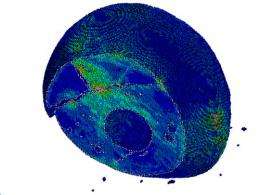
X-ray photography has been used for decades for medical purposes. Now, scientists have found new ways of obtaining precise and comprehensive data from x-ray computer tomography. In the project BIO-CT-EXPLOIT, an international team of mathematicians, physicists, and engineers figured out new ways to extract valuable information from the data obtained in CT scans. The research project has led to new computer codes for medical applications. In future, they will be used for bone implants, surgery, and tissue engineering.
“If we want to make the most of our x-ray data, we need to have an excellent understanding of the microstructure we are looking at”, says project coordinator Professor Christian Hellmich from the Vienna University of Technology. “We created detailed, voxel-specific computer models of biological tissue. That way, we can gain information from the CT-scans which has not been accessible up until now.” The research team has pioneered concepts for the extraction of chemical information from CT-scans. Using micro-mechanical computer modelling, this information can be converted into a 3D-map of specific material properties. “It is an unparalleled, highly reliable simulation tool for structural design purposes”, Christian Hellmich says. It should not be difficult to use the newly developed computer codes for real-life applications: “Our prototype tools are fully compatible and pre-tailored for commercial simulation packages and the software that comes with commercial CT-devices”, says Hellmich.
Cooperation of Industry and Academic Research
In the BIO-CT-EXPLOIT-project, academic research and private companies collaborated very closely. Four private enterprises (Simpleware Ltd, InMatrixs, CADFEM GmbH, Skyscan NV.) and four academic partners (Vienna University of Technology, Universita Politecnica delle Marche, Politechnika Warszawska, Hochschule für Angewandte Wissenschaften Hamburg) joined forces to create computer codes, which are supposed to lead to commercially available software tools in the future. The consortium was coordinated by the Institute of Materials and Structures at the Vienna University of Technology. The project started on December 1, 2009 – funded by the European Union through the 7th Framework Programme within the programme “Research for the benefit of small and medium-sized enterprises (SMEs)”. Now, the funding period is over and the program is completed. “In only two years, we have accomplished our goals – the collaboration was very successful”, says coordinator Christian Hellmich.
Software Tool for Dentists
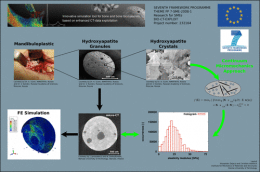
CADFEM, one of the private research partners, offers a complete portfolio of leading software tools for numerical simulations (particularly Finite Element analyses and Computer Aided Design and their interfaces). In the context of the joint research project, CADFEM has enhanced a software prototype which allows a dentist to perform patient-specific simulations of a dental implant. With this tool, a dentist can calculate the stress pattern around the implant in the mandible for getting information on potential mechanical overloading of the bone. The results of the finite-element simulation significantly depend on a realistic characterization of the mechanical properties of the bone tissue. Previously, CADFEM modeled the mechanical properties of the bone tissue in a simplified manner and did not account for all effects (e.g. anisotropy, microstructure, correlation between gray values and stiffness) of the real bone.
Now, CADFEM can perform much more realistic simulations of patient-specific models. The technology provided by the academic research partners to CADFEM can directly be implement it into their existing software tool. The new technology developed within the BIO-CT-EXPLOIT project will have a huge impact on CADFEM’s further developments in the field of biomechanics, and helps them to better capture the behavior of bone tissues and tissue engineering scaffolds
3D modelling and image evaluation
SIMPLEWARE offers world-leading software and services for the conversion of 3D image data into high-quality CAD, Rapid Prototype, CFD, and Finite Element models. SIMPLEWARE customers range from international blue chip corporations to research institutes and universities world-wide. The determination of realistic elasticity properties from CT-data based micromechanics, as provided in an unprecedented fashion through the BIO-CT-EXPLOIT project, will significantly extend SIMPLEWARE’s portfolio in realistic simulation tools for complex problems related to bio-structures - and beyond.
SkyScan microtomography is available in a range of easy-to-use desktop instruments, which generate 3D images of the enduser’s samples’ morphology and internal microstructure, with resolution down to the sub-micrometer level. Software for visualization and analysis in 3D is included with all SkyScan systems. BIO-CT-EXPLOIT paved the way to extending the software portfolio towards unique, novel features, such as image improvement through artefact removal, bone chemical composition, and mechanical property maps.
Skeletal Tissue Engineering
INMATRIXS Ltd was founded as an academic spin-off company by the Russian Academy of Science (RAS), Institute for Physical Chemistry of Ceramics. InMatrixs is a biomedical device and skeletal tissue engineering company to manufacture medical products based on calcium phosphate. The Company’s goal is to provide integrated and cost-effective healthcare solutions based on advanced tissue engineering concepts for the regeneration of damaged skeletal tissues, with particular emphasis on bone. BIO-CT-EXPLOIT has helped to unravel structure-property relations in INMATRIXS ceramics, and provided numerical tools to show the beneficial properties of these biomaterials. As such computer-aided quality assessment is expected to reach significant impotance in the future, BIO-CT-EXPLOIT has put INMATRIXS in a priviledged market position.
The SMEs and RTDs plan future collaboration, both with regards to commercialization of the produced tools, and for identification of exciting new research avenues.


