Essential protein for the formation of new blood vessels identified
January 17, 2012 in Medical research

Essential protein for the formation of new blood vessels identified

Enlarge

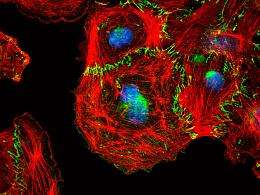
Nascent cell-cell contacts between endothelial cells. The transmembrane protein VE-Cadherin (green) mediates the formation of cellular junctions and is connected to the intracellular actin cytoskleton (red). The nucleus is stained in blue. Credit: Reiner Wimmer

New research explains how cells regulate their bonds during the development of new blood vessels. For the first time, the role of the protein Raf-1 in determining the strength of the bond between cells has been shown. If Raf-1 is not present, the cells cannot stick together and the formation of new blood vessels is inhibited. This discovery may one day lead to new approaches to cancer treatment.

Angiogenic sprouting, the process by which new grow from existing vessels, is a double-edged sword. It enables the to develop in the embryo, and is vital for in adults. But it also supplies growing tumors with nutrients and oxygen.

is an example of collective cellular migration. Cells move as a group, held together by connections called adherens junctions. For the cells to move, they have to make and break these connections continuously. If the junctions are too stiff, they will not be able to move at all, but if they are too weak, the groups of cells will break apart. How this mechanism is controlled was unknown.

This video is not supported by your browser at this time.

In vitro vessel formation of control and Raf-1 deficient endothelial cells. In the absence of Raf-1 cells are unable to migrate collectively and fail to form capillary like structures in 3D fibrin gels. Frames were taken every 30min and the movie is displayed at 15fps (Credit: Reiner Wimmer).

The mechanism has now been uncovered by Manuela Baccarini’s group at the Max F. Perutz Laboratories, a joint venture of the University of Vienna and the Medical University of Vienna, who investigate cell signaling. They have established a crucial role for Raf-1, a multi-purpose signal transducer, in this process.

“The real breakthrough came when we were able to use video microscopy on the developing vessels in vitro,” explains the paper’s first author Reiner Wimmer. “We realized that the cells without Raf-1 were actively migrating, but only as single cells. They could not migrate in a group.”

This video is not supported by your browser at this time.

In vitro vessel formation of control and Raf-1 deficient endothelial cells. In the absence of Raf-1 cells are unable to migrate collectively and fail to form capillary like structures in 3D fibrin gels. Frames were taken every 30min and the movie is displayed at 15fps (Credit: Reiner Wimmer).

The meaning of this discovery became clear in further experiments: the role of Raf-1 is to bring the new adherens a kinase they need for the remodeling of the cytoskeleton. This means that Raf-1 is fine-tuning the bonds between the migrating cells by causing the local remodeling of the cell’s cytoskeleton.

As the process of angiogenic sprouting is necessary for the growth of tumors, this new discovery may one day be applied to produce cancer therapies to target Raf-1 and the other parts of this control mechanism, thereby disrupting the environment of the tumor.

More information: Wimmer R, et al. (2011). Angiogenic sprouting requires the fine-tuning of endothelial cell cohesion by the Raf-1/Rok-α complex. Developmental Cell. DOI:10.1016/j.devcel.2011.11.012 , PMID: 22209329

Provided by University of Wien

5 /5 (1 vote)  

Rank 5 /5 (1 vote)
Relevant PhysicsForums posts

More news stories

Now we know why old scizophrenia medicine works on antibiotics-resistant bacteria

In 2008 researchers from the University of Southern Denmark showed that the drug thioridazine, which has previously been used to treat schizophrenia, is also a powerful weapon against antibiotic-resistant bacteria such as ...

Medical research created 21 hours ago | popularity 3.7 / 5 (3) | comments 0 | with audio podcast

SUMO wrestling cells reveal new protective mechanism target for stroke

Scientists investigating the interaction of a group of proteins in the brain responsible for protecting nerve cells from damage have identified a new target that could increase cell survival.

Medical research created May 17, 2013 | popularity 5 / 5 (1) | comments 0

How serotonin receptors can shape drug effects, from LSD to migraine medication

New findings by researchers carrying out experiments at the U.S. Department of Energy Office of Science's Advanced Photon Source (APS) help explain why some drugs that interact with two kinds of human serotonin ...

Medical research created May 17, 2013 | popularity not rated yet | comments 0 | with audio podcast

Preventing blood poisoning

Peptide molecules derived from the body's natural immune system can help boost the body's defence against life-threatening blood poisoning, joint University research has uncovered.

Medical research created May 17, 2013 | popularity 4 / 5 (1) | comments 0 | with audio podcast

New mechanism to prevent type 2 diabetes in obese individuals

A new Montréal study conducted by Dr. May Faraj, associate research professor at the Université de Montréal and invited scientist at the IRCM, along with her research team and medical collaborators, shows ...

Medical research created May 17, 2013 | popularity not rated yet | comments 0 | with audio podcast


New research identifies risks, interventions for children's GI health

An increasing number of U.S. children are experiencing gastrointestinal issues that require interventions to resolve, according to research presented at Digestive Disease Week (DDW).

US psychiatry gets makeover in new manual

The latest makeover to a massive psychiatric tome honored by some, reviled by others and even called the "Bible" of mental disorders is being released Saturday with a host of new changes.

New case of SARS-like virus in Saudi: ministry

A new case of the deadly coronavirus has been detected in Saudi Arabia where 15 people have already died after contracting it, the health ministry announced on Saturday on its Internet website.

AIDS science at 30: 'Cure' now part of lexicon

Big names in medicine are set to give an upbeat assessment of the war on AIDS on Tuesday, 30 years after French researchers identified the virus that causes the disease.

New colonoscope provides ground-breaking view of colon

A ground-breaking advance in colonoscopy technology signals the future of colorectal care, according to research presented today at Digestive Disease Week(DDW). Additional research focuses on optimizing the minimal withdrawal ...

For combat veterans suffering from post-traumatic stress disorder, 'fear circuitry' in the brain never rests

Chronic trauma can inflict lasting damage to brain regions associated with fear and anxiety. Previous imaging studies of people with post-traumatic stress disorder, or PTSD, have shown that these brain regions can over-or ...