Many high-risk Americans don't get hepatitis B vaccine
January 19, 2012 in Diseases, Conditions, Syndromes
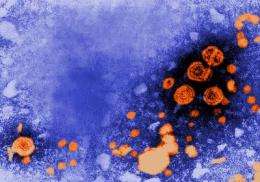
A transmission electron microscope image shows particles of the hepatitis B virus. A vaccine has existed since 1982 but many people at high risk for getting the virus nevertheless are not inoculated. Credit: CDC/ Dr. Erskine Palmer
Although there is an effective vaccine for hepatitis B and public health officials have a strong sense of who is at highest risk for the infectious liver disease, tens of thousands of people in the United States contract the virus every year. According to a new study by researchers at Brown University, missed opportunities to administer the vaccine continue to be a reason why infections persist.
"This is a really simple thing that we could do and if somebody ends up getting the disease because we didn't make the effort then I think that's really a shame," said Brian Montague, assistant professor of medicine in the Warren Alpert Medical School of Brown University and a physician at The Miriam Hospital.
Yet in an analysis published Jan. 12, 2012, in advance online in the journal Infection, senior author Montague and lead author Farah Ladak found that in a nationally representative sample of high-risk adults, 51.4 percent said they were unvaccinated. More than half of them had the potential to receive the vaccine based on their reported contact with health care providers.
The study is based on responses by more than 15,000 adults to the 2007 Behavioral Risk Factor Surveillance Survey, which gathers health information from more than 430,000 people across the United States. The respondents in the study's analysis acknowledged engaging in risk behaviors such as certain sexual practices or needle drug use and could definitively report their hepatitis B status. Previous research has found that more than 95 percent new infections in adults occur among people with such behavioral risk factors.
Montague, Ladak, and their co-authors sought to figure out who among this highly vulnerable population was going unvaccinated and whether and where they could have received the three required shots.
They found that vaccinations were relatively infrequent among adults older than 33 (vaccinations have increased markedly in children since the 1990s), among people with less access to health insurance, and among people who have also not been vaccinated against other diseases such as the flu.
But even among people with access to health care, including people who reported specific contact with health care providers, thousands of people went unvaccinated, Ladak said. The study identifies places where improved vaccine delivery would make a substantial difference for instance when people are tested for HIV, such as at the doctor's office, in a hospital or clinic, and especially in jail.
For those infected as adults, hepatitis B does not always result in persistent infection and chronic liver disease, but it is especially likely to do so among people infected with HIV. Such co-infections are common because many of the risk factors for contracting either virus are the same.
"In persons visiting [HIV-testing] locations there was a high prevalence of people who had not received the vaccine," said Ladak, a Brown public health graduate. "One of the areas that really stuck out was jails and prisons. Given that many states have mandates to vaccinate incarcerated individuals, you wonder why in so many of these prisons people have not received vaccinations."
Ladak noted that the new study's figures from 2007 closely mirror similar research published in 2000, suggesting that despite widespread awareness among public health officials that vaccinations have been lacking among adults, there has not been clear progress.
Calls to do better
The study lends additional support to the urging of the Institute of Medicine, which in a 2010 report emphasized the importance of seizing opportunities to vaccinate people for hepatitis B and C. The report suggested that officials have not devoted enough resources to vaccination programs, perhaps because the infections sometimes don't present any symptoms, as a reason for the continued prevalence of the diseases.
Montague said some programs are also structured to ensure missed opportunities. For example, funding for HIV care programs allows testing and vaccination of those who are HIV positive. Funding is often not available, though, for combined screening for hepatitis B together with HIV.
"Given that the risks for HIV, hepatitis B and hepatitis C overlap, what we need is integrated testing and prevention programs and strategies that link those cases identified with effective treatment in the community," Montague said.
Provided by
Brown University
-
Study examines incident hepatitis C infection in HIV-infected men
Feb 01, 2011 |
not rated yet |
0
-
Analysis finds mortality from all causes higher among hepatitis C-infected
Jun 10, 2011 |
not rated yet |
0
-
Hepatitis C is transmitted by unprotected sex between HIV-infected men
Jul 21, 2011 |
not rated yet |
0
-
IOM report recommends steps to tackle hepatitis B and C
Jan 11, 2010 |
not rated yet |
0
-
Hepatitis B and C remain public health issue -- up to 5.3 million Americans infected
Feb 24, 2010 |
not rated yet |
0
-
Of mice and mental models: Neuroscientific implications of risk-optimized behavior in the mouse
May 25, 2012 |
not rated yet |
0
-
Limits to growth: Scientists identify key metastasis-enabling enzyme
May 22, 2012 |
5 / 5 (4) |
0
-
Seeing is as seeing does: Spatially-structured retinal input in early development of cortical maps
Apr 26, 2012 |
5 / 5 (4) |
1
-
Dreamless nights: Brain activity during nonrapid eye movement sleep
Apr 09, 2012 |
4.4 / 5 (12) |
0
-
Take your time: Neurobiology sheds light on the superiority of spaced vs. massed learning
Mar 28, 2012 |
4.5 / 5 (21) |
3
-
Classical and Quantum Mechanics via Lie algebras
Apr 15, 2011
- More from Physics Forums - Independent Research
More news stories
Flesh-Eating bacteria no cause for panic, experts say
(HealthDay) -- Despite scary headlines by the score, most people don't have to fear that they'll be the next victim of the so-called flesh-eating bacteria disease, experts say.
Diseases, Conditions, Syndromes
May 25, 2012 |
not rated yet |
0
World Health Assembly endorses new plan to increase global access to vaccines
Ministers of Health from 194 countries at the Sixty-fifth World Health Assembly today endorsed a landmark Global Vaccine Action Plan (GVAP), a roadmap to prevent millions of deaths by 2020 through more equitable access to ...
Diseases, Conditions, Syndromes
May 25, 2012 |
not rated yet |
0
Physicians definitively links irritable bowel syndrome and bacteria in gut
An overgrowth of bacteria in the gut has been definitively linked to Irritable Bowel Syndrome in the results of a new Cedars-Sinai study which used cultures from the small intestine. This is the first study to use this "gold ...
Diseases, Conditions, Syndromes
May 25, 2012 |
not rated yet |
0
|
Study provides compelling evidence for an effective new treatment for tinnitus
According to new research, a multidisciplinary approach to treating tinnitus that combines cognitive behaviour therapy with sound-based tinnitus retraining therapy is significantly more effective than currently available ...
Diseases, Conditions, Syndromes
May 24, 2012 |
not rated yet |
0
Infections may be deadly for many dialysis patients
An infection called peritonitis commonly arises in the weeks before many dialysis patients die, according to a study appearing in an upcoming issue of the Journal of the American Society of Nephrology (JASN). The findings sugges ...
Diseases, Conditions, Syndromes
May 24, 2012 |
not rated yet |
0
Keep food safety in mind this memorial day weekend
(HealthDay) -- Picnics, parades and cookouts are as much a part of Memorial Day weekend as tributes to the United States' war veterans.
Travel to high altitudes tied to Crohn's, colitis flare-ups
(HealthDay) -- People with inflammatory bowel disease, which includes Crohn's disease and colitis, may be at increased risk for flare-ups when they fly or travel to high altitudes for skiing or mountain climbing, ...
Family history of Alzheimer's affects functional connectivity
(HealthDay) -- Cognitively normal individuals with a family history of late-onset Alzheimer's disease (AD) may display lower resting state functional connectivity in the default mode network (DMN) of the brain, ...
Transvaginal mesh op restores pelvic organ prolapse at price
(HealthDay) -- Transvaginal mesh (TVM) procedures are effective for anatomical restoration of pelvic organ prolapse (POP), but patients report a worsening of sexual function following surgery, according to ...
Of mice and mental models: Neuroscientific implications of risk-optimized behavior in the mouse
(Medical Xpress) -- Regardless of an organism’s biological complexity, every encephalized animal continuously makes under-informed behavioral choices that can have serious consequences. Despite its ubiquity, ...
Weight struggles? Blame new neurons in your hypothalamus
New nerve cells formed in a select part of the brain could hold considerable sway over how much you eat and consequently weigh, new animal research by Johns Hopkins scientists suggests in a study published in the May issue ...