Metastasis of pancreatic cancer in action
January 19, 2012 in Cancer
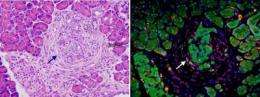
Pancreatic cells spread by blending in. The left panel shows an inflammed pancreatic duct surrounded by what appear to be fibroblasts (blue arrow). Lineage tagging allowed the researchers to see that some of these fibroblast-like cells are actually invading pancreatic epithelial cells in disguise (left panel, white arrow). Such cells have undergone a process of epithelial-to-mesenchymal transition and are able to enter the bloodstream. Credit: Andrew Rhim, PhD, Perelman School of Medicine, University of Pennsylvania; Cell Press
Ben Stanger, MD, PhD, assistant professor of Medicine in the Division of Gastroenterology at the Perelman School of Medicine, University of Pennsylvania, and Andrew Rhim, MD, a Gastroenterology Fellow in the Stanger lab, discovered that pancreatic cancer cells in an animal model begin to spread before clinically obvious tumor tissue is detected. What's more, they showed that inflammation enhances cancer progression in part by facilitating a cellular transformation that leads to entry of cancer cells into the circulation. They report their findings this week in Cell.
Metastasis has been difficult to study because it involves a series of unpredictable events. To capture these events, the team developed a sensitive method to tag and track pancreatic epithelial cells in a mouse model of pancreatic cancer. Tagged cells invaded and entered the bloodstream unexpectedly early, before overt malignancy could be detected by rigorous analysis of tissue slides.
Pancreatic cancer is among the most lethal of cancers, with no real treatments, and at the time of diagnosis up to three-quarters of patients have metastatic disease, says Stanger. Little is known about how pancreatic cancer cells spread, "What leads to this are rare events that are hard to catch in tissues. Small numbers of cells break off tumors and move, but how can we find them?"
These wandering cells are associated with a phenomenon called the epithelial-to-mesenchymal transition (EMT). This change in cell motility is an important process during the development of embryos. But when the transition is aberrantly reactivated in adults it can have dire physiological consequences, leading to cancer metastasis as well as other disease processes. Epithelial cells form a covering or lining of a body surface and are the type of cell from which most solid tumors arise. However, when a molecular switch is turned off or absent, epithelial cells acquire characteristics of another cell type, called mesenchymal cells, and gain the ability to migrate and move away from the primary tumor site.
Using a mouse model of pancreatic cancer developed at Penn in 2005, the team delivered mutations in an oncogene and a tumor suppressor protein, K-ras and p53 respectively, in the pancreas. A green marker was also induced in the embryos' still-forming pancreas. At about one to two months, the juvenile mice developed pre-malignant lesions, and at about four to five months full blown pancreatic cancer.
During this time, the mouse pancreatic epithelial cells lost their epithelial characteristics and became more like mesenchymal cells, blending in and making their way to the bloodstream. True epithelial cells are sticky, keeping linings tightly connected, but these imposter epithelial cells changed identity, becoming less sticky.
With the green stain, the researchers were able to detect the transition from epithelial cell to mesenchymal cell in a tissue slide, showing many green cells that had undergone EMT. "We are now able to see what was before before unseeable the pancreas cells that have taken on a disguise," says Stanger.
What spurs the EMT in first place? The team surmised that it was inflammation, so they blocked inflammation with an immunosuppressant, and at about eight to ten weeks, the green cells undergoing EMT disappeared. Conversely, when they induced pancreatitis- associated inflammation, the EMT green cells increased.
In trying to relate these findings to metastasis, they looked for green EMT cells outside of the pancreas and found them in the blood and distinct tissues such as the liver at eight to ten weeks of age, long before a pathologist would recognize it as cancer.
"These results provide new insight into the earliest events of cellular invasion and suggest that inflammation enhances cancer progression by giving cells increased access to the bloodstream," says Stanger.
The team plans to use the methodology used in this study to enhance the detection of spreading cells in human patients at an early timepoint, when therapy could have a greater impact.
Both the development of the pancreatic cancer mouse model and Dr. Stanger's current work were partially funded by research grants from the Pancreatic Cancer Action Network. "We are highly encouraged by Dr. Stanger's recent results," said Lynn Matrisian, PhD, vice president of Scientific and Medical Affairs at the Pancreatic Cancer Action Network. "A deeper understanding of the disease biology, and in particular metastasis, will move us closer to our goal of doubling the survival rate of pancreatic cancer by the year 2020."
Provided by
University of Pennsylvania School of Medicine
-
Dental researcher finds switch that turns on the spread of cancer
Feb 14, 2010 |
not rated yet |
0
-
Signaling pathways point to vulnerability in breast cancer stem cells
Jun 09, 2011 |
not rated yet |
0
-
New clues to how cancer spreads
Jun 27, 2011 |
not rated yet |
0
-
Protein and microRNA block cellular transition vital to metastasis
Feb 25, 2011 |
not rated yet |
0
-
Embryonic pathway delivers stem cell traits
May 15, 2008 |
not rated yet |
0
-
Of mice and mental models: Neuroscientific implications of risk-optimized behavior in the mouse
May 25, 2012 |
not rated yet |
0
-
Limits to growth: Scientists identify key metastasis-enabling enzyme
May 22, 2012 |
5 / 5 (4) |
0
-
Seeing is as seeing does: Spatially-structured retinal input in early development of cortical maps
Apr 26, 2012 |
5 / 5 (4) |
1
-
Dreamless nights: Brain activity during nonrapid eye movement sleep
Apr 09, 2012 |
4.4 / 5 (12) |
0
-
Take your time: Neurobiology sheds light on the superiority of spaced vs. massed learning
Mar 28, 2012 |
4.5 / 5 (21) |
3
-
Potential Breakthrough in Seizure Control
16 hours ago
-
Popping/Cracked sternum.
21 hours ago
-
Which Mental Illness Encompasses This Problem?
21 hours ago
-
A question about drug tolerance
May 23, 2012
-
Poor nutrition leading to overeating?
May 23, 2012
-
Math and dyslexia?
May 21, 2012
- More from Physics Forums - Medical Sciences
More news stories
Skp2 activates cancer-promoting, glucose-processing Akt
HER2 and its epidermal growth factor receptor cousins mobilize a specialized protein to activate a major player in cancer development and sugar metabolism, scientists report in the May 25 issue of Cell.
Cancer
May 25, 2012 |
not rated yet |
0
|
Pancreatectomy OK without downstaging from therapy
(HealthDay) -- Pancreatectomy improves median survival in pancreatic cancer patients even when presurgical neoadjuvant therapy does not lead to radiographic downstaging of tumors, according to a study published ...
Cancer
May 25, 2012 |
not rated yet |
0
Common therapies for basal cell carcinoma offer similar survival
(HealthDay) -- For patients with superficial basal cell carcinoma (sBCC), treatment with imiquimod or photodynamic therapy (PDT) results in similar long-term tumor-free survival, according to a review published ...
Cancer
May 25, 2012 |
not rated yet |
0
Cancer may require simpler genetic mutations than previously thought
Chromosomal deletions in DNA often involve just one of two gene copies inherited from either parent. But scientists haven't known how a deletion in one gene from one parent, called a "hemizygous" deletion, can contribute ...
Cancer
May 25, 2012 |
not rated yet |
0
|
New prostate cancer screening guidelines face a tough sell, study suggests
(Medical Xpress) -- Recent recommendations from the U.S. Preventive Services Task Force (USPSTF) advising elimination of routine prostate-specific antigen (PSA) screening for prostate cancer in healthy men are likely to encounter ...
Cancer
May 25, 2012 |
not rated yet |
1
Keep food safety in mind this memorial day weekend
(HealthDay) -- Picnics, parades and cookouts are as much a part of Memorial Day weekend as tributes to the United States' war veterans.
Travel to high altitudes tied to Crohn's, colitis flare-ups
(HealthDay) -- People with inflammatory bowel disease, which includes Crohn's disease and colitis, may be at increased risk for flare-ups when they fly or travel to high altitudes for skiing or mountain climbing, ...
Family history of Alzheimer's affects functional connectivity
(HealthDay) -- Cognitively normal individuals with a family history of late-onset Alzheimer's disease (AD) may display lower resting state functional connectivity in the default mode network (DMN) of the brain, ...
Transvaginal mesh op restores pelvic organ prolapse at price
(HealthDay) -- Transvaginal mesh (TVM) procedures are effective for anatomical restoration of pelvic organ prolapse (POP), but patients report a worsening of sexual function following surgery, according to ...
Of mice and mental models: Neuroscientific implications of risk-optimized behavior in the mouse
(Medical Xpress) -- Regardless of an organism’s biological complexity, every encephalized animal continuously makes under-informed behavioral choices that can have serious consequences. Despite its ubiquity, ...
Weight struggles? Blame new neurons in your hypothalamus
New nerve cells formed in a select part of the brain could hold considerable sway over how much you eat and consequently weigh, new animal research by Johns Hopkins scientists suggests in a study published in the May issue ...