Sri Lanka donates eyes to the world
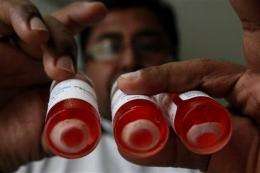
(AP) -- At 10:25 a.m., a dark brown eye was removed from a man whose lids had closed for the last time. Five hours later, the orb was staring up at the ceiling from a stainless steel tray in an operating room with two blind patients - both waiting to give it a second life.
S.P.D. Siriwardana, 63, remained still under a white sheet as the surgeon delicately replaced the cornea that had gone bad in his right eye following a cataract surgery. Across the room, patient A.K. Premathilake, 32, waited for the sclera, the white of the eye, to provide precious stem cells and restore some vision after acid scalded his sight away on the job.
"The eye from this dead person was transplanted to my son," said A.K. Admon Singho, who guided Premathilake through the hall after the surgery. "He's dead, but he's still alive. His eye can still see the world."
This gift of sight is so common here, it's become an unwritten symbol of pride and culture for Sri Lanka, an island of about 20 million people located off the southern coast of India. Despite recently emerging from a quarter century of civil war, the country is among the world's largest cornea providers.
It donates about 3,000 corneas a year and has provided tissue to 57 countries over nearly a half century, with Pakistan receiving the biggest share, according to the nonprofit Sri Lanka Eye Donation Society. The organization began promoting eye donation decades ago, but has since faced allegations of mismanagement and poor quality standards.
The supply of corneas is so great in Sri Lanka that a new, state-of-the-art government eye bank opened last year, funded by Singapore donors. It has started collecting tissue from patients at one of the country's largest hospitals, hoping to add an additional 2,000 corneas to those already shipped abroad annually. Nearly 900,000 people have also signed up to give their eyes in death through the Eye Donation Society's longstanding eye bank.
"People ask me, 'Can we donate our eyes while we are living? Because we have two eyes, can we donate one?'" said Dr. Sisira Liyanage, director of Sri Lanka's National Eye Hospital in the capital, Colombo, where the new eye bank is based. "They are giving just because of the willingness to help others. They are not accepting anything."
The desire to help transcends social and economic barriers. Prime ministers pass on their corneas here along with the poorest tea farmers. Many Sri Lankans, about 67 percent of whom are Buddhist, believe that surrendering their eyes at death completes an act of "dana," or giving, which helps them be reincarnated into a better life.
It's a concept that was first promoted a half century ago by the late Dr. Hudson Silva, who was frustrated by the massive shortage of corneas in his native Sri Lanka. Most eyes back then were harvested from the handful of prisoners hanged each year, leaving little hope for blind patients in need of transplants.
Silva wrote a newspaper piece in the late 1950s pledging to donate his own corneas and appealing to readers to also give "Life to a Dead Eye." The response was overwhelming.
With no lab facilities or high-tech equipment, he and wife Irangani de Silva began harvesting eyes and storing them in their home refrigerator. They started the Eye Donation Society, and in 1964, the first cornea sent abroad was hand-carried in an ice-packed tea thermos aboard a flight to Singapore. Since then, 60,000 corneas have been donated.
While the Society's eye bank was a pioneer, questions about quality emerged as international eye banking standards improved over the next 20 to 30 years. Concerns have recently been raised about less advanced screening for HIV and other diseases, and the eye bank has also faced allegations of mismanagement.
Many of its corneas are harvested from the homes of the dead in rural areas across the country, making auditing and quality assurance levels harder to maintain, said Dr. Donald Tan, medical director of Singapore National Eye Center, who helped set up the new eye bank. Once, he said, a blade of grass was found packaged with tissue requested for research.
Eye Donation Society manager Janath Matara Arachchi says the organization sends "only the good and healthy eyes" and has not received a complaint in 20 years. Arachchi said the organization checks for HIV, hepatitis and other sexually transmitted diseases by dipping a strip into blood samples and waiting to see if it changes color for a positive result. Sri Lanka's Health Ministry also said it has received no complaints about the eye bank from other countries.
Medical director Dr. M.H.S. Cassim denied that anyone from the organization is making money off donations sent abroad. He said they charge up to $450 per cornea to cover operational costs and the high price of preservatives needed to store the tissue.
The cornea is the dome-shaped transparent part of the eye that covers the iris and pupil. It helps to focus entering light, but can become cloudy from disease or other damage. Corneas must be carefully extracted from donors to avoid damaging the thin layer of cells on the back that pump water away to keep it clear. They must be harvested within eight hours of death, and can today be preserved and stored in refrigeration for up to 14 days.
Sri Lanka has no official organ donation registry, as is provided in some countries when driver's licenses are issued. Instead, the idea is passed down from generation to generation. Eye donation campaigns are organized at temples by Buddhist monks, but people of other faiths also give, including Hindus and Christians.
Future donors simply mail in the bottom half of a consent form distributed by Silva's Eye Donation Society. The top portion, which looks like an award certificate with a fancy scroll lacing around it, is also filled out and often proudly displayed on the wall - serving as proof to the living that the pledge comes from a generous spirit.
"Just think if we had that level of organ donation and commitment and belief system in the United States, where we have these long lists of people waiting for hearts, livers and kidneys," said Dr. Alfred Sommer of Johns Hopkins University, who spent more than 40 years fighting blindness in the developing world. "If we had that level of cultural investment, there would be no lists for organ transplants."
The U.S. is the world's biggest cornea provider, sending more than 16,000 corneas to other countries in 2010, according to the Eye Bank Association of America. But Sri Lanka, which is 15 times smaller, actually donates about triple that number of corneas per capita each year.
There is no waiting list for eye tissue in Sri Lanka, and its people get first access to free corneas. About 40,000 have been transplanted locally since the beginning, but that still leaves a surplus each year.
Pakistan, an Islamic country where followers are typically required to be buried with all parts intact, has received some 20,000 corneas since overseas donations began, Cassim said. Egypt and Japan are two other major recipients, receiving 8,000 and 6,000 corneas respectively to date, he said.
But Sri Lanka cannot meet global demand on its own. An estimated 10 million people - 9 out of 10 in poor countries - suffer worldwide from corneal blindness that could be helped by a transplant if tissue and trained surgeons were available, according to U.S.-based SightLife, an eye bank that partners with developing countries. It has been working with Sri Lanka's new government facility.
"Sri Lanka has long been known to be a country with an incredible heart for eye donation and a willingness to share surplus corneas to restore sight around the world," said SightLife president Monty Montoya. "While efforts have been made to share information with other countries, I am not aware of any one location being able to replicate Sri Lanka's success."
Where possible, eye tissue should be transplanted within hours of death. That was done in the Colombo operating room where patients Siriwardana and Premathilake were stitched up with what looked like tiny fishing hooks, then bandaged and helped outside.
For Premathilake - whose sight was lost when an open can of acid spilled onto his face while working at a rubber factory - this is his last hope. His right eye still blinks, but there is nothing but an empty pink cavity inside. The stem cells attached to his left eye should help create a new window of sight that he hopes will allow him to go back to work, or at least carry out daily tasks without depending on his parents.
"I am extremely happy," he said. "I didn't know the man who died in his previous life, but I'm always going to say blessings for him during his next births."
©2012 The Associated Press. All rights reserved. This material may not be published, broadcast, rewritten or redistributed.


