Unexpected discovery opens up new opportunities for targeting cancer
January 10, 2012 in Cancer
Unexpected discovery opens up new opportunities for targeting cancer

Enlarge

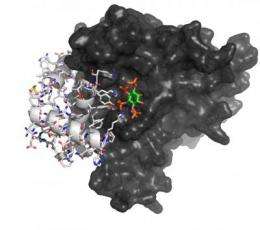
This graphic shows the atomic resolution structure of histone deacetylase 3 (dark grey surface), the corepressor SMRT (light grey sticks/ribbons) and the key signaling molecule IP4 (green / orange sticks). Credit: University of Leicester

Scientists at the University of Leicester have opened up a whole new approach to the therapeutic intervention for a family of anti-cancer drug targets, thanks to a completely new and unexpected finding.

Professor Schwabe and his colleagues, Drs Watson, Fairall and Santos, have published their research this week in leading science magazine Nature detailing a new understanding of how transcriptional repression complexes work. Their work, which is based around determining structures of medically important bio-molecular complexes, has been ongoing for six years, and is currently funded through a grant from The Wellcome Trust.

Transcriptional regulatory complexes play an important role in the regulation of development, differentiation, cancer and homeostasis. Transcription is the process of creating a complementary RNA copy of a sequence of DNA and is the first step in the process of gene expression.

Professor John Schwabe, of the University of Leicester's Department of Biochemistry, said: "We have discovered a completely new and unexpected link between inositol phosphate signalling (in this case IP4) and the regulation of histone deacetylase enzymes and hence transcriptional repression or gene silencing.

"In simple terms, we have shown that IP4 acts as a natural signalling molecule to regulate histone deacetylase enzymes which play a key role in regulating . Apart from the considerable intellectual importance of understanding how transcription is regulated, repression complexes are important therapeutic targets for a number of cancers including several types of leukaemia.

"Our research identifies several new means to potentially target histone deacetylase enzymes therapeutically: either by using drugs to prevent IP4 binding to the enzyme or by interfering with the pathway through which the body makes IP4. Thus this work opens up a whole new area of research with potential for and a new approach to targeting histone deacetylase enzymes."

Professor Schwabe said that this research is not only an exciting breakthrough in the field, but is also a technological feat relying on both the excellent research facilities in Leicester and the microfocus X-ray source at the Diamond Light Source in Oxfordshire.

Provided by University of Leicester search and more info website

not rated yet  

Rank not rated yet
Related Stories
Relevant PhysicsForums posts
  • Potential Breakthrough in Seizure Control
    created19 hours ago
  • Popping/Cracked sternum.
    createdMay 25, 2012
  • Which Mental Illness Encompasses This Problem?
    createdMay 25, 2012
  • A question about drug tolerance
    createdMay 23, 2012
  • Poor nutrition leading to overeating?
    createdMay 23, 2012
  • Math and dyslexia?
    createdMay 21, 2012
  • More from Physics Forums - Medical Sciences

More news stories

Skp2 activates cancer-promoting, glucose-processing Akt

HER2 and its epidermal growth factor receptor cousins mobilize a specialized protein to activate a major player in cancer development and sugar metabolism, scientists report in the May 25 issue of Cell.

Cancer created May 25, 2012 | popularity not rated yet | comments 0 | with audio podcast

Pancreatectomy OK without downstaging from therapy

(HealthDay) -- Pancreatectomy improves median survival in pancreatic cancer patients even when presurgical neoadjuvant therapy does not lead to radiographic downstaging of tumors, according to a study published ...

Cancer created May 25, 2012 | popularity not rated yet | comments 0

Common therapies for basal cell carcinoma offer similar survival

(HealthDay) -- For patients with superficial basal cell carcinoma (sBCC), treatment with imiquimod or photodynamic therapy (PDT) results in similar long-term tumor-free survival, according to a review published ...

Cancer created May 25, 2012 | popularity not rated yet | comments 0

Cancer may require simpler genetic mutations than previously thought

Chromosomal deletions in DNA often involve just one of two gene copies inherited from either parent. But scientists haven't known how a deletion in one gene from one parent, called a "hemizygous" deletion, can contribute ...

Cancer created May 25, 2012 | popularity not rated yet | comments 0 | with audio podcast

New prostate cancer screening guidelines face a tough sell, study suggests

(Medical Xpress) -- Recent recommendations from the U.S. Preventive Services Task Force (USPSTF) advising elimination of routine prostate-specific antigen (PSA) screening for prostate cancer in healthy men are likely to encounter ...

Cancer created May 25, 2012 | popularity not rated yet | comments 1


Keep food safety in mind this memorial day weekend

(HealthDay) -- Picnics, parades and cookouts are as much a part of Memorial Day weekend as tributes to the United States' war veterans.

Travel to high altitudes tied to Crohn's, colitis flare-ups

(HealthDay) -- People with inflammatory bowel disease, which includes Crohn's disease and colitis, may be at increased risk for flare-ups when they fly or travel to high altitudes for skiing or mountain climbing, ...

Family history of Alzheimer's affects functional connectivity

(HealthDay) -- Cognitively normal individuals with a family history of late-onset Alzheimer's disease (AD) may display lower resting state functional connectivity in the default mode network (DMN) of the brain, ...

Transvaginal mesh op restores pelvic organ prolapse at price

(HealthDay) -- Transvaginal mesh (TVM) procedures are effective for anatomical restoration of pelvic organ prolapse (POP), but patients report a worsening of sexual function following surgery, according to ...

Of mice and mental models: Neuroscientific implications of risk-optimized behavior in the mouse

(Medical Xpress) -- Regardless of an organism’s biological complexity, every encephalized animal continuously makes under-informed behavioral choices that can have serious consequences. Despite its ubiquity, ...

Weight struggles? Blame new neurons in your hypothalamus

New nerve cells formed in a select part of the brain could hold considerable sway over how much you eat and consequently weigh, new animal research by Johns Hopkins scientists suggests in a study published in the May issue ...